
Connect with us

Weather where you are

Choose your location or share it once. We round your coordinates to about 1 km before sending them to our site and MET Norway for your forecast. Your choice stays in this browser tab.

Stay close to Boston

Get new Boston stories and Boston Made company updates, delivered as browser notifications.

Choose Enable notifications, then allow notifications in your browser.

Your browser subscription is stored by Boston Made and delivered through your browser’s push service. You can turn notifications off in your browser’s site settings. Privacy policy

Economy

Why Energy Costs Run High in New England: An Explainer Before Heating Season

New England often pays more for electricity and heat than much of the country. Pipelines, winter demand and an aging fuel mix help explain why.

Ecosystem Intelligence Desk

Published

on

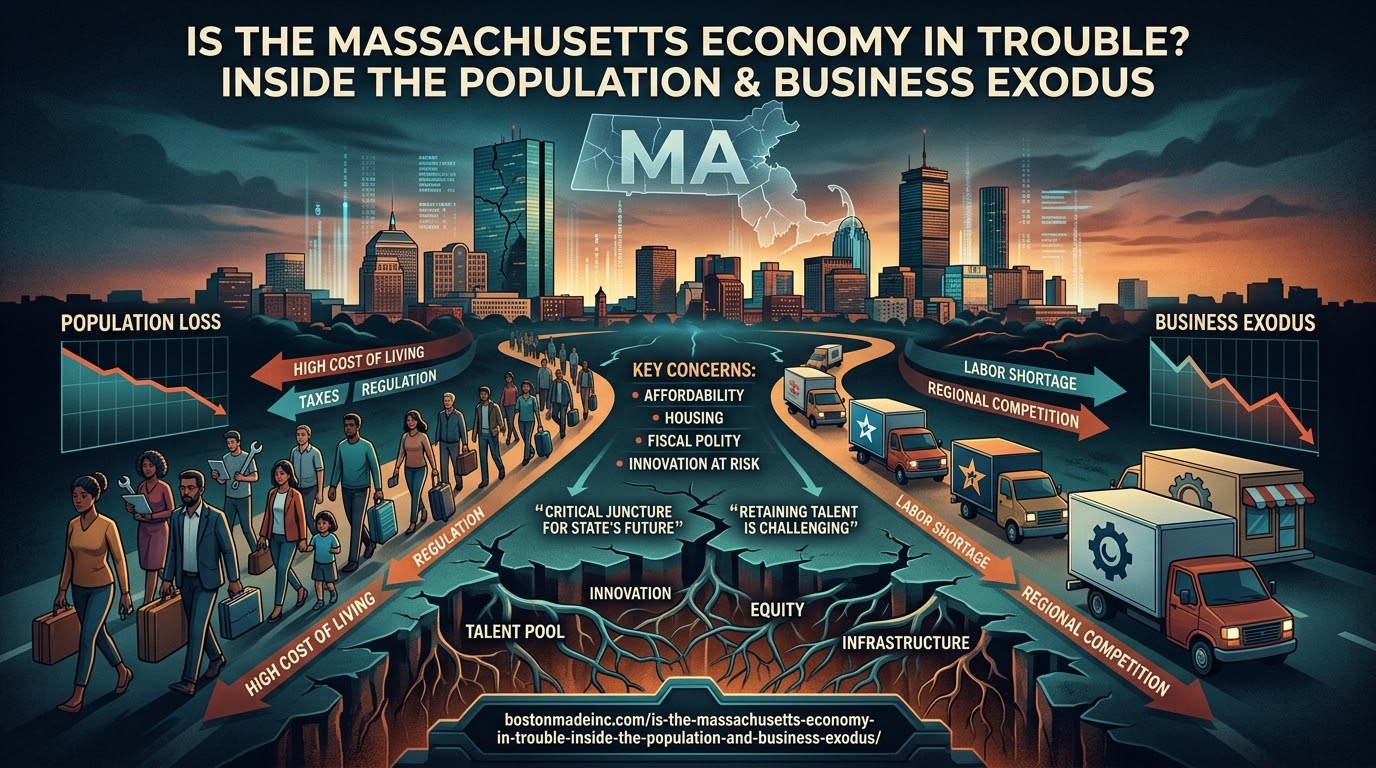
Illustration for “Is the Massachusetts Economy in Trouble? Inside the Population and Business Exodus”

As October nights turn cold, households and businesses across New England start thinking about heating bills. The region has a long-standing reputation for some of the highest energy costs in the continental United States. The reasons are less about any single villain and more about geography, infrastructure and the way the region’s power system has developed.

At the End of the Line

New England produces very little of its own fossil fuel. Natural gas, heating oil and propane all have to come from elsewhere, by pipeline, ship or truck. The region sits near the end of the interstate natural gas pipeline network, and its pipeline capacity is limited. Most of the year, that capacity is enough. In the coldest weeks of winter, when demand for home heating spikes, it can become a bottleneck.

Advertisement

When pipelines are full, the remaining supply becomes more expensive, and the region leans more heavily on alternatives such as liquefied natural gas delivered by ship and on oil-fired power plants that run only when needed.

Gas Heats Homes and Makes Electricity

Over the past few decades, natural gas has become a major fuel for generating electricity in New England, replacing much of the coal and oil the region once used. That shift lowered emissions and, for much of the year, costs. It also linked two markets together. When gas is in high demand for heating, it is also more expensive for power plants, which can push up wholesale electricity prices.

The regional power grid is overseen by ISO New England, an independent nonprofit that runs the wholesale electricity markets and plans the bulk transmission system for the six states. It regularly publishes information on winter reliability and fuel supply.

What Goes Into Your Bill

A typical electricity bill in Massachusetts has two broad parts:

  • Supply, the cost of the electricity itself, which reflects wholesale market prices and can change seasonally.
  • Delivery, the cost of the poles, wires and local utility operations that bring power to your building.

Bills may also include charges for state programs such as energy efficiency and clean energy initiatives. Many communities offer municipal aggregation programs that buy supply on behalf of residents, and customers can sometimes choose competitive suppliers. Terms vary widely, so read contracts carefully.

Changes Underway

The region’s energy system is in transition. New England states have set goals to reduce emissions, which has encouraged offshore wind, solar, battery storage, imported hydropower and heat pumps. These changes may reduce dependence on imported fossil fuels over time, though they also involve large investments in transmission and new infrastructure, and debates about cost and pace continue.

Practical Steps for This Winter

While no household can change regional markets, a few steps can help manage costs:

  • Schedule a no-cost home energy assessment through the state’s energy efficiency program, Mass Save, if you are eligible.
  • Seal drafts around windows and doors and add insulation where possible.
  • Ask your utility about budget billing, which spreads costs more evenly across the year.
  • Check eligibility for fuel assistance and discount rates if money is tight.

For decisions about major equipment such as heat pumps or solar panels, get multiple quotes and consider talking with an independent energy professional about what fits your home.

PupWear (.org) Boston Made family PupWear (.org) Dog apparel and gear inspired by Boston the GoldenDoodle. Visit site →

Advertisement

The institutional news desk of the Boston Made network. Reporting is researched from wire services including The Associated Press and local sources, and written by the desk.

Economy

Fed Holds Rates in Split 10–2 Vote as Two Officials Push for a Hike; Stocks Edge Higher

The Fed held its target range at 3.75% to 4%, but Lisa Cook and Beth Hammack dissented in favor of a hike. Stocks closed modestly higher while the 10-year yield climbed to about 5.05%.


Ecosystem Intelligence Desk

Published

on

economy fed

The Federal Reserve left interest rates unchanged on Wednesday, but the vote showed a central bank leaning toward tighter policy. Policymakers held the federal funds target range at 3.75% to 4% in a 10–2 decision. Governor Lisa Cook and Cleveland Fed President Beth Hammack both dissented in favor of a quarter-point increase.

It was the first time since 1992 that a Fed governor and a regional bank president dissented together on the same side, and Cook’s first dissent since she joined the Board in 2022. The pause comes one month after the Fed raised rates for the first time in three years, and less than a week before the midterm elections.

Advertisement

What the statement said

The Committee described economic activity as growing briskly, with strong productivity and capital investment. Job gains have kept pace with growth in the workforce, and the unemployment rate has changed little. On prices, the language was blunt: “Inflation remains elevated.” The statement said the Fed wants a “timely” return to its 2% goal and added a line that stood out: “The Committee will deliver price stability.”

That framing matters because inflation has moved the wrong way this year. Consumer prices rose 3.7% in September from a year earlier, up from 2.4% in February, as the conflict with Iran pushed up oil and gasoline costs. Unemployment sits at 4.2%.

Warsh: the medicine is “starting to work some”

At his press conference, Chair Kevin Warsh described the decision as a chance to “take stock” after September’s hike. He said the overwhelming consensus on the Committee was that the Fed’s “monetary medicine is starting to work some,” while stressing that officials had reached no firm conclusions. He did not commit to a move in December.

Markets did not take that as a dovish turn. Traders kept roughly an 85% chance of a quarter-point hike at the December 9 meeting priced in, and several strategists called a December increase close to a foregone conclusion. Economists at Indeed Hiring Lab said the joint dissent signals how uneasy part of the Committee is about rising inflation expectations.

How markets closed

  • S&P 500: 7,743.98, up 21.38 points (+0.28%)
  • Dow Jones Industrial Average: 52,475.10, up 97.53 points (+0.19%)
  • Nasdaq Composite: 26,549.85, up 72.04 points (+0.27%)
  • 10-year Treasury yield: about 5.05%, up roughly 5 basis points. The 2-year rose about 4 basis points to 4.78%.
  • Gold: futures finished near $4,075 an ounce, roughly flat, after spot gold slipped toward $4,030 earlier in the day as higher oil prices revived inflation worries.

Stocks spent most of the session in a narrow range and held small gains after the decision. Oracle jumped about 11% on a bullish long-range revenue outlook, and chipmakers firmed after SK Hynix reported a sharp jump in profit. After the bell, Microsoft rose on better-than-expected results while Alphabet fell on a revenue and earnings miss, setting up a mixed open for big tech on Thursday.

What to watch next

Thursday’s PCE inflation report, the Fed’s preferred price gauge, is the next test. September PCE is forecast to have risen 3.6% from a year earlier, with the core measure at 3.1%. A hot reading would reinforce expectations for a December hike. A 10-year yield holding above 5% also keeps pressure on mortgage rates, which reached a three-year high of 7.4% earlier this month.

This article is for general information only and is not investment, financial or tax advice. Markets move quickly, and past performance does not guarantee future results. Consult a licensed professional before making investment decisions.

Sources

Paxton-Digital Boston Made family Paxton-Digital Enterprise technology for IP protection and portfolio management · a Kingswell company. Visit site →

Advertisement

Continue Reading

Economy

Caught in the Crossfire: How the U.S.-Canada Tariff War Is Squeezing Massachusetts Makers

Massachusetts sends about $6 billion a year in goods and services to Canada. Fifty-percent tariffs are now hitting factories like Northbridge’s Riverdale Mills on both ends.


Ecosystem Intelligence Desk

Published

on

newengland harbor

Massachusetts is not the target of the trade war between Washington and Ottawa. It is paying for it anyway.

In September, the U.S. imposed 50% tariffs on roughly $20 billion in Canadian goods, and Canada matched them dollar for dollar. A ban on about $1 billion in Canadian imports, from alcohol and dairy to motorcycles, followed. For a state that ships about $3.1 billion in goods and another $3 billion in services to Canada every year, that is a direct hit.

Advertisement

Paying twice

Riverdale Mills in Northbridge shows how it works on a factory floor. The wire-mesh maker gets about 70% of its steel rod from Canada, and steel makes up roughly two-thirds of its production costs. It also exports about 40% of what it makes. Chief executive Jim Knott says the company now pays the 50% tariff on its raw material while foreign customers face the same rate on its finished product. Its tariff bill was close to $1.5 million in 2025, up from just over $1 million in 2018. Knott says some domestic orders that once went to China have come back, but not enough to offset lost exports.

Confidence is slipping

Associated Industries of Massachusetts, which represents more than 3,000 employers, says its Business Confidence Index fell 5.2 points in a single month. About three-quarters of members it surveyed in September reported damage from tariffs. AIM chief executive Brooke Thomson points to knock-on costs for consumers, from Canadian lumber in new housing to heating oil.

Northeastern University professor Ravi Ramamurti calls the fight a lose-lose. He notes the first round covers only about 5% of U.S.-Canada trade, and that the state’s largest import from Canada, energy, is still exempt. But medical-device exporters, a Massachusetts strength, are in the line of fire.

What to watch

The next AIM confidence reading, any exemptions for steel inputs used by domestic manufacturers, and whether Canada widens its retaliation list. For Boston-area investors, the exposure is concentrated in industrial and med-tech names with heavy cross-border supply chains.

This article is for informational purposes only and is not investment advice.

Sources: GBH News. Reported and written by the Ecosystem Intelligence Desk.

Boston Made Foundation Boston Made family Boston Made Foundation The philanthropic arm of the Boston Made family. Visit site →

Advertisement

Continue Reading

Economy

Amazon Plans 6,000 Seasonal Jobs in Massachusetts as Holiday Hiring Heats Up

Half of the openings are in Greater Boston, averaging about $20 an hour, while Target adds 1,900 seasonal workers across the region.


Ecosystem Intelligence Desk

Published

on

transit station

The holiday labor market in Massachusetts got its biggest signal of the season this week.

Amazon says it will hire about 6,000 seasonal workers in Massachusetts, roughly 3,000 of them in the Boston area, as part of a national push for more than 300,000 holiday hires. The company puts average seasonal pay at about $20 an hour, with both part-time and full-time shifts across its fulfillment and delivery network.

Advertisement

What workers get

  • Pay: an average of about $20 an hour, according to the company.
  • Benefits: starting Jan. 1, seasonal staff working 30 or more hours a week become eligible for health coverage.
  • A path in: many seasonal roles can convert to permanent positions.
  • Timing: openings are posted on a rolling basis and added weekly through December.

Target is adding about 1,900 seasonal team members across Boston as well, adding to competition for warehouse and retail labor heading into November.

The read for the Massachusetts economy

Seasonal hiring is a useful early read on how retailers see consumer demand. Big headcount plans suggest companies still expect a solid holiday quarter, even as households in the state report pressure from rising costs and as tariff fights with Canada weigh on local manufacturers. For small businesses, the bigger question is wages: when the largest employers set a $20 average, hourly staffing across retail and hospitality gets more expensive for everyone.

Sources: Boston.com. Reported and written by the Ecosystem Intelligence Desk.

Pupwear Boston Made family Pupwear Dog apparel and gear inspired by Boston the GoldenDoodle. Visit site →

Advertisement

Continue Reading
Advertisement

Advertisement

Ad

Advertisement

Trending

--:--·---·--°