Connect with us

Weather where you are

Choose your location or share it once. We round your coordinates to about 1 km before sending them to our site and MET Norway for your forecast. Your choice stays in this browser tab.

Stay close to Boston

Get new Boston stories and Boston Made company updates, delivered as browser notifications.

Choose Enable notifications, then allow notifications in your browser.

Your browser subscription is stored by Boston Made and delivered through your browser’s push service. You can turn notifications off in your browser’s site settings. Privacy policy

Boston Made Eats

Charlie’s Kitchen Won’t Reopen: Harvard Square Loses Its 75-Year-Old Burger Landmark

A January dishwasher flood caused $2M in damage and the building has sold. Harvard Square’s 1951 burger landmark is closed for good.

Ecosystem Intelligence Desk

Published

on

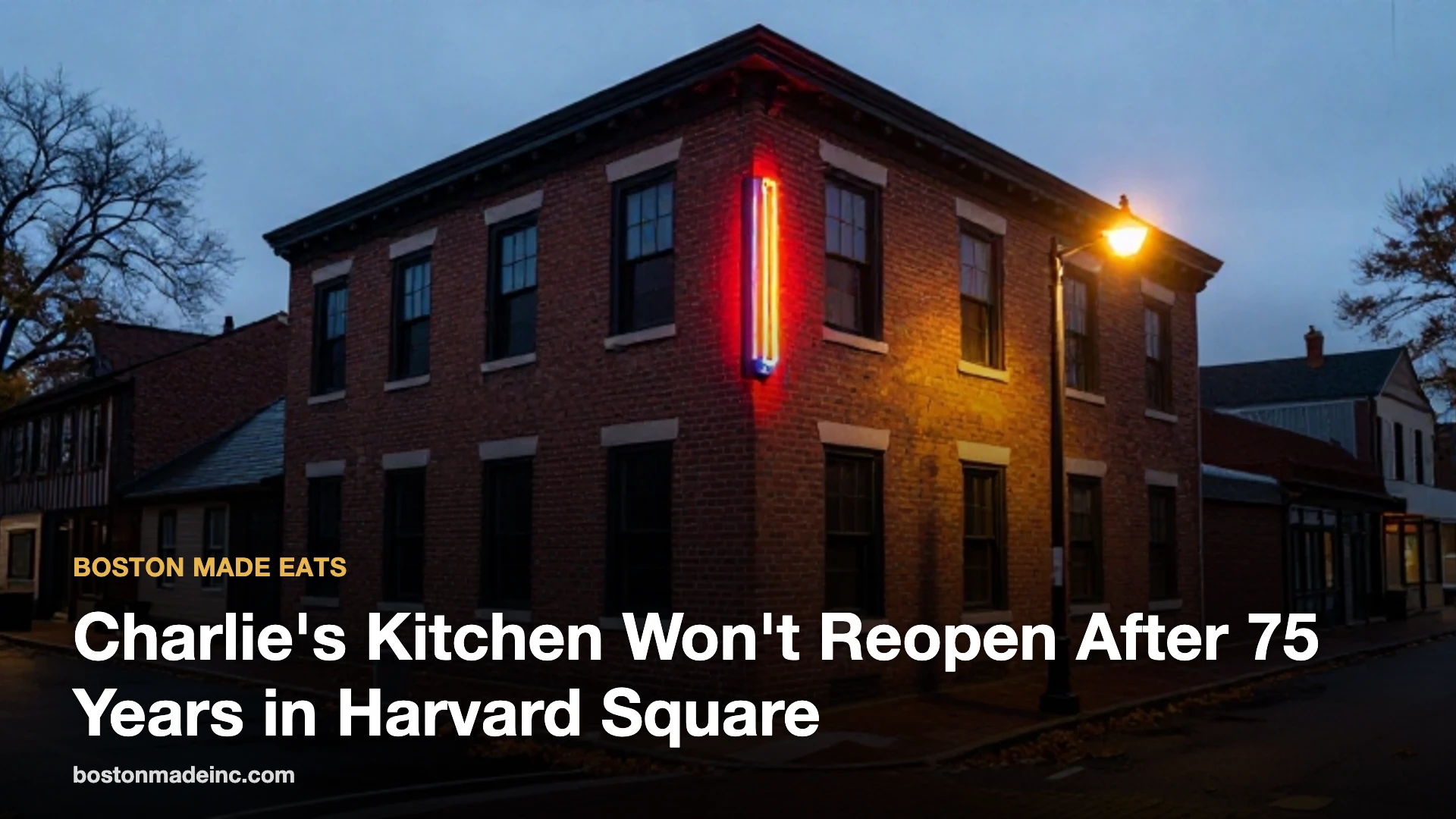
Illustration of an old brick tavern building at dusk with dark windows on a quiet college-town street

Reported from public sources as of Sunday, Nov. 8, 2026.

Charlie’s Kitchen, the Eliot Street burger joint and bar that fed Harvard Square for 75 years, will not reopen. Owner and head chef David Toraji Oshima announced the decision on Friday, Nov. 6, ending months of uncertainty that began when a malfunctioning dishwasher flooded the building last winter. The Boston Globe, NBC Boston and Boston Restaurant Talk all reported the closure, and the Globe reported that the building at 10 Eliot Street has been sold to a buyer with no plans to bring the restaurant back.

Advertisement

Advertisement

For generations of students, musicians, late-shift workers and families, Charlie’s was the cheap, loud, unpretentious counterweight to an increasingly polished Harvard Square. Its loss lands in the same season that two other Cambridge institutions, Cambridge Common and the Lizard Lounge, announced they will close next spring, and it says a good deal about how fragile even a beloved independent restaurant can be when disaster meets an expensive building.

What happened on Eliot Street

The trouble began in January, when the timing mechanism on a dishwasher failed and water poured through the building, according to the Globe. The restaurant closed temporarily, and damage was eventually estimated at more than $2 million, a figure the Globe, NBC Boston and Boston Restaurant Talk all cite.

Oshima told the Globe that the first- and second-floor ceilings were destroyed, the wiring was waterlogged, walls were crumbling and the building had no running water. He said repair costs had become unsustainable. The landlord and Oshima received an insurance advance, but a full settlement had not arrived, according to the paper.

By late September, the signs pointed toward an ending. The Globe reported then that Charlie’s was selling off furniture, signs and dinnerware, and about a month before Friday’s announcement Oshima held an auction of memorabilia. A second auction of what remains, including restored neon signs, matchbooks with the original logo, pieces of the interior mural and the original sign, will be scheduled later, with updates on the restaurant’s Instagram account.

Oshima told the Globe he had offered to buy the building himself but was outbid. He did not name the buyer. “I didn’t want to sell,” he told the paper.

Advertisement

Seventy-five years of double cheeseburgers

Charlie’s opened in 1951, and public histories credit its founding to Charlie Lambrose. Over the decades it became known for its double cheeseburger, its bars on two floors, a seasonal backyard beer garden and a jukebox that Boston Phoenix readers repeatedly voted the city’s best. In its final announcement, the restaurant described its double cheeseburger as Boston’s most famous, a claim regulars were never inclined to dispute.

Oshima, a Somerville native who previously cooked at Yume Wo Katare in Cambridge and opened The Cornerstone in Somerville, took over ownership and management recently. NBC Boston and Boston Restaurant Talk date the handover to 2024; the Globe reports it as January 2025. Either way, he had only a short run before the flood, during which he updated the menu and renovated the space.

The closure also affected roughly 30 staff members. A GoFundMe raised $25,000 for them, the Globe reported, and while many found new jobs, some returned to their home countries.

Advertisement

Confirmed facts and open questions

Confirmed by multiple outlets: the restaurant is permanently closed; the January dishwasher failure caused more than $2 million in damage; the business opened in 1951; Oshima made the announcement on Nov. 6.

Reported by one outlet so far: the Globe is the main source for the sale of the building, the insurance details and Oshima’s account of his offer to buy it. The buyer’s identity and plans for 10 Eliot Street have not been made public.

Possible next chapter: Oshima told the Globe he is not finished with the restaurant business. His ideal, he said, would be to take over the Cambridge Common space on Massachusetts Avenue after that restaurant closes and bring Charlie’s Kitchen there. No deal has been reported, and readers should treat it as an aspiration rather than a plan.

The Newsroom Take

The newsroom reads this as a disaster story first and a real estate story second. A flood of this scale would test any small operator. Insurance can take months to settle, and a restaurant with no revenue cannot carry payroll, rent and repairs while it waits. Few independents have the cash to bridge that gap.

The sale of the building is what turned a long closure into a permanent one. In a neighborhood where commercial property is scarce and valuable, an old four-story building needing major work is worth more to some buyers as a blank slate than as a home for a dive bar. That is not villainy; it is the economics of Harvard Square, and it is the same pressure that has reshaped the Square for two decades.

What the city loses is a particular kind of place: inexpensive, open late, welcoming to students and long-time residents alike. Those rooms are increasingly rare in Cambridge and Boston, and once they close, they are almost never replaced at the same price point. If Oshima does manage to revive the name a few blocks away, it would be one of the more hopeful turns in a difficult year for local dining. The newsroom will watch for any filings or announcements about the Cambridge Common space.

What it means for you

  • Want a piece of history? Follow the restaurant’s Instagram for the date of the second memorabilia auction.
  • Holding a gift card? Contact the business directly through its social channels; closed restaurants are rarely able to honor cards for long.
  • Love cheap eats? Support the remaining affordable, late-night spots on weeknights, when independents are most likely to lose money.
  • Run a restaurant? Review your business-interruption coverage now. This closure shows how long a claim can take to settle.

Test yourself

What caused Charlie’s Kitchen to close in January?

Answer: A dishwasher’s timing mechanism failed and flooded the building.

How much damage did the flood cause?

Answer: More than $2 million, according to several outlets.

What year did Charlie’s Kitchen open?

Answer: 1951.

Which space has the owner said he would ideally like to take over?

Answer: Cambridge Common on Massachusetts Avenue, which is set to close next spring.

Discussion

  1. Should a beloved restaurant’s name and recipes survive a move to a new address, or is the building part of what made it special?
  2. What, if anything, should Cambridge do to keep affordable, late-night places in Harvard Square?
  3. What is your favorite Charlie’s Kitchen memory?

Beacon Federal Partners Affiliate Beacon Federal Partners Independent government-contracting firm and Boston Made affiliate. Visit site →

Advertisement

Latest stories

View all

The institutional news desk of the Boston Made network. Reporting is researched from wire services including The Associated Press and local sources, and written by the desk.

Boston Made Eats

Banyan Won’t Reopen and Wahlburgers Leaves Fenway: A Week of Goodbyes in Boston Dining

Banyan Bar + Refuge won’t reopen after its 2025 fire, Wahlburgers has left Fenway, and more Boston-area closings show the cost of running a restaurant.

Ecosystem Intelligence Desk

Published

on

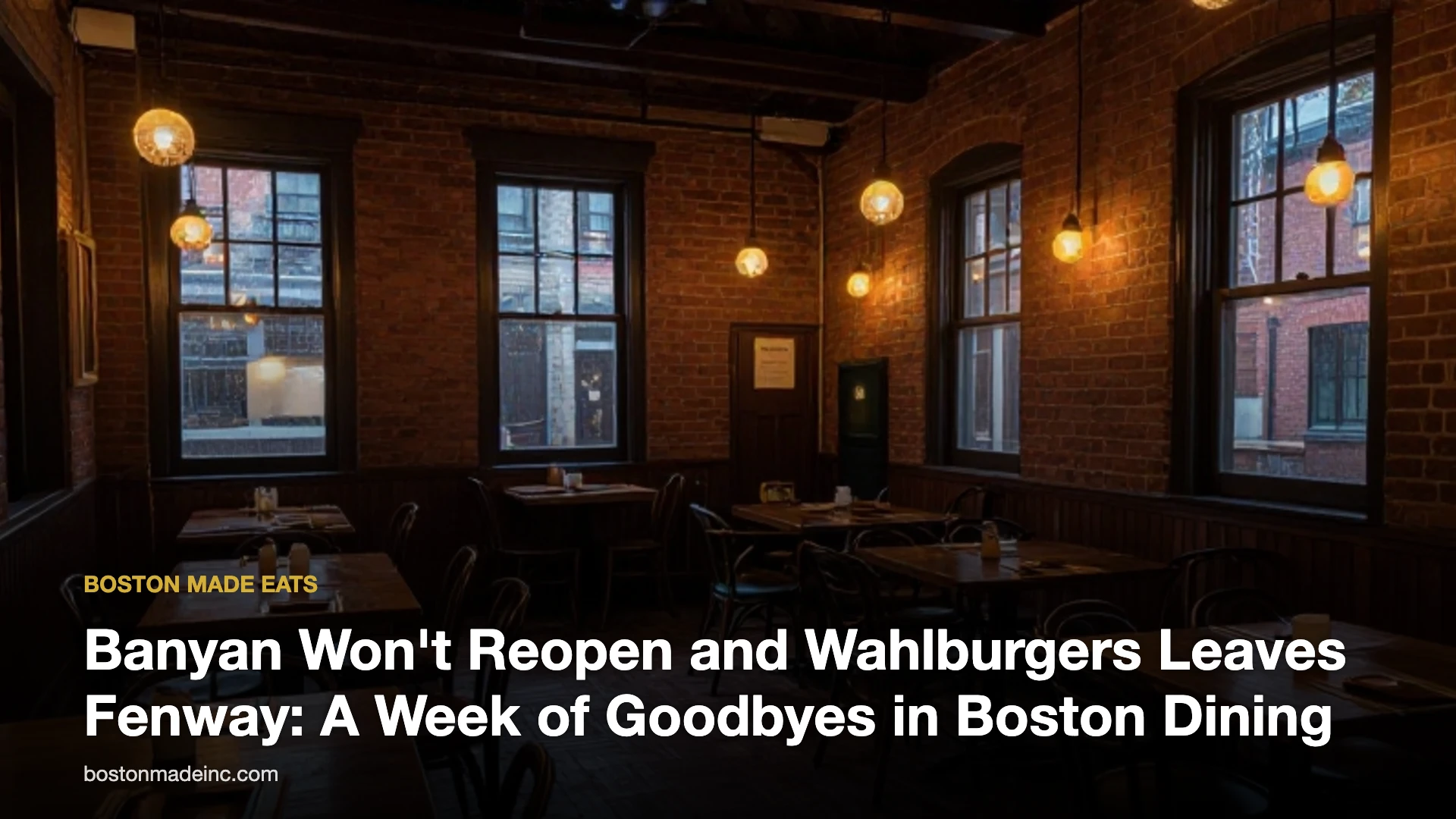
Empty gastropub dining room with chairs stacked on wooden tables under warm pendant lights at dusk

Reported from public sources as of Thursday, Nov. 5, 2026.

Boston’s restaurant calendar is crowded with openings this month, but the first week of November has been just as notable for goodbyes. A South End gastropub that spent more than a year trying to come back from a kitchen fire has decided not to reopen. The last standalone Wahlburgers in Greater Boston has left Fenway. And a pair of suburban restaurants in Burlington have quietly gone dark. Taken together, the closures say a good deal about what it costs to run a dining room in and around the city right now.

Advertisement

Advertisement

Banyan Bar + Refuge will not return

Banyan Bar + Refuge, the Asian-inspired gastropub at 553 Tremont Street in the South End, announced on social media this week that it will not reopen. Both Boston.com and Boston Restaurant Talk reported the decision, which ends a run of roughly a decade on one of the neighborhood’s busiest dining corridors.

The restaurant had been closed since a kitchen fire in the summer of 2025, which struck about a month before its 10th anniversary. What was first expected to be a closure of a few weeks stretched on as the damage proved more extensive than anticipated. Shortly after the fire, the restaurant was also broken into, with electronics stolen and registers damaged, according to Boston.com, which noted that the forced entry by firefighters had left the door unable to lock properly.

Banyan belongs to the Gallows Group, the hospitality company founded by Rebecca Roth Gullo that also runs Blackbird Doughnuts and Sally’s Sandwiches. In announcing the closure, the group said it would put its energy into expanding Blackbird. Gullo told followers she was “enormously proud” of what the Banyan team had built, according to Boston.com. Boston Restaurant Talk had reported in October that the business was being sold. Neither outlet reported what will happen to the Tremont Street space.

Wahlburgers leaves Fenway after about 11 years

A few blocks and a world away from the South End, Wahlburgers closed its restaurant at 132 Brookline Avenue in the Fenway on Saturday, Oct. 31. The company said on social media that the location was closing because its lease was ending, and both Boston.com and NBC Boston confirmed the closure. The company said it is “actively pursuing a new home in the Boston area,” per NBC Boston, but gave no timeline.

The Fenway departure caps a difficult stretch for the burger chain’s home market. The original Hingham restaurant, opened in 2011 by Paul Wahlberg and his brothers Mark and Donnie, closed in late September. The MarketStreet Lynnfield location closed earlier, and the South Bay outlet in Dorchester shut several years ago. According to Boston.com, the remaining Massachusetts locations are two at Logan Airport, plus Plainville and Springfield. Nationally, the company says it opened 10 restaurants this year and plans more in 2027, so the Boston pullback reflects leases and local economics rather than a brand in retreat.

Advertisement

Quieter closings in the suburbs and a JP landmark under pressure

Two other items come from Boston Restaurant Talk alone and had not been independently confirmed by a second outlet when this was published, so they should be read as reports rather than settled fact.

The blog reported that Temazcal Tequila Cantina and Jack’s Coal Fired Pizza at 2 Wall Street in Burlington have both closed. It said Temazcal had been removed from its company’s locations page and a phone call confirmed that Jack’s had closed. Both are run by Rebel Restaurants, which also operates Tony C’s. Temazcal locations in Dedham and Lynnfield remain open, according to the report. No reason was given.

Advertisement

The same outlet reported that the Midway Cafe, the Jamaica Plain bar and music venue at 3496 Washington Street that has operated for nearly 40 years, faces a sharp rent increase from a new building owner. Owner Jay Balerna is looking for a new operator to keep the club going, and the landlord has agreed to delay the increase for about a year, the blog said.

The Newsroom Take

The newsroom sees three different stories here, and it would be a mistake to read them as one. Banyan’s ending is the story of a disaster that never fully resolved. A fire, a break-in and a long rebuild are expensive for any independent operator, and an owner with a growing doughnut brand has to decide where scarce time and capital go. The choice to focus on Blackbird is a business decision, not a verdict on the South End.

Wahlburgers is a lease story. When a chain says a location closed because its lease was ending, it usually means the renewal terms no longer worked. Fenway rents have climbed as the neighborhood has been redeveloped, and a casual burger concept needs a lot of covers to carry a big-city lease. The company’s promise to find a new Boston home suggests it still values the market, just not at that address and price.

The Midway report is the most worrying for the city’s character, if it holds up. Neighborhood bars that double as music rooms rarely survive a doubled rent, and they are almost impossible to replace once they go. The one-year reprieve gives Jamaica Plain time to find a buyer, which is more than many venues get.

The common thread is cost: rent, insurance, repairs and labor all weigh on restaurants whose prices diners already find high. Openings get the headlines, but the closings are a more honest measure of how hard the business has become.

What it means for you

  • Use your gift cards. If you hold a Banyan or Wahlburgers Fenway gift card, contact the company directly about where it can still be redeemed.
  • Support the places you love on weeknights. Slow Tuesdays and Wednesdays are where many independents lose money.
  • Watch the Midway. If you care about local music, follow the venue’s own channels for news on a new operator.
  • Burger fans have options. The Logan Airport Wahlburgers remain open for travelers, and the chain says a new Boston site is in the works.

Test yourself

What event first closed Banyan Bar + Refuge?

Answer: A kitchen fire in the summer of 2025, about a month before its 10th anniversary.

Which brand will the Gallows Group focus on now?

Answer: Blackbird Doughnuts.

Why did the Fenway Wahlburgers close?

Answer: The company said its lease was ending.

Where are the remaining Massachusetts Wahlburgers?

Answer: Two at Logan Airport, plus Plainville and Springfield.

Discussion

  1. Should cities do more to help restaurants recover after fires and other disasters?
  2. Is a neighborhood music bar like the Midway worth public support to keep it open?
  3. Which Boston closing from the past year do you miss most, and why?

Fenway Web Boston Made family Fenway Web Web design, development and SEO studio — custom websites for small businesses, churches and local brands. Visit site →

Advertisement

Continue Reading

Boston Made Eats

Five November Openings, From a Beacon Hill Ale House to Detroit-Style Squares in West Roxbury

A British-style ale house on Charles Street, a Seaport matcha bar and an Adams Village Irish pub lead Boston’s November openings. Here’s what to know.

Ecosystem Intelligence Desk

Published

on

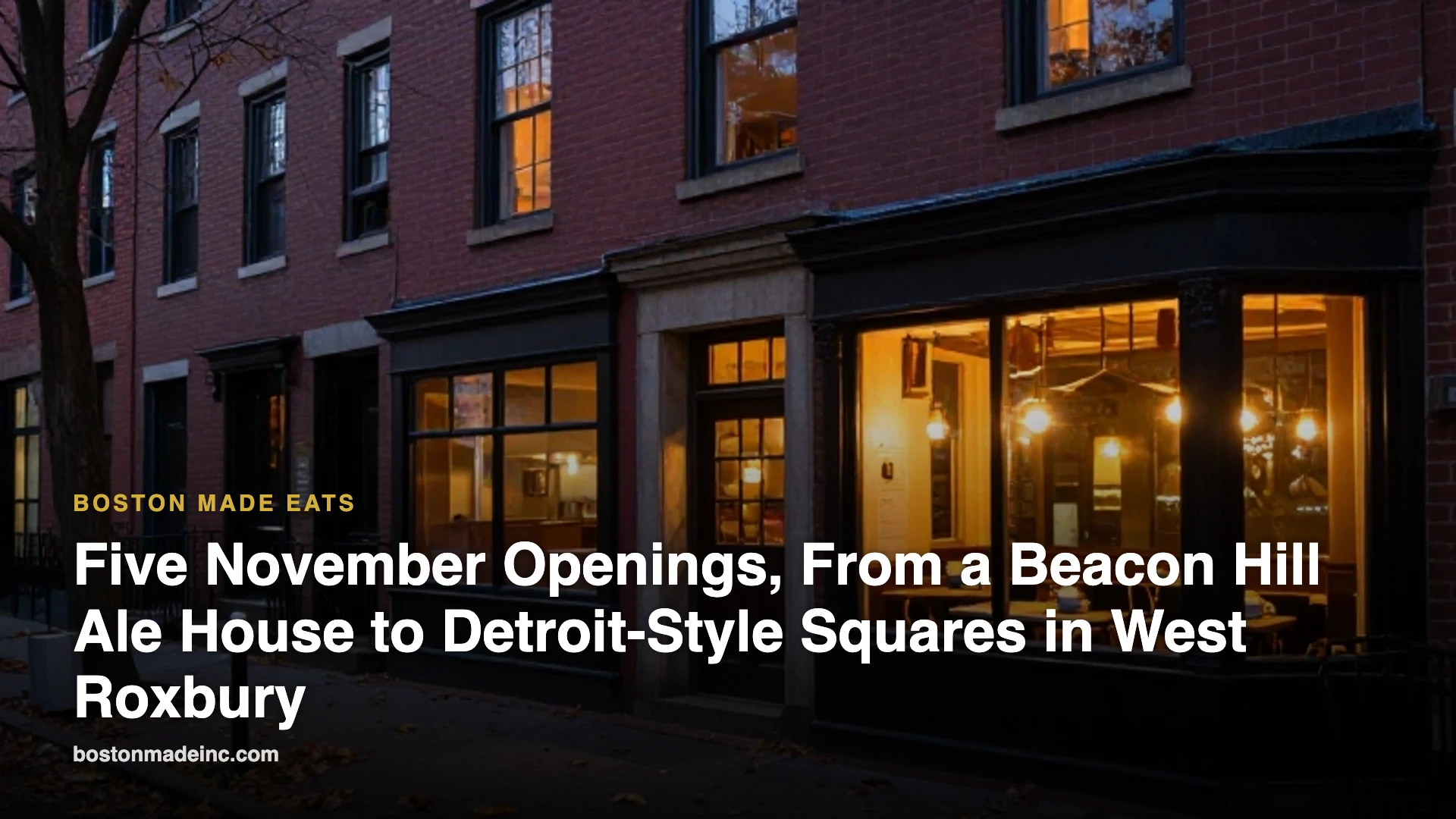
Illustration of a Boston neighborhood street at dusk with warmly lit restaurant windows and autumn leaves

Boston Made Eats | Wednesday, Nov. 4, 2026

Boston’s restaurant calendar usually slows after Halloween, but this November is moving in the opposite direction. Five new or nearly open spots, spread from the West End to West Roxbury, are arriving just ahead of the holiday dining season. Taken together they show where operators see opportunity right now: neighborhood pubs that double as music rooms, daytime cafes that turn into bars at night, and chef-driven pizza that started life as a pop-up.

Advertisement

Advertisement

The roundup below draws on reporting published this week by Boston.com and on earlier coverage by the Dorchester Reporter, WhatNow Boston and The Boston Globe. Opening dates are the operators’ own targets and can slip; we note where a place is already serving.

Beacon Hill: Harry Hare’s replaces the Beacon Hill Pub

The biggest name on the list belongs to a familiar operator. Patrick Lyons of the Lyons Group is converting the longtime Beacon Hill Pub space on Charles Street into Harry Hare’s, a British-inspired ale house named for his late father-in-law, who loved traditional English pubs. Boston.com reports a mid-November target and a menu that leans on pot pies, London-style Indian curries with charred naan and Belgian ale-steamed mussels, with British ales on tap.

The project has been in motion since the summer. WhatNow Boston reported in July that the Boston Licensing Board had approved the transfer of the liquor license, which Lyons is buying from the building’s owner, and described the concept as a quieter, more refined room than the dive bar that closed during the pandemic. For a block that has lost several casual spots over the years, a full-service pub with a kitchen is a meaningful addition.

Dorchester: Session House arrives in Adams Village

In Adams Village, Session House is taking over the space most recently occupied by Scobie’s Cafe & Bar, which the Dorchester Reporter said closed for renovations in early February. The Reporter identified the operator as Esteemed Hospitality, with Teresa Murphy as managing partner, and described a concept built around live music that blends traditional Irish sessions with contemporary acts.

Boston.com now puts the opening in mid-November and adds detail: restaurateur Frank Delaney is involved, the interior was designed with help from Mass Art students, and the plan calls for live music five to seven nights a week, including a baby grand piano. Delaney’s clam chowder, made from a recipe that won awards in the late 1990s, is expected on the menu alongside a teriyaki salmon bowl that Murphy has singled out.

Advertisement

West Roxbury: Old Friend graduates from pop-up

Chef-owner Alden Cadwell’s Old Friend is already open on Washington Street in West Roxbury after operating as a roaming pop-up. The draw is Detroit-style pizza: rectangular pies baked in pans, with dough fermented for three days, Jersey tomatoes and cheese pushed to the edges so it caramelizes into a crisp frame. Alongside classics such as charred pepperoni, the kitchen is running seasonal collaborations, including a delicata squash pie.

Seaport and West End: tea by day, sushi at night

On Seaport Boulevard, Bloom Bar is open as a matcha cafe in the daytime and a cocktail bar in the evening, with drinks built on teas such as genmaicha and white tea. Its founders draw on Vietnamese, Thai, Cantonese and Japanese backgrounds, and Boston.com reports a compact food menu that will range from tea sandwiches to Japanese curry.

In the West End, family-owned Black Bamboo soft-opened at the end of October on Canal Street, near TD Garden, with a sushi and Asian-fusion menu. Boston.com lists scallop, toro and unagi among the sushi offerings, and larger plates including Korean fried chicken and truffle udon soup.

The Newsroom Take

The Boston Made Newsroom reads this month’s list as a vote of confidence in the neighborhood pub, a format many observers had written off after the pandemic. Two of the five openings are pubs, and both are betting on something a delivery app cannot replicate: Session House on nightly live music, Harry Hare’s on a room built for lingering. Both also reuse existing bar spaces with existing licenses, which remains one of the few practical ways to open a full bar in Boston, where liquor licenses are scarce and expensive.

The other three openings illustrate a separate trend: owners trying to earn revenue across more hours of the day. Bloom Bar’s cafe-to-cocktail model and Old Friend’s move from pop-up to storefront are both ways of testing demand before committing to a full-scale restaurant. The Newsroom notes that none of the operators has published prices in the reporting so far, and diners facing higher grocery and dining costs this year will judge these places partly on value. Opening dates also deserve caution; mid-November targets often slide toward Thanksgiving.

What it means for you

  • Check before you go. Harry Hare’s and Session House are targeting mid-November; confirm hours on their own channels before making plans.
  • Book holiday gatherings early. New pubs with music and private-event space tend to fill December calendars quickly.
  • Try the soft openings. Black Bamboo and Bloom Bar are in early operation, which is when kitchens are most open to feedback.
  • Look beyond downtown. West Roxbury and Adams Village are getting destination-worthy spots with easier parking than the Seaport.

Test yourself

Which longtime Charles Street bar is becoming Harry Hare’s?

Answer: The Beacon Hill Pub, which closed during the pandemic.

What style of pizza does Old Friend in West Roxbury serve?

Answer: Detroit-style, baked in rectangular pans with three-day fermented dough.

Which Adams Village pub did Session House replace?

Answer: Scobie’s Cafe & Bar.

What does Bloom Bar serve before it becomes a cocktail bar at night?

Answer: Matcha and other tea drinks, as a daytime cafe.

Discussion

  1. Do live-music pubs like Session House give neighborhoods something that newer restaurant formats do not?
  2. Should Boston make it easier to open new bars instead of relying on transfers of existing liquor licenses?
  3. Which of these five openings would you visit first, and why?

Paxton-Digital Boston Made family Paxton-Digital Enterprise technology for IP protection and portfolio management · a Kingswell company. Visit site →

Advertisement

Continue Reading

Boston Made Eats

Cambridge Common and the Lizard Lounge Will Close Next May After Three Decades on Mass. Ave.

The Mass. Ave. pub and its basement music club will close at the end of May 2027 as the owners plan to sell the building. What it means for diners.

Ecosystem Intelligence Desk

Published

on

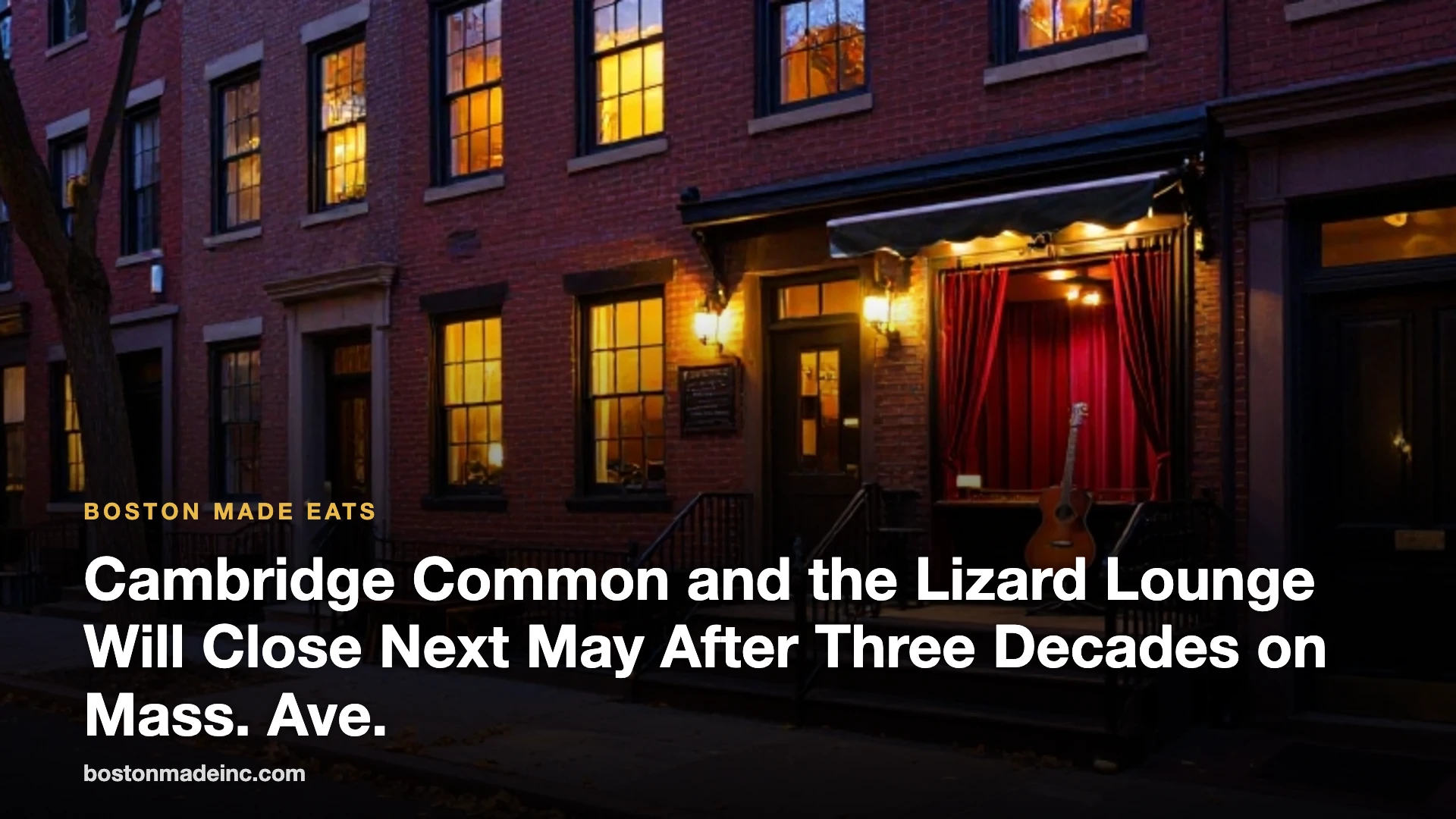
Illustration of a brick pub on a Cambridge avenue at dusk, with a basement music room glowing red behind a stairway.

One of the longest-running pairings of pub food and live music between Harvard and Porter squares has set an end date. Cambridge Common, the American-fare restaurant at 1667 Massachusetts Avenue, and the Lizard Lounge, the intimate music club in its basement, will both close at the end of May 2027, according to reporting by WBUR, the Boston Globe and Boston.com. Owners Holly Heslop and Charlie Christopher plan to sell the building and are in talks with a buyer, WBUR reported.

That leaves roughly seven months of burgers, pints and Sunday poetry nights before a Cambridge fixture that opened in 1996 turns off the lights. For a dining scene that has lost a string of independent, owner-run rooms in recent years, the news is another reminder of how much neighborhood character rests on a small number of longtime proprietors.

Advertisement

Advertisement

What is closing, and when

Both businesses will close at the end of May 2027. WBUR first reported the decision on October 30, and Boston.com and the Globe followed the same day. A public farewell is planned for the spring, according to WBUR and Boston.com. Staff learned of the plan about a month before it became public, and the restaurant’s three managers intend to make the final months their best, WBUR reported.

The parcel, listed in Cambridge city records as 1667-1673 Massachusetts Avenue, carries an assessed value of about $3.6 million, according to WBUR and the local outlet CSIndie. Neither outlet named the prospective buyer, and no plans for the site have been announced.

Why now

By the owners’ account, the reasons are personal rather than financial. Heslop is 77 and Christopher is 82, and Christopher has ongoing health problems, WBUR and Boston.com reported. The kitchen is also losing its anchor: Arcesio Suarez, the restaurant’s chef for 28 years, plans to return to Colombia. Heslop told WBUR the business has had “a long run,” adding that she would have liked to keep going but had to face the facts.

A restaurant that paid for the music

The closing matters to diners partly because of how the two businesses fit together. The couple opened Cambridge Common in 1996 and turned the basement, once a function hall, into the Lizard Lounge a year later. According to WBUR and Boston.com, revenue from the restaurant upstairs effectively subsidized the club downstairs, covering the liquor license and insurance for both. Every plate of food and every round at the bar helped keep a small room, with a capacity of about 105 according to CSIndie, open for touring and local musicians.

That arrangement is rarer than it used to be. A full-service restaurant with a steady neighborhood crowd can absorb the thin margins of a small music room; a stand-alone club often cannot. When the pairing ends, the dining room and the stage tend to disappear together.

Advertisement

The club’s reputation stretched well beyond Cambridge. WBUR reported that it hosted early shows by Lake Street Dive and sets by artists including Patty Griffin and Guster, along with a long-running Sunday poetry night backed by a jazz band. Matt Smith, managing director of Club Passim, told Boston.com the Lounge has been “an essential part of the Cambridge/Somerville music ecosystem.”

A familiar pattern on Mass. Ave.

This is not the owners’ first exit. They previously ran Christopher’s restaurant and the Toad music bar in Porter Square and sold those businesses in 2024 for $2.9 million, according to CSIndie. The restaurant reopened in 2025 as McCarthy’s under the owners of the Burren in Davis Square, and Toad was preserved, WBUR and CSIndie reported. That outcome offers one hopeful template for 1667 Mass. Ave., though nothing has been decided.

The news also caps a busy week of turnover in Greater Boston dining. Boston Restaurant Talk reports that Cafe Barada, the Lebanese restaurant in North Cambridge, will end full-service dining on December 5, while newcomers include Old Friend Pizza, a Detroit-style spot in West Roxbury, and a planned Crisscross Bakehouse next to Honeycomb Creamery, also on Mass. Ave. between Porter and Harvard.

The Newsroom Take

The Boston Made Newsroom sees this closing as a succession problem more than a market problem. Cambridge Common is not shutting because diners stopped coming; it is closing because its founders are ready to step back and its longtime chef is heading home. Many of the region’s best-loved neighborhood restaurants share that profile: owner-operators who started decades ago, built loyal crowds and never planned a handoff. When those owners also hold the real estate, as they do here, selling the building can be the most rational exit even when the business still works.

The newsroom also notes that the next owner of the property will largely decide whether this stretch between Harvard and Porter keeps a casual place to eat and hear music. The Porter Square sale shows that a buyer who values the existing use can keep it alive under a new name. Residents who want that outcome have about seven months to show, with their visits, that the demand is real.

What it means for you

  • Regulars have until the end of May 2027 to visit; watch the venue’s official channels for details of the spring farewell.
  • Music fans should keep an eye on the Lizard Lounge calendar; WBUR reports that the band Club D’Elf hopes to return for a residency in 2027.
  • Neighbors can follow any sale or redevelopment through Cambridge city records and permitting notices.
  • Diners who want to support independents can spread their spending across other owner-run rooms, from Cafe Barada before December 5 to newcomers such as Old Friend Pizza.

Test yourself

In what years did Cambridge Common and the Lizard Lounge open?

Answer: Cambridge Common opened in 1996, and the Lizard Lounge followed in 1997.

Who is the restaurant’s longtime chef, and how long has he cooked there?

Answer: Arcesio Suarez, for 28 years.

About how much is the property assessed at?

Answer: Roughly $3.6 million.

Which band got an early start at the Lizard Lounge?

Answer: Lake Street Dive.

Discussion

  1. Should cities do more to help long-running restaurants and music rooms find buyers who will keep them going?
  2. Is pairing a restaurant with a small music venue still a workable business model in Greater Boston?
  3. What would you most like to see at 1667 Massachusetts Avenue after May 2027?

Pupwear Boston Made family Pupwear Dog apparel and gear inspired by Boston the GoldenDoodle. Visit site →

Advertisement

Continue Reading
Advertisement

Advertisement

Ad

Advertisement

Trending

--:--·---·--°