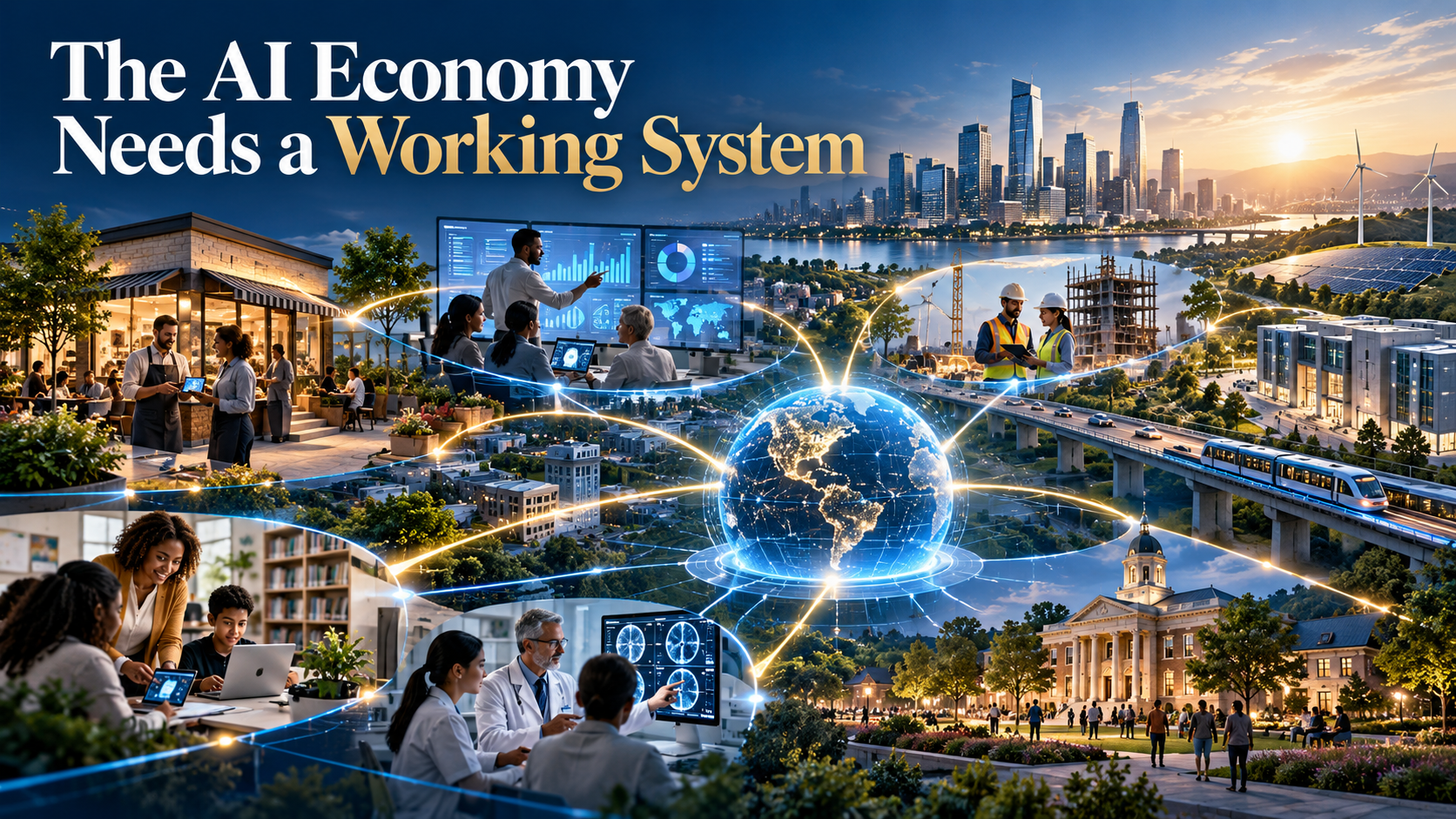
The most useful question about AI in 2026 is no longer “What can the model generate?” It is “What system turns intelligence into a reliable result for a real person, business, or community?”
That question is the center of the Boston Made ecosystem. It connects infrastructure intelligence, local discovery, operator software, digital experiences, and the practical work of helping organizations become more visible and more useful in an AI-mediated economy.
AI has crossed the demo boundary
The first wave of AI adoption was measured in experiments: a chatbot, a content tool, an internal assistant, a prototype. The current wave is being measured in workflows. Can the system help a customer find the right business? Can it keep a facility operating? Can it turn a complex source base into a decision? Can it reduce the friction between intent and action?
That is why AI is appearing simultaneously in data centers, tourism, search, commerce, local government, operations, and communications. The technology is converging with the systems that organize daily life.
The physical economy underneath AI
The infrastructure layer is becoming more visible. QumulusAI has disclosed repeat-customer, take-or-pay inference contracts. Alignment Engine has disclosed $1.17 billion of AMD-based orders with contractual prepayments. Corning and AT&T have announced more than $3 billion in fiber and cable commitments. Firmus and Meta are building regional AI-factory capacity with expansion options.
These are not isolated chip stories. They are evidence of a broader buildout involving power, cooling, fiber, construction, financing, and operations software.
See the executive infrastructure watch ↗
The lesson for businesses is simple: AI is not weightless. It depends on physical systems and commercial systems. Every “instant” answer has a supply chain underneath it.
The discovery economy is changing
AI is also changing how people discover products, services, destinations, and businesses. Research from Salesforce describes growth in agentic search and new discovery channels, while travel research shows that people increasingly use AI to narrow options before returning to official sites and trusted sources to verify.
Read Salesforce’s agentic search research ↗
This creates an opportunity for smaller businesses, but only if they become legible. A business needs accurate information, specific positioning, trustworthy proof, and a digital experience that answers the questions a customer is likely to ask.
That is the strategic role of a connected ecosystem: not just to publish more content, but to make the right information available in the right context.
Local identity is a competitive asset
AI can flatten a market when every organization describes itself in the same language. The antidote is not to avoid structured data or machine-readable content. It is to pair structure with real identity.
A regional directory should preserve the details that make a place distinctive. A service business should explain how it works in human terms. A technology brand should show the operational problem it solves. A community platform should connect institutions, businesses, and people in ways that feel useful rather than abstract.
Boston Made’s network is designed around that idea: use modern technology to make real places, real operators, and real opportunities easier to find.
Why the system matters more than the tool
Businesses often ask which AI tool they should buy. That can be the wrong first question. The more important questions are:
- What information must be accurate?
- Who owns the source of truth?
- How does a customer move from discovery to action?
- What should remain human?
- How do we measure whether the system actually helped?
Without those answers, AI becomes a layer of novelty. With them, it becomes an operating system for decisions, service, marketing, and learning.
Five layers of a working AI system
- Evidence: facts, sources, dates, permissions, and provenance.
- Context: the language, geography, customer, and operating environment that make information meaningful.
- Workflow: the next action, not merely the next answer.
- Interface: the portal, article, dashboard, directory, or assistant where a person can use the result.
- Feedback: the signals that show whether the system is accurate, trusted, and improving.
This framework applies to AI infrastructure, local commerce, regional tourism, facility operations, and enterprise services. It is also why the ecosystem needs multiple properties that play different roles while sharing a common intelligence layer.
What the Boston Made ecosystem is building
Paxton Digital and SCOUT provide the executive and infrastructure intelligence view. Boston Made Reader carries the evidence-led reporting layer. Grandstrand.app makes local knowledge useful to residents and visitors. ATLAS is positioned for infrastructure and operations intelligence. Fenway Web turns complex systems into customer-facing experiences. Kingswell and KEYSTONE focus on discovery, diligence, and opportunity mapping.
These are not unrelated brands. Together, they form a practical answer to the question: how do you connect information, intelligence, and action across an ecosystem?
The next advantage
The next advantage will not belong only to the organization with the largest model or the biggest media budget. It will belong to the organization that can keep its information accurate, make its value understandable, and connect a user to a useful next step.
That is a system problem. It requires editorial judgment, software, structured data, operations, design, and trust.
Conclusion
The AI economy needs a working system because intelligence alone is not enough. Models can summarize, recommend, classify, and generate. People still need reliable information, context, accountability, and a path to action.
Boston Made’s opportunity is to build that connective tissue across technology, infrastructure, local economies, and digital experiences—so that AI makes the ecosystem more useful without making it less human.
This article is strategic analysis and ecosystem editorial content, not investment advice.
📚 Keep reading: the AI-infrastructure companies behind this system are profiled one by one in Picks & Shovels. Follow every Boston Made storyline on the Boston Made Reader → Storylines.













 Corporate News4 weeks ago
 E-Commerce10 months ago
 Boston Made Stories3 weeks ago
 Fiction1 month ago
 Pet Industry9 months ago