Connect with us

Weather where you are

Choose your location or share it once. We round your coordinates to about 1 km before sending them to our site and MET Norway for your forecast. Your choice stays in this browser tab.

Stay close to Boston

Get new Boston stories and Boston Made company updates, delivered as browser notifications.

Choose Enable notifications, then allow notifications in your browser.

Your browser subscription is stored by Boston Made and delivered through your browser’s push service. You can turn notifications off in your browser’s site settings. Privacy policy

Small Business & Entrepreneurship

Before Amazon’s Drones Fly Over Westborough, MassDOT Says the State Gets a Say

A state letter reminds Amazon that no Prime Air takeoff site can open in Massachusetts without an Aeronautics Division certificate, a safety and environmental review, and at least one public hearing.

Published

on

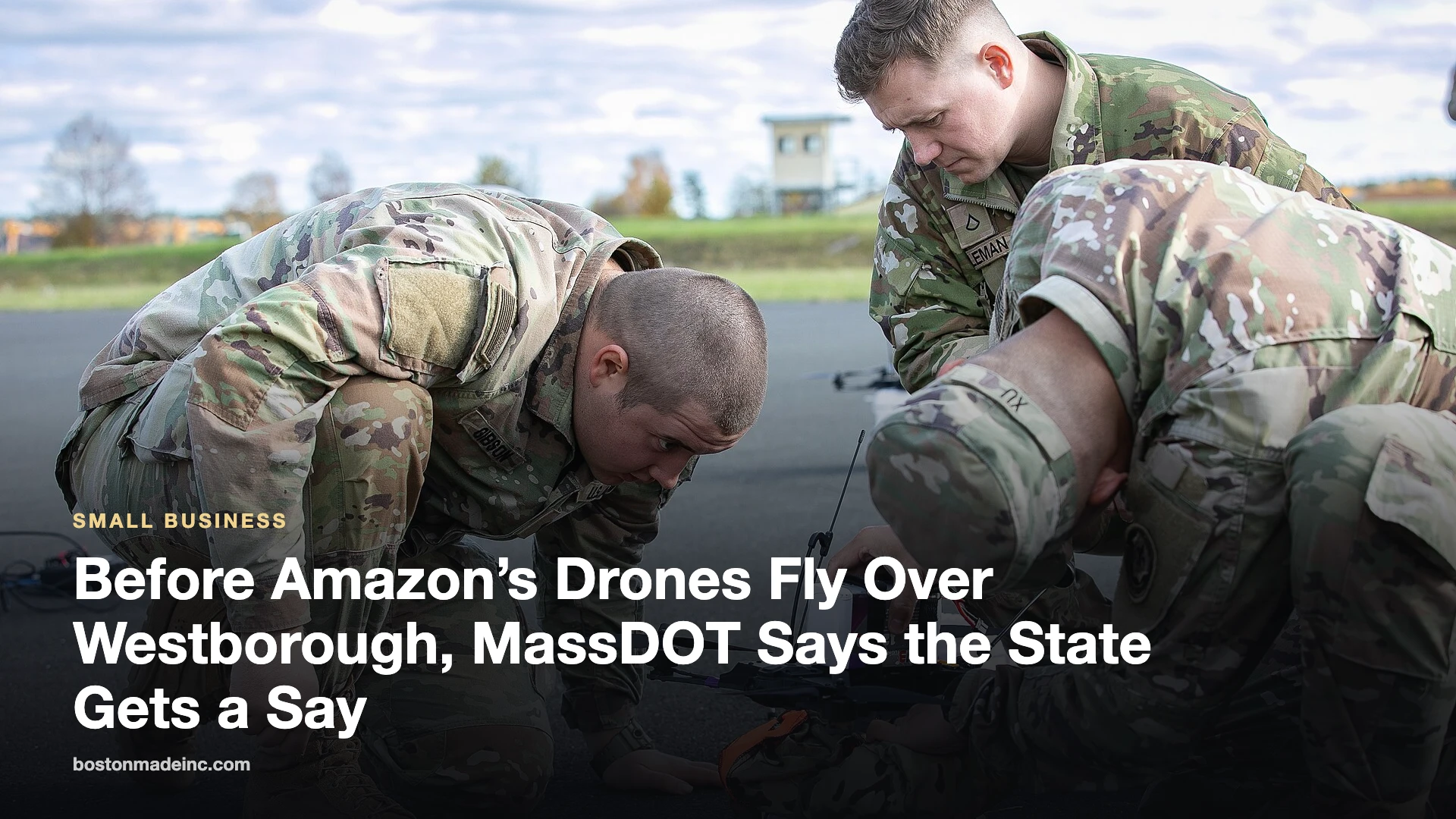
A delivery drone in flight during a supply-drop exercise

Amazon wants to launch Prime Air drone deliveries from a takeoff and landing area in Westborough. The Massachusetts Department of Transportation has a message for the company: not before the state signs off.

In a letter dated October 22, MassDOT told Amazon that the FAA approves its drones as an air carrier, but the flights are commercial operations subject to state law. No takeoff and landing site can be established in Westborough or anywhere else in Massachusetts without a certificate of approval from the state’s Aeronautics Division.

Advertisement

Advertisement

What the state wants first

  • An official notification and review request from Amazon, which the division says it has not received.
  • Its own suitability review confirming the operation poses no safety threat.
  • An environmental impact review.
  • At least one public hearing before any certificate is issued.

The division said residents have already raised concerns about low-altitude flights over private property and possible conflicts with police, public safety crews and other drone operators.

The town has spoken, too

At a Special Town Meeting on Monday, October 20, Westborough voters overwhelmingly backed a bylaw restricting commercial drones. That bylaw still needs sign-off from the state attorney general and the Aeronautics Division.

Amazon spokesperson Lindsay Hamilton said the company remains committed to working with state and local officials and welcomes the chance to demonstrate the safety of its operations, noting Prime Air has flown in nine states with FAA approval.

Why it matters

Massachusetts is drawing a line that other states will watch: federal clearance gets a drone in the air, but the state decides where it can take off and land. For Amazon, the Westborough site is now a permitting process with a public hearing, not a launch date.

Source: Boston.com. Reported and written by the Ecosystem Intelligence Desk.

Advertisement

Background

Drone delivery sits at the meeting point of two very different kinds of rules. The Federal Aviation Administration regulates the national airspace, including the safety of aircraft, pilots and operators. Cities, towns and states have traditionally regulated land use, including where businesses can operate, what they can build and how they affect neighbors. A delivery drone touches both systems: it flies through federally regulated airspace, but it has to take off and land somewhere on the ground.

Advertisement

That split has been a recurring question as commercial drone programs have grown across the country. Federal approval typically focuses on whether the aircraft and the operation can fly safely. State and local reviews tend to focus on questions such as zoning, noise, environmental effects and how a facility fits into a community. How those layers fit together for drones is still being worked out in many places, which is why the Massachusetts approach described here draws attention.

What it means for Boston-area readers

For residents of Westborough and surrounding towns, the most practical point in the state’s letter is the process it describes. A suitability review, an environmental impact review and at least one public hearing all create moments when residents can learn details and share views. People who want to follow the matter can watch for official notices from the Aeronautics Division and from the town.

For businesses in the region, the case is a useful reminder that federal permission is not always the only permission an activity needs. Companies considering new technology, from drones to new kinds of vehicles or equipment, often face a mix of federal, state and local requirements, and the timing of those reviews can shape when a project can begin.

  • Residents may want to know how the review process works and where hearing notices will be posted.
  • Local officials are weighing how a town bylaw fits alongside state and federal rules.
  • Other businesses can watch how the state applies its certificate process to commercial drone operations.

Key terms

  • FAA: the Federal Aviation Administration, the federal agency responsible for civil aviation safety and the national airspace.
  • Air carrier: an operator approved to carry goods or passengers commercially by air.
  • MassDOT Aeronautics Division: the part of the Massachusetts Department of Transportation that oversees aviation matters in the state, including airports and landing areas.
  • Certificate of approval: the state sign-off the division says is needed before a takeoff and landing site can be established.
  • Bylaw: a local law adopted by a town, often through town meeting in Massachusetts.
  • Special Town Meeting: a town meeting called outside the regular annual schedule to act on specific articles.

What to watch

  • Whether Amazon files the notification and review request the division says it has not yet received.
  • How the attorney general and the Aeronautics Division respond to the Westborough bylaw.
  • When a public hearing is scheduled, and what information is made available beforehand.
  • What the suitability and environmental reviews examine, and how their findings are shared.
  • Whether other Massachusetts communities consider similar local rules on commercial drones.

Each of those steps will shape how, and whether, drone deliveries move forward in Westborough. Following the official record, rather than speculation, is the most reliable way to keep up. Public hearing notices, meeting minutes and published review documents are typically the clearest sources, and they allow residents to see the same information officials are weighing before any decision is made. Town and state websites usually post these materials, along with instructions for submitting written comments.

Quick check: According to MassDOT, what is required before a drone takeoff and landing site can be established in Massachusetts?

  1. Only FAA approval
  2. A certificate of approval from the state’s Aeronautics Division
  3. A permit from the town police department
Show answer

B. MassDOT said no site can be established without a certificate of approval from the Aeronautics Division.

Boston Made Reader Boston Made family Boston Made Reader Free e-reader app for long reads, wires and books. Visit site →

Advertisement

Latest stories

View all

Economy

What Rising Costs Mean for Boston’s Small Businesses in 2026

Boston-area inflation is running at 3.7% year-over-year, led by a 16% jump in energy costs and rising shelter prices, squeezing small business margins across the region.

Published

on

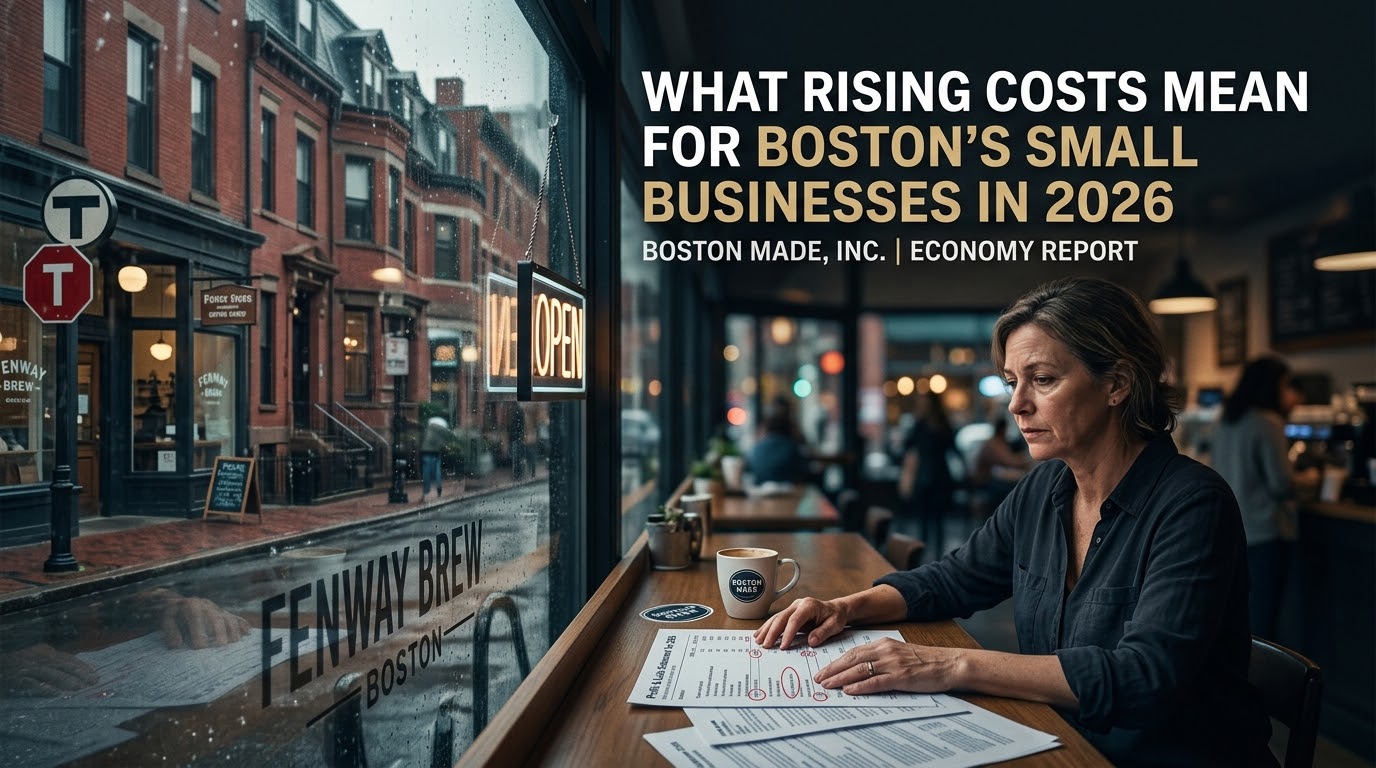
Illustration for “What Rising Costs Mean for Boston’s Small Businesses in 2026”

Small business owners in Greater Boston are contending with a cost environment that, while cooling in some categories, is still squeezing margins in the places that matter most: energy, rent, and labor.

What’s driving prices higher

The Boston-Cambridge-Newton metro area’s consumer price index rose 3.7% year-over-year as of July 2026, according to federal labor statistics. Energy costs are the biggest culprit, up 16.0% over the year with gasoline alone jumping 30.5%. Shelter costs — which factor into commercial as well as residential rents in many small-business leases — climbed 4.7%, and education and communication costs rose 4.5%.

Advertisement

Advertisement

Core inflation, which strips out food and energy, still expanded 3.0% over the year, with shelter again cited as the single largest contributor to price growth over the most recent two-month period.

Where businesses are catching a break

Not every cost is rising. Apparel prices actually fell 6.9% over a recent two-month stretch, and dairy prices are down 2.9% year-over-year — the lone decline among major grocery categories. For retailers and restaurants, that’s a modest offset against the bigger increases in energy and occupancy costs.

Why small businesses feel it more than big ones

Unlike large employers, most small businesses can’t hedge energy contracts or negotiate multi-year rent concessions at scale. A double-digit jump in energy costs and a near-5% rise in shelter costs hits a neighborhood restaurant or independent retailer’s bottom line directly and immediately, often faster than it shows up in headline economic data.

That squeeze is happening against the backdrop of a broader economic picture that’s sending mixed signals: statewide job growth is outpacing the national average, but biotech layoffs, corporate relocations, and population loss have all been part of the conversation about the health of the Massachusetts economy this year.

What owners can watch for

Energy and shelter costs are the two line items most likely to keep pressuring small business margins through the rest of 2026. Boston Made’s Economy desk will continue tracking regional CPI data as new releases come out, along with the state and local policy responses aimed at easing costs for small employers.

Advertisement

Background

The Consumer Price Index is produced by the U.S. Bureau of Labor Statistics and measures changes over time in the prices households pay for a broad basket of goods and services. Alongside the national index, BLS publishes indexes for a number of metropolitan areas, including Boston-Cambridge-Newton. Metro-area indexes are released less frequently than the national figure, and because they are based on smaller samples, they can be more volatile from one release to the next.

The CPI is designed to measure consumer prices, not business costs directly. Still, many of the categories it tracks, such as energy, food and shelter, overlap with the costs small businesses face. A restaurant buys food and pays utility bills; a retailer pays rent and heats a storefront. That overlap is why business owners often watch the CPI as one signal among several.

Advertisement

Core inflation, which excludes food and energy, is meant to show underlying price trends without the swings of those volatile categories. For businesses with high energy use, though, the headline number that includes energy can be closer to their own experience.

It also helps to remember that inflation figures describe the rate at which prices are changing, not the price level itself. A slowing inflation rate means prices are rising more slowly, not that they are falling.

What it means for small businesses

Small businesses cannot control regional prices, but they can manage how those prices affect them. A few general practices are widely used:

  • Know your biggest cost lines. Reviewing the last twelve months of expenses by category shows which increases matter most for your margins.
  • Review your lease. Commercial leases vary. Some pass through costs such as property taxes, insurance or common-area maintenance. Knowing what can change, and when, helps with planning.
  • Look at energy use. Many utilities and state programs offer energy assessments and incentives for commercial customers. Simple changes, such as efficient lighting or better controls on heating and cooling, can reduce use.
  • Revisit pricing thoughtfully. Small, well-explained price adjustments are often easier for customers to accept than infrequent large ones.
  • Compare suppliers. Periodically checking prices with alternative suppliers can reveal savings or provide leverage in negotiations.
  • Build a cash cushion. Even a modest reserve can help absorb unexpected cost spikes.
  • Talk to an accountant. A professional can help model how rising costs affect profitability and taxes.

Key terms

  • Consumer Price Index (CPI): A measure of the average change in prices paid by urban consumers for a basket of goods and services.
  • Metro-area CPI: A CPI calculated for a specific metropolitan region, such as Boston-Cambridge-Newton.
  • Core inflation: Inflation excluding food and energy prices.
  • Shelter: The CPI category covering housing costs, the largest single component of the index.
  • Margin: The share of revenue a business keeps after covering costs.
  • Pass-through: A lease or contract provision that shifts certain costs to the tenant or customer.

What to watch

Several public releases can help owners follow cost trends, without assuming any particular direction:

  • Upcoming releases of the Boston-Cambridge-Newton CPI from BLS.
  • National CPI and core inflation, which offer a broader context.
  • Seasonal electricity supply rate changes announced by utilities.
  • Heating fuel prices during the colder months.
  • State and local programs aimed at small employers, such as energy incentives or grants.
  • Your own monthly expense reports compared with the same months last year.

Quick check: What does core inflation exclude?

  1. Housing and rent
  2. Food and energy
  3. Clothing and education
Show answer

B. Core inflation strips out food and energy, whose prices tend to swing sharply.

BOSSTOX Boston Made family BOSSTOX AI-infrastructure news and research covering power, cooling, chips and capital. Visit site →

Advertisement

Continue Reading

Economic Development

Boston’s Innovation Economy at a Crossroads as Venture Capital Pulls Back

Massachusetts’ life sciences and startup ecosystem is facing a funding pullback, with venture capital share and the number of funded companies both declining in 2026.

Published

on

Boston’s Innovation Economy at a Crossroads as Venture Capital Pulls Back

Boston built its reputation as an innovation hub on a simple formula: world-class research institutions feeding a steady pipeline of venture-backed startups, especially in biotech. That formula is under more pressure than it’s faced in years.

Fewer companies are getting funded

Massachusetts’ share of national venture capital dollars has slipped, and the number of companies in the state receiving funding has fallen by 13%. For a regional economy where early-stage funding rounds often determine whether a lab-based startup can hire its next ten employees, that decline matters well beyond the venture world itself.

Advertisement

Advertisement

Empty lab space tells the same story

Much of the lab and life-sciences real estate built during the pandemic-era expansion now sits vacant at record levels. Developers who bet heavily on continued biotech growth in Cambridge, the Seaport, and along Route 128 are now absorbing that space more slowly than projected, which in turn has made landlords and lenders more cautious about financing the next wave of lab construction.

Layoffs compound the funding slowdown

The funding pullback is landing at the same time hiring in the sector has turned negative: 745 life sciences jobs were cut across 14 Massachusetts companies in the first quarter of 2026 alone. Fewer new funding rounds and fewer open positions together make it harder for laid-off scientists and executives to find their next role without leaving the state entirely — a dynamic that feeds directly into the broader population and talent-retention concerns policymakers have been raising this year.

The state’s response

Governor Healey’s $4 billion Mass Leads Act is designed specifically to shore up life sciences and technology, and the state’s new Competitiveness Council has been tasked with identifying regulatory and tax changes that could make Massachusetts more attractive to venture investors and the companies they fund. More than 30 companies have expanded in the state recently, evidence that the ecosystem hasn’t stalled entirely — but the funding and real estate data both point to a market that has cooled meaningfully from its pandemic-era highs.

What it means for founders and workers

For entrepreneurs building in Boston right now, the practical takeaway is that capital is more selective and runways matter more than they did two or three years ago. Boston Made’s Economy desk will continue tracking funding, lab vacancy, and hiring data across the innovation sector as it develops.

Advertisement

Background

Massachusetts’ innovation economy grew around a set of reinforcing strengths: research universities that produce discoveries and graduates, teaching hospitals that run clinical research, and investors willing to fund early-stage companies. Biotech in particular depends on long timelines. A drug can take many years to move from the lab through clinical trials to approval, and most candidates do not succeed. Venture capital fills the gap by funding companies through those years in exchange for ownership.

Lab space is a distinctive part of the picture. Life sciences buildings need specialized ventilation, plumbing, power and safety features, which makes them more expensive to build than ordinary offices and harder to convert to other uses. When demand for lab space falls, those buildings can remain vacant longer than general office space might.

How venture funding works

Startups typically raise money in stages. Early rounds fund research and prototypes. Later rounds fund larger trials, hiring and commercialization. Each round is priced based on the company’s progress and investors’ view of its prospects. When investors become more cautious, companies may find it harder to raise new money, may raise at lower valuations or may cut costs to extend the time their existing funds will last.

  • Seed and Series A: early funding for initial research and team building.
  • Later rounds: larger amounts for clinical trials, scale-up or market entry.
  • Bridge funding: smaller amounts to carry a company to its next milestone.
  • Exits: acquisitions or public offerings that return money to investors.

What it means for founders and workers

For founders, a more selective funding environment usually rewards clear milestones, careful spending and realistic plans. For workers, it can mean fewer openings and more competition for roles, but also opportunities at companies that are still growing. Professional networks, industry associations and university career resources can help people navigate a slower market.

  • Track runway carefully and plan for funding to take longer than expected.
  • Keep relationships with investors active even between fundraising rounds.
  • Explore grants and nondilutive funding sources where available.
  • For job seekers, consider adjacent roles that use similar skills.

Key terms

  • Venture capital: investment in young, high-growth companies in exchange for equity.
  • Runway: how long a company can operate before it runs out of cash.
  • Lab vacancy: the share of laboratory space that is unoccupied.
  • Nondilutive funding: money, such as grants, that does not require giving up ownership.
  • Valuation: the value assigned to a company in a funding round.
  • Life sciences: fields including biotechnology, pharmaceuticals and medical devices.

What to watch

  • Quarterly venture funding reports for Massachusetts and national comparisons.
  • Lab vacancy and leasing trends in Cambridge, the Seaport and suburban markets.
  • Hiring and layoff announcements in the life sciences sector.
  • Implementation of the Mass Leads Act and recommendations from the Competitiveness Council.
  • Company expansions and relocations into or out of the state.

Funding data is often reported by quarter, and a single very large round can lift a total sharply, so looking at the number of deals alongside the dollar amount gives a clearer sense of how broadly capital is reaching companies across the ecosystem.

Quick check: By how much has the number of Massachusetts companies receiving venture funding fallen, according to the article?

  1. 3%
  2. 13%
  3. 30%
Show answer

B. The article says the number of companies in the state receiving funding has fallen by 13%.

Lumo Kingswell Lumo Precious-metals education and a two-sided gold exchange with a live gold price. Visit site →

Advertisement

Continue Reading
Advertisement

Advertisement

Ad

Advertisement

Trending

--:--·---·--°