
Connect with us

Weather where you are

Choose your location or share it once. We round your coordinates to about 1 km before sending them to our site and MET Norway for your forecast. Your choice stays in this browser tab.

Stay close to Boston

Get new Boston stories and Boston Made company updates, delivered as browser notifications.

Choose Enable notifications, then allow notifications in your browser.

Your browser subscription is stored by Boston Made and delivered through your browser’s push service. You can turn notifications off in your browser’s site settings. Privacy policy

Banking & Finance

The Deal Window Is Wide Open: Why 2026 Could Set Records for IPOs and Mergers, and Why Timing Matters Now

A Masterpass briefing: JPMorgan says dealmaking could hit an all-time record this year. What’s driving it, what could shut the window, and how founders and owners should prepare now.


Nathanael Strickland

Published

on

Boston Made Newsroom illustration: The Deal Window Is Wide Open: Why 2026 Could Set Records for IPOs and Mergers, and Why Timing Matters Now

While headlines focus on Iran, oil and Washington, Wall Street’s deal machine is running at one of its fastest paces ever. JPMorgan’s Dorothee Blessing says 2026 could set an all-time record for mergers and IPOs, driven by a year-end rush, Bloomberg reported.

Global deal volume reached about $2.6 trillion in the first half, up roughly 30% from a year earlier. The record is $5.3 trillion, set in 2021.

🔒 Masterpass briefing

You’re reading a free preview.

The rest of this story is for Boston Made Masterpass members. Here’s how it works:

  1. Tap Get Masterpass and choose a membership.
  2. Sign in with the same account.
  3. Come back to this page. The full briefing will be here, along with every member story across the network.

Get Masterpass →Already a member? Sign in

Running a business? Keystone by Kingswell includes Boston Made Membership in its software stack.

Founder of Boston Made, Inc., a Boston-based media and business portfolio company. I lead Boston Made's independent, hyperlocal coverage of Boston's economy, businesses, and neighborhoods, alongside a growing portfolio of Boston-rooted brands — including Boston Made Pets, where my passion for dog wearables and canine wellness lives on. I’m an avid reader and journaler who believes in reporting that's closer to home.

Continue Reading
Click to comment

Leave a Reply

Your email address will not be published. Required fields are marked *

Banking & Finance

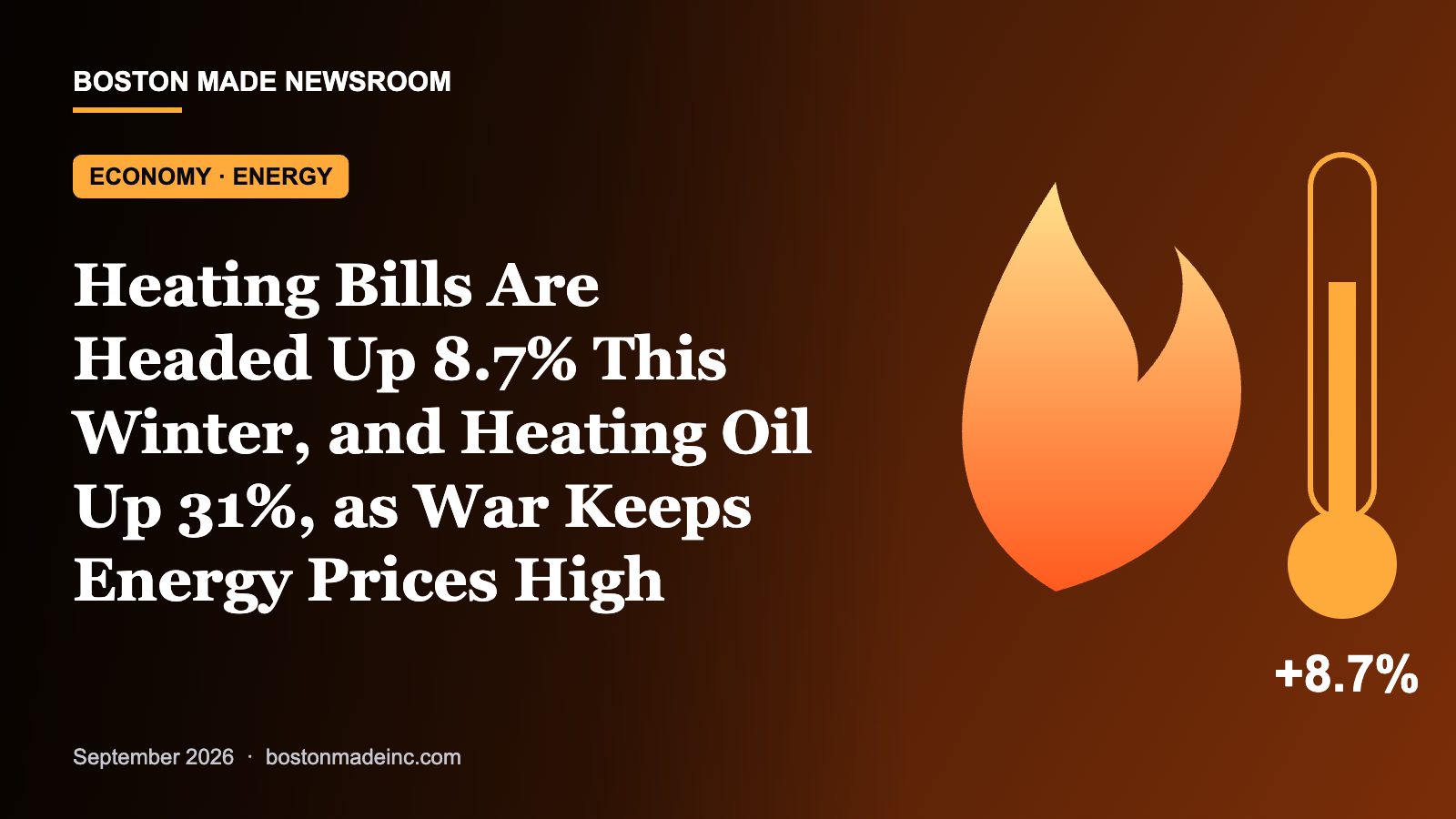
Heating Bills Are Headed Up 8.7% This Winter, and Heating Oil Up 31%, as War Keeps Energy Prices High

Energy-assistance directors project the average family will pay about $1,030 to heat their home this winter. Here is why, who gets hit hardest, and what to do now.
Nathanael Strickland

Published

on

Boston Made Newsroom illustration: Heating Bills Are Headed Up 8.7% This Winter, and Heating Oil Up 31%, as War Keeps Energy Prices High

Americans should expect to pay more to stay warm this winter. The National Energy Assistance Directors Association (NEADA) projects that home heating costs will rise 8.7% across all fuel types, to an average of about $1,030 per household, according to its September 14 forecast. NEADA notes that is more than 2.5 times the rate of inflation.

Families who heat with oil will be hit much harder. NEADA projects they will pay 31.3% more, with average seasonal bills of about $2,300, Quartz reported.

Why: two wars and one oil market

  • The Iran war is the main driver. Fighting around the Strait of Hormuz, a U.S. oil blockade of Iran and attacks on Gulf energy sites have kept crude near $100 a barrel. Heating oil is refined from crude, so it moves first and furthest.
  • Russia’s war in Ukraine, now in its fifth year, keeps pressure on global energy. Europe’s turn away from Russian gas since 2022 has tightened world natural-gas markets and pulled more U.S. gas overseas as LNG.
  • Everything else costs more too. With electricity, food and rent already up, higher heating bills land on budgets that are already stretched.

Average heating bill: about $1,030, up 8.7%. Heating-oil homes: about $2,300, up 31%. (NEADA)

Who gets hit hardest

New England and the rest of the Northeast rely on heating oil far more than the rest of the country, so Boston-area households, landlords and small businesses will feel this first. Older homes, renters in oil-heated buildings, seniors on fixed incomes and restaurants and shops with high heating loads are most exposed.

What to do now, before the cold

  1. Lock in or pre-buy heating oil or propane if your dealer offers a fixed-price or budget plan. Compare at least two dealers.
  2. Get a tune-up. A clean, serviced furnace or boiler burns less fuel.
  3. Seal the leaks: weatherstrip doors and windows, and insulate the attic if you can. Ask your utility about free or discounted energy audits.
  4. Apply for help early. LIHEAP, the federal home-energy assistance program, and state fuel-assistance programs open in the fall and funds can run out. In Massachusetts, apply through your local community action agency.
  5. Call your utility before you fall behind. Payment plans and winter shutoff protections are easier to set up early.

For business owners

Budget for higher heating and energy costs in Q4 and Q1, check whether your leases pass heating costs through, and watch oil: our markets briefing tracks what the Iran talks could do to prices.

Run your business on one keystoneKeystone by Kingswell connects market intelligence, operations and your website in one stack, so you can see what headlines like these mean for you.

Explore Keystone ↗

Continue Reading

Banking & Finance

Headline Whiplash: Nasdaq Hits Records as Iran, Oil, Rates and a Cyber Breach Keep Markets on Edge

A Masterpass markets briefing: why tech keeps climbing while the Dow and banks slip, what oil near $100 is telling you, and the catalysts that could whipsaw stocks this week.

Nathanael Strickland

Published

on

Boston Made Newsroom illustration: Headline Whiplash: Nasdaq Hits Records as Iran, Oil, Rates and a Cyber Breach Keep Markets on Edge

Wall Street is trading the headlines. On Tuesday, September 22, the Nasdaq Composite posted its second straight record close as oil prices eased, while the Dow finished lower and bank stocks slid, according to Quartz and Yahoo Finance. The S&P 500 was roughly flat.

Under the surface, the moves have been large and fast, and they are driven by geopolitics more than earnings.

🔒 Masterpass briefing

You’re reading a free preview.

The rest of this story is for Boston Made Masterpass members. Here’s how it works:

  1. Tap Get Masterpass and choose a membership.
  2. Sign in with the same account.
  3. Come back to this page. The full briefing will be here, along with every member story across the network.

Get Masterpass →Already a member? Sign in

Running a business? Keystone by Kingswell includes Boston Made Membership in its software stack.

Continue Reading

Banking & Finance

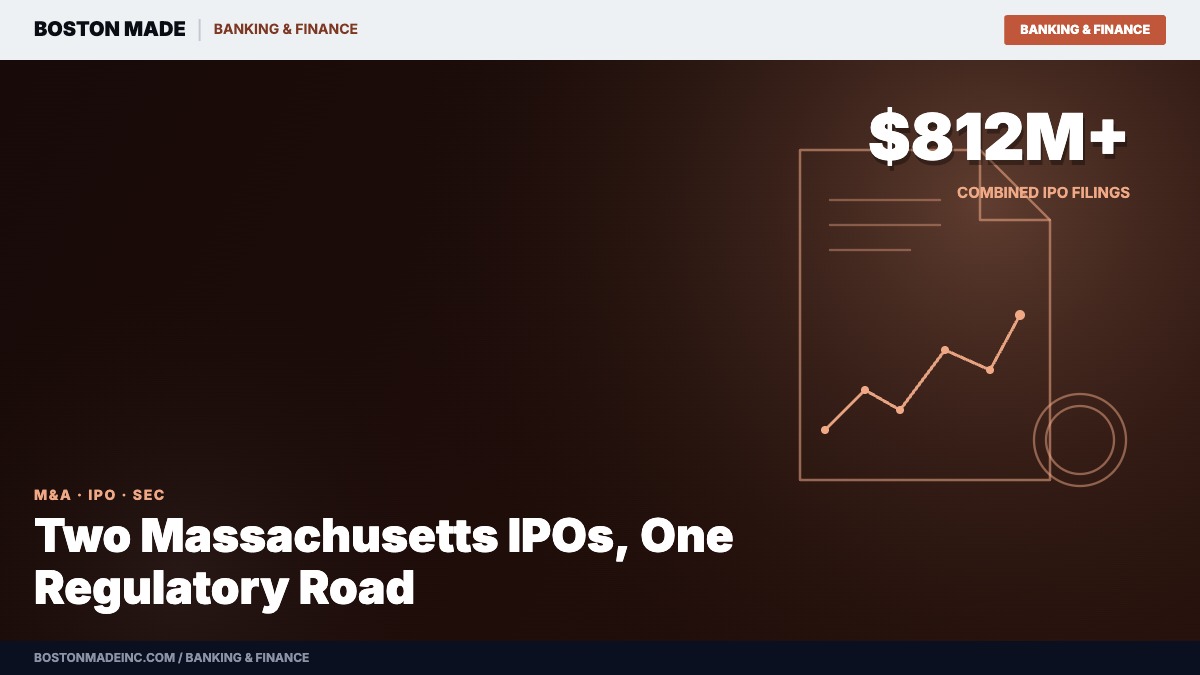
Two Massachusetts IPOs, One Regulatory Road: Understanding S-1s, Red Herrings, and the Lawyers Behind the Deal
Nathanael Strickland

Published

on

BOSTON — Two very different Massachusetts companies filed to go public this year, and together they’re a useful crash course in how the public-markets side of business actually works — the paperwork, the terminology, and the lawyers behind both.

Two real IPOs, two different stories

Hometown Financial Group, the Easthampton-based parent of several Massachusetts community banks, filed an S-1 registration statement with the SEC on September 10, 2026, seeking to raise between roughly $510 million and $690 million — with room to grow to nearly $794 million — in an offering priced at $10.00 per share under the ticker HFG on Nasdaq. The offering is tied to a mutual-to-stock conversion: Hometown Financial Group, MHC will cease to exist as a mutual entity, replaced by a newly incorporated public holding company. The proceeds are earmarked for a specific purpose — financing the company’s $160 million acquisition of Bedford, New Hampshire-based Primary Bank, repaying a $135 million senior note coming due in 2027, and covering an Employee Stock Ownership Plan obligation.

A few miles away, Seaport Therapeutics, a Boston-based biotech developing antidepressant and anti-anxiety treatments, filed its own registration with the SEC for a $212.4 million IPO, offering 11.8 million shares in a $16–$18 range that would value the company near $912 million at the top end. Founded in 2024 and roughly half-owned by PureTech Health, Seaport is led by CEO Daphne Zohar, who previously co-founded Karuna Therapeutics — the company Bristol-Myers Squibb acquired for $14 billion in 2024. Seaport expects Phase 2 depression-treatment trial results in the first half of 2027.

Different industries, different sizes, same regulatory road: an S-1 filed with the SEC, a roadshow, and a market that will ultimately decide the price.

What a “Red Herring” actually is

The M&A and IPO world is full of jargon that sounds more mysterious than it is. Boston Made’s own brand-advisory arm puts it plainly on its Mergers & Acquisitions page: “A ‘Red Herring’ is the industry term for a preliminary prospectus — a red-flagged draft disclosure document, named for the red-ink notice on its cover, used ahead of a formal public offering to describe a company’s business, financials, and risks before pricing is finalized.” Both Hometown Financial Group’s and Seaport Therapeutics’ S-1 filings are, at this stage, functioning exactly like that — public, but explicitly preliminary, with final pricing still to come.

Where attorneys and privilege fit in

Every serious M&A process or public offering runs on legal infrastructure most outside observers never see. Company counsel drafts and negotiates the disclosure documents. Attorney-client privilege protects the internal deliberations — valuation debates, risk disclosures, negotiating strategy — that happen before anything becomes public. Due diligence generates enormous volumes of documentation: cap tables, material contracts, litigation history, IP assignments, regulatory filings — all of it reviewed by counsel on both sides before terms are finalized. None of that is unique to Hometown Financial Group or Seaport Therapeutics; it’s simply how public offerings and acquisitions get done, at every scale.

Boston Made’s own M&A process, outlined on the page linked above, mirrors that structure: a submission, an automatic NDA, a documentation request that explicitly includes preliminary Red Herring materials where relevant, a structuring-and-terms phase conducted “with you and your counsel,” and finally a close-and-integration stage — or, for companies pursuing a public listing rather than an acquisition, a hand-off to Bosstox.com. As that page notes plainly: it describes a process, not legal, financial, or investment advice.

Why it’s worth understanding

Boston’s public-markets activity this year — from a 100-plus-year-old community bank going public to fund an acquisition, to a four-year-old biotech chasing a $900 million valuation — shows the range of companies working through this exact machinery right now. Understanding the vocabulary doesn’t require a law degree. It just requires someone willing to explain it plainly, which is what this page is for.


This article is for informational purposes only and does not constitute legal, financial, or investment advice. Boston Made, Inc. is not affiliated with Hometown Financial Group or Seaport Therapeutics. Businesses considering a sale, acquisition, or capital raise can learn more about Boston Made’s own process at brands.bostonmade.com/mergers-acquisitions.

Continue Reading
Advertisement

Advertisement

Ad

Advertisement

Trending

--:--·---·--°
♫ Music Video Player
Press play — keeps playing while you browse