Connect with us

Weather where you are

Choose your location or share it once. We round your coordinates to about 1 km before sending them to our site and MET Norway for your forecast. Your choice stays in this browser tab.

Stay close to Boston

Get new Boston stories and Boston Made company updates, delivered as browser notifications.

Choose Enable notifications, then allow notifications in your browser.

Your browser subscription is stored by Boston Made and delivered through your browser’s push service. You can turn notifications off in your browser’s site settings. Privacy policy

Corporate News

Boston Made Shares a First Look at Heart Latch

A name, a mark and a web address: Boston Made, Inc. offers the first clues about Heart Latch, a new app built around how two people meet.

Published

on

Heart Latch logo: two linked shapes forming a heart beside the Heart Latch wordmark

FOR IMMEDIATE RELEASE
November 20, 2026

Boston Made, Inc. today shared the first look at a new venture it has been keeping quiet: a name, a mark and a web address. The name is Heart Latch. The mark is two shapes that link together to form a heart. The address is heartlatch.com.

Advertisement

Advertisement

Everything else is staying under wraps for now, but the company offered a few clues about where this is going. Heart Latch is an app. It is about people, not products. And it is built around a simple belief: the hardest part of meeting someone should not be the software.

Reading the mark

The Heart Latch logo is made of two rounded shapes, one coral and one deep rose, that cross and lock into a single heart. Where they overlap, the color deepens. At the point where they meet there is a small opening, the latch. Two separate things, one connection, and a door that only opens when both sides want it to.

Two people. One latch. The rest of the story is coming.

What the company will say for now

  • Heart Latch is a new company in the making, with its own name, its own look and its own home at heartlatch.com.
  • It is being designed for real conversations and real first meetings, not endless scrolling.
  • Safety, honesty and respect are being treated as the foundation, not as features added later.
  • It will arrive on phones first.

What comes next

Boston Made is not announcing a launch date, pricing or a list of cities today. Those details will be shared when the product is ready to be judged on its own merits. In the meantime, the name and the mark are public, and the address is live to bookmark.

Anyone curious about Heart Latch can follow the Boston Made newsroom for the full announcement.

Advertisement

About Boston Made, Inc.

Boston Made, Inc. is a Delaware corporation founded in 2019 by Nathanael Strickland, Founder & CEO. It is the company behind the Boston Made family of brands, spanning publishing, pets, web design, software and community projects. Learn more at bostonmade.com.

Media contact: sales@bostonmade.com

This release describes projects that are still in development. Names, features, timing and availability may change, and nothing here is an offer to sell a product or service.

Boston Made Pets Boston Made family Boston Made Pets Pet apparel and gear inspired by Boston the GoldenDoodle. Visit site →

Advertisement

Latest stories

View all

Corporate News

Boston Made Opens Advertising on bostonmade.com and BOSSTOX With Published Rates

Boston Made, Inc. opened advertising on bostonmade.com and BOSSTOX, with event boosts from $5 a day and rates posted on each site’s Advertise page.

Published

on

A printing press running sheets of newsprint

BOSTON, Nov. 12, 2026 — Boston Made, Inc. today opened advertising on two of its websites, bostonmade.com and BOSSTOX (bosstox.com), with rates published on each site’s Advertise page. Local businesses, event organizers and companies that want to reach readers following the AI infrastructure buildout can now see prices, placements and ground rules before they reach out, rather than requesting a media kit and waiting for a quote.

The launch follows the company’s move this week to give each brand its own newsletter list, so sponsors reach readers who signed up for that brand’s coverage specifically.

Advertisement

Advertisement

What is available on bostonmade.com

Boston Made publishes Boston and New England news, city guides and local stories. Its Advertise page, at bostonmade.com/advertise, lists three options:

  • Event boost — $5 per day. An event or local listing appears in a spot labeled “Promoted” on bostonmade.com for the days the advertiser chooses. It is built for small budgets: a neighborhood fundraiser, a pop-up market or a restaurant’s holiday menu can run for a long weekend for the price of a coffee a day.
  • Newsletter sponsor — $150 per send. A short, labeled message in the Boston Made newsletter, written in plain language and linked to the sponsor’s site. Each newsletter carries one sponsor, so the message is never buried among others.
  • Sponsored article — pricing on request. A feature written with the Boston Made desk or supplied by the sponsor, labeled “Sponsored” with the sponsor’s name and kept separate from news coverage.

What is available on BOSSTOX

BOSSTOX covers the infrastructure that makes artificial intelligence possible: power, grid equipment, data centers, cooling, chips, networking, capital and supply chains. Its readers include operators, engineers, procurement teams, founders and business readers who want specifics. The BOSSTOX Advertise page, at bosstox.com/advertise, lists:

  • Newsletter sponsorship — $40 to $100 CPM. Priced per 1,000 newsletter opens, with one sponsor per edition. The rate depends on placement and length.
  • Display and site sponsorship — pricing on request. Clearly labeled positions alongside BOSSTOX coverage.
  • Research and briefing sponsorship — pricing on request. Support for a labeled research series, briefing or special report that fits BOSSTOX readers’ interests.

Every BOSSTOX sponsorship carries an “education only” label. BOSSTOX does not run stock picks, brokerage offers or trading promotions, and it does not execute trades or give investment advice.

Why publish the prices

Many publishers keep their rates behind a media kit request or a sales call. That works for large agencies, but it slows down the small businesses that make up most of a local audience. A bakery owner deciding whether to promote a holiday open house should not need three emails to learn what it costs.

Published prices also make the offer easier to compare. An advertiser can weigh a $5 daily event boost against a social media ad, or a $150 newsletter sponsorship against a print insert, and decide in minutes. Final terms are still confirmed in writing before anything runs, and prices are listed in U.S. dollars.

Advertisement

Publishing rates also keeps the company honest with readers. When the price of a placement is public, so is the fact that it is paid, and the labels on the page match what anyone can read on the Advertise page.

The rules every sponsor agrees to

Both sites apply the same standards to paid placements:

  1. Every paid placement is labeled. Readers see “Promoted” or “Sponsored” wherever paid material appears.
  2. Advertisers do not buy coverage. Sponsors never review, approve or edit news reporting, sourcing or corrections.
  3. One sponsor per newsletter. Each send carries a single sponsor message.
  4. Written terms first. Pricing, dates and placement are confirmed in writing before a placement runs.

The full terms for each placement are listed on the Boston Made and BOSSTOX Advertise pages.

How the newsletters fit in

Newsletter sponsorships depend on readers who chose to subscribe. Boston Made now keeps a separate list for each brand: a reader who joins on bosstox.com joins the BOSSTOX weekly, and a reader who joins on bostonmade.com joins Boston Made’s list. Nobody is added to a list without signing up, and every email includes a way to unsubscribe.

For sponsors, that separation is the point. A message about grid equipment or data center services reaches BOSSTOX readers who asked for AI infrastructure coverage. A message about a Boston restaurant week reaches readers who follow the city. Neither audience receives the other’s offers.

Advertisement

Who the program is for

  • Local businesses and organizers in Greater Boston promoting events, openings, seasonal menus, markets, classes and fundraisers.
  • Companies serving the AI buildout, including equipment makers, engineering and construction firms, energy and cooling suppliers, and software and services providers, that want to reach technical and business readers.
  • Nonprofits and community groups that want an affordable, clearly labeled way to announce a date or a drive during the holiday season.

How to book

To book on bostonmade.com, email sales@bostonmade.com with the business name, what you want to promote, your dates and your budget. To book on BOSSTOX, use the contact form linked from bosstox.com/advertise and include who you want to reach and your timing. Each site replies with available dates and written terms.

The holiday season is typically the busiest time for local events. Event boosts can be booked for specific days, so organizers can line up promotion around a single weekend or a run of December dates.

About Boston Made, Inc.

Boston Made, Inc. is a Massachusetts company behind a family of independent websites and brands, including bostonmade.com, BOSSTOX and Pupwear. The company builds digital products, local guides and media for readers and businesses across Massachusetts and beyond.

Media contact: sales@bostonmade.com

Source: Boston Made, Inc.

Quick check

How much did you catch? Tap a question to see the answer.

1. What does an event boost on bostonmade.com cost?

Answer: $5 per day, in a spot labeled “Promoted.”

2. How is BOSSTOX newsletter sponsorship priced?

Answer: $40 to $100 per 1,000 newsletter opens (CPM), one sponsor per edition.

3. Can a sponsor review news coverage before it runs?

Answer: No. Sponsors never review, approve or edit news reporting.

Pupwear Boston Made family Pupwear Dog apparel and gear inspired by Boston the GoldenDoodle. Visit site →

Advertisement

Continue Reading

Corporate News

Boston Made, Inc. Opens Brand Newsletters, Launches a Springfield City Guide and Adds Verified Sign-Ups

Boston Made, Inc. opened sign-ups for the BOSSTOX weekly and Pupwear’s The Pack, published a Springfield city guide and added email-verified accounts.

Published

on

Aerial view of the Boston skyline at sunset

Photo: Rackeem Borges / Unsplash

BOSTON, Nov. 11, 2026 — Boston Made, Inc. today announced three updates across its websites: new brand-specific email newsletters for BOSSTOX and Pupwear, a new Springfield, Massachusetts city guide on bostonmade.com, and email verification for new member accounts on its member sites. The changes went live this week.

Advertisement

Advertisement

Together, the updates reflect the company’s focus this season: giving each brand its own direct line to readers, expanding local coverage across Massachusetts and protecting member communities from automated sign-ups.

Brand newsletters: one list per brand

Readers who sign up on a Boston Made brand site are now added to that brand’s own newsletter list, instead of a single shared list. Each brand speaks to its readers directly, about the topics they came for.

  • BOSSTOX weekly (bosstox.com): BOSSTOX covers the infrastructure behind artificial intelligence, including compute, power, cooling, networks and the capital that funds them. The weekly newsletter gathers that coverage in one email. BOSSTOX publishes news and analysis for information only and does not execute trades.
  • Pupwear’s “Join The Pack” (pupwear.org): Pupwear’s list is for dog owners who want practical warmth, apparel and gear guidance, and dog-life stories.

Sign-ups happen through a small join box on each site. Existing subscribers keep receiving the emails they already signed up for; nobody has been moved to a new list without signing up. Every email includes a way to unsubscribe.

How the newsletter sign-up works

The join box asks for an email address and adds it to the newsletter of the site the reader is visiting: a BOSSTOX reader joins the BOSSTOX list, and a Pupwear reader joins The Pack. The box appears only after a visitor has made a choice on the site’s cookie banner, so privacy choices always come first.

Separate lists also make each newsletter more useful. A reader interested in AI infrastructure and capital markets does not need dog-gear updates, and a dog owner looking for winter coat advice does not need market coverage. Keeping lists by brand lets each newsletter stay focused on what its readers signed up for.

Advertisement

A new Springfield city guide

Boston Made has published a Springfield city guide at bostonmade.com/explore-springfield-ma. Springfield is a western Massachusetts city on the Connecticut River with its own downtown and surrounding neighborhoods, and the guide is designed as a starting point for people researching the city for a home or a business location.

The guide is organized around practical questions:

  • Homes: visit an address at different times of day, check transportation routes, building access, utilities and the condition of the home, and compare documented facts with your needs.
  • Commercial: confirm permitted use, access, parking, utilities and any existing lease terms with local offices and professionals before evaluating a business location.
  • Records: go to the source, confirming municipal records directly.

The guide states plainly that live MLS listings and city-level market statistics are not connected yet. It is a research tool, not a listing service, and it sits alongside Boston Made’s other Massachusetts and New England location pages.

Email verification for new member accounts

New member accounts on bostonmadeinc.com and app.bostonmade.com now require email confirmation. When someone registers, they receive an account activation email, and the account becomes active only after the link in that email is clicked.

The change follows a review of member accounts across Boston Made sites this month, during which more than 150 spam and automated accounts were removed. Automated sign-ups can clutter member communities, distort audience numbers and create security risks. Email verification is a simple, widely used step that stops most of them while adding only a moment for real members.

Existing members are not affected and do not need to take any action.

Advertisement

Email verification, step by step

  1. A new member completes the registration form on a Boston Made member site.
  2. The site sends an account activation email, with the subject line “Please activate your account.”
  3. The new member clicks the activation link in that email.
  4. The account becomes active, and the member can sign in.

If the email does not arrive, it is worth checking spam or promotions folders and adding the sender to the address book. Accounts that are never activated simply stay inactive, which keeps automated sign-ups out of the member community.

What has not changed

These updates do not change existing member accounts, existing newsletter subscriptions or the content on any Boston Made site. Readers who already receive Boston Made emails will continue to receive them unless they choose to unsubscribe. The Springfield guide adds to Boston Made’s location pages without replacing any of them.

Why these updates matter

Each change addresses a simple goal. Brand-specific newsletters mean readers get the content they asked for. Local guides such as Springfield’s help people make better decisions about where to live and work. Verified sign-ups keep member communities real.

For readers and members

  • To join a brand newsletter: visit the brand’s website and use the join box.
  • To explore Springfield: visit bostonmade.com/explore-springfield-ma.
  • New to a Boston Made member site? Watch your inbox for the activation email after registering, and check your spam folder if it does not arrive within a few minutes.
  • Already a member? Nothing changes for you.

About Boston Made, Inc.

Boston Made, Inc. is a Massachusetts company behind a family of independent websites and brands, including bostonmade.com, BOSSTOX and Pupwear. The company builds digital products, local guides and media for readers and businesses across Massachusetts and beyond.

Media contact: sales@bostonmade.com

Source: Boston Made, Inc.

Quick check

How much did you catch? Tap a question to see the answer.

1. Which two brand newsletters opened this week?

Answer: The BOSSTOX weekly and Pupwear’s “Join The Pack.”

2. Does the Springfield guide show live MLS listings?

Answer: Not yet. It is a research starting point; listings and market statistics are not connected yet.

3. What do new members need to do after registering?

Answer: Click the link in the account activation email.

Keep Up With Nate Boston Made family Keep Up With Nate The personal site of Boston Made founder Nathan Strickland. Visit site →

Advertisement

Continue Reading

Corporate News

Fenway Web Relaunches FenwayWeb.com With Published Pricing and Care Plans

Published

on

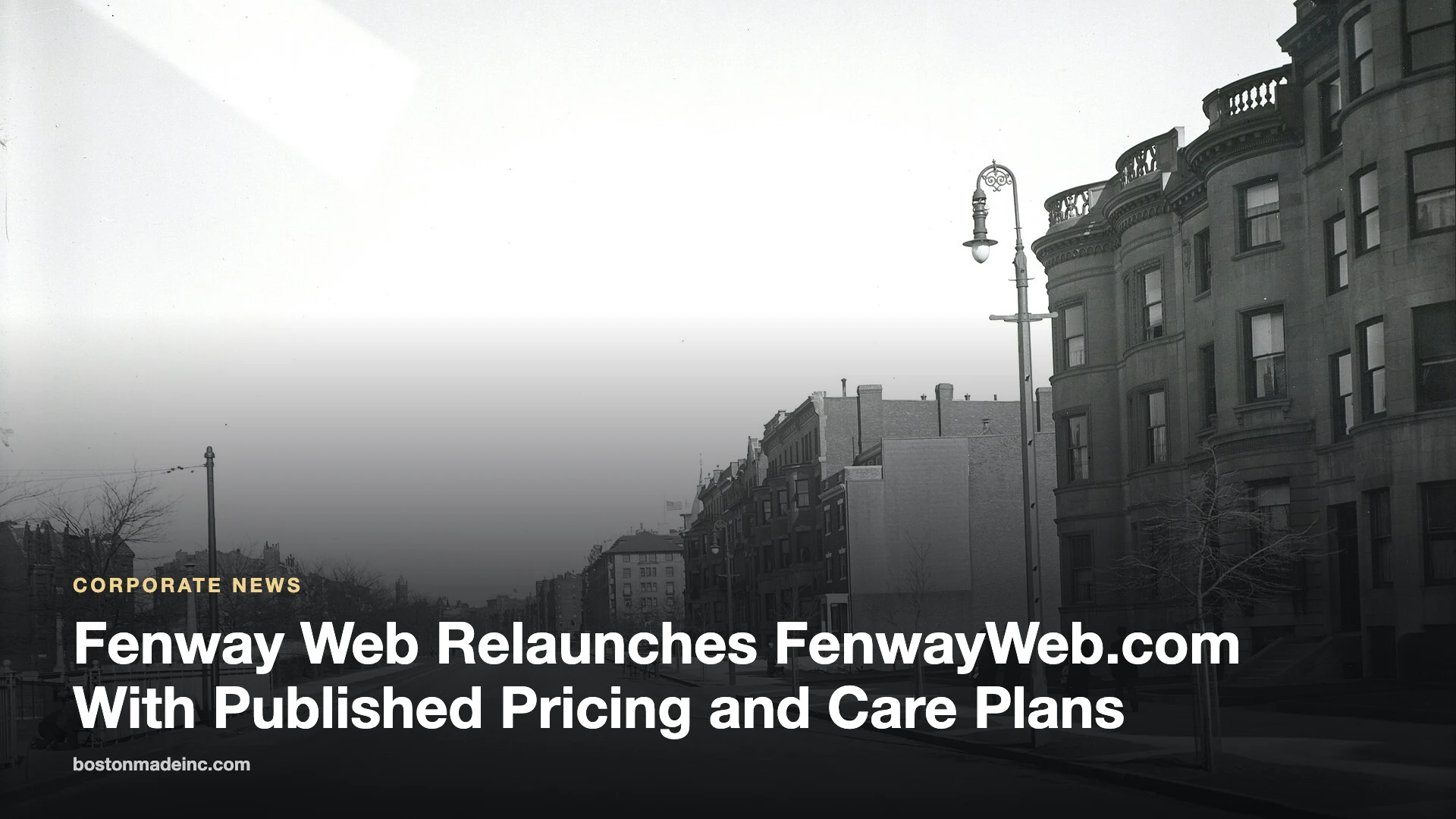
The south side of Kenmore Square, near Fenway, around 1915

FOR IMMEDIATE RELEASE

WORCESTER, Mass., Oct. 24, 2026 — Fenway Web, the web design and development studio of Boston Made, Inc., today announced the relaunch of fenwayweb.com. The new site publishes the studio’s pricing in full for the first time and introduces monthly care plans so clients have a team behind their website long after launch.

Advertisement

Advertisement

Three ways to start

Fenway Web now lists three build options. Starter ($1,500) covers up to five pages, mobile-first design, a contact form and local SEO setup. Business ($3,500) covers up to fifteen pages, copywriting, booking or lead forms, and analytics with training. Custom builds start at $7,500, with scope and price agreed in a written proposal before any work begins.

Care after launch

Optional care plans start at $49 a month and cover software updates, backups, security monitoring and post-launch edits, with a client portal for requests.

Who it builds for

The studio builds for small businesses, churches and local brands. Its portfolio spans New England, North Georgia and South Carolina’s Grand Strand, including sites for AX Home Pro, Sherry’s Homes, Victory Construction, The Soft Play Social, Coastal Community Church, Daniel Strickland Music and Howard Strickland.

Boston Made+ Business members save 10% on Fenway Web builds and care plans. Portfolio, pricing and the “Start a project” form are at fenwayweb.com.

About Fenway Web. Fenway Web is the web design, development and SEO studio of Boston Made, Inc. It designs, builds and looks after websites for small businesses, churches and local brands. fenwayweb.com

Advertisement

About Boston Made, Inc. Boston Made, Inc. is a Delaware corporation headquartered in Worcester, Massachusetts, behind The Boston Made family of companies, a family of brands spanning media, software, pets, parking, precious metals and web services. bostonmade.com/brands

Media contact: sales@bostonmade.com · Boston Made, Inc., 8 Grafton Street, Suite 210, Worcester, MA 01608

The post Fenway Web Relaunches FenwayWeb.com With Published Pricing and Care Plans appeared first on Fenway Web.

Advertisement

Background

Web design studios have traditionally handled pricing in different ways. Some publish packages with fixed prices, while others quote every project individually after a discovery call. Both approaches have trade-offs. Published prices help buyers understand the range before they reach out. Custom quotes allow a studio to account for unusual requirements, integrations or content needs that a package cannot anticipate.

Ongoing website maintenance, often called a care plan, maintenance plan or support retainer, has also become common across the industry. Websites are not finished products in the way a printed brochure is. The software they run on receives regular updates, security threats evolve, and businesses keep changing their hours, services and staff. A site that is never maintained can slowly become slower, less secure and less accurate.

What it means for small businesses

For a small business, church or local organization considering a new website, the real decision is usually not just the build price. It is the total cost and effort of owning a website over several years. A few general questions help compare any web provider fairly:

  • What is included in the build? Ask how many pages, whether copywriting is included, how many rounds of revisions are allowed and what happens if the scope grows.
  • Who owns the site? Confirm who owns the domain name, the content, the design files and the hosting account, and how you would move the site if you ever needed to.
  • What does maintenance cover? Updates, backups and security monitoring are common, but the details vary. Ask how often backups run, where they are stored and how quickly problems are addressed.
  • How are changes requested? A clear request process, such as a ticket system or portal, makes it easier to track what was asked and when.
  • What is the exit path? Understand what happens if you cancel a maintenance plan, and what you receive when you do.

Getting these answers in writing, as part of a proposal or agreement, helps prevent misunderstandings later.

Planning before you request a quote

Any web project goes more smoothly when the business has done a little homework first. Useful preparation includes:

  1. A short list of the main things visitors should be able to do, such as call, book, donate or request a quote.
  2. A rough sitemap listing the pages you think you need.
  3. Logos, brand colors and any existing photos of your work, team or space.
  4. Examples of other websites you like, and notes on why.
  5. Login details for your domain registrar and any current hosting, kept secure and shared only with the people who need them.

Key terms

  • Scope: The agreed list of pages, features and deliverables in a project.
  • Mobile-first design: An approach that designs for phone screens first, then adapts layouts for larger screens.
  • Local SEO: Practices that help a business appear in search results for nearby customers.
  • Care plan: An ongoing service agreement covering updates, backups, monitoring and small edits after launch.
  • Client portal: An online space where clients submit and track requests.

What to watch

  • Does a proposal clearly separate one-time build costs from recurring costs?
  • Are timelines, revision limits and responsibilities for content spelled out?
  • After launch, are updates and backups happening on the schedule described?
  • Is the site still accurate a year later, and who is responsible for keeping it that way?

Quick check: Why do many websites need ongoing care after launch?

  1. Websites stop working automatically after one year
  2. Software updates, security threats and business changes require regular attention
  3. Search engines require monthly redesigns
Show answer

B. The software behind a site receives updates, threats evolve and business details change, so maintenance keeps a site secure and accurate.

Beacon Federal Partners Affiliate Beacon Federal Partners Independent government-contracting firm and Boston Made affiliate. Visit site →

Advertisement

Continue Reading
Advertisement

Advertisement

Ad

Advertisement

Trending

--:--·---·--°