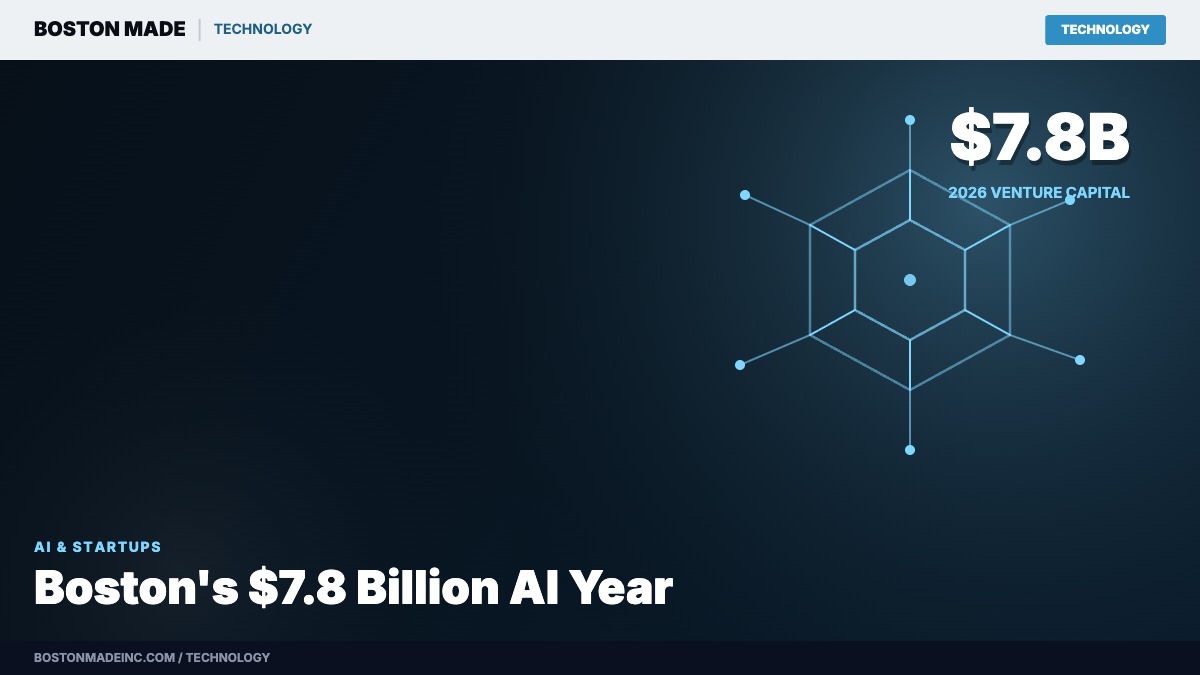
CAMBRIDGE — Boston’s startup economy is having its strongest fundraising year in roughly four years, with greater-Boston companies pulling in an estimated $7.8 billion in venture investment so far in 2026. The headline number is real. So is the more complicated story underneath it: Boston is winning big, specific bets in artificial intelligence and robotics — just not in the way Silicon Valley is.
Two Cambridge companies, two different AI plays
Walden Robotics, based in Cambridge and spun out of the Toyota Research Institute, raised a $300 million round this year at a $1.1 billion valuation, with backing from Toyota, Nvidia, Boeing, and Deviation Capital. The company builds partially humanoid robots — arms, sensors, wheeled bases — for factory and warehouse floors, trained using “large behavior models” that let a robot learn a new task from demonstration rather than new code. Led by MIT professor Russ Tedrake, Walden already has robots running inside a Toyota manufacturing plant in North America. It’s one of the largest robotics deals to come out of Boston, trailing only autonomous-vehicle maker Motional.
Advertisement
A few subway stops away in Kendall Square, Blitzy took a different path to a similar milestone. The company, founded by former Army Ranger Brian Elliott and ex-Nvidia engineer Sid Pardeshi, builds AI tools that help large enterprises untangle and modernize legacy codebases — some running software 25 to 30 years old — before generating AI-assisted rewrites. Blitzy raised $200 million at a $1.4 billion valuation, led by Northzone with a bench of Boston-area investors including Battery Ventures, Flybridge Capital, and PSG. At roughly 80 employees, it’s now a Kendall Square unicorn built on unglamorous, essential infrastructure — exactly the kind of company Boston tends to produce.
Whoop and the AI-health crossover
The single largest round of the year in Boston didn’t come from a pure AI lab — it came from a wearable. Whoop closed a $575 million Series G in March at a $10.1 billion valuation, built on what the company describes as 24 billion hours of physiological data feeding purpose-built AI models to generate personalized health insights. It’s a reminder that Boston’s AI story is increasingly inseparable from its health-tech and biotech story — sectors that, combined, still account for more than half of the region’s largest funding rounds this year.
The honest comparison
Boston hasn’t produced a foundation-model company on the scale of OpenAI or Anthropic, and reporting on the region’s 2026 numbers has been candid about that gap — no single Boston round this year approaches the scale of the largest Bay Area AI mega-deals. But the region’s institutional advantages haven’t gone anywhere: MIT alone has been actively working to unleash more faculty and student startups amid the AI boom, and Kendall Square continues to sit at the intersection of deep technical talent, biotech capital, and now a growing bench of applied-AI companies solving specific, high-value enterprise problems rather than chasing general intelligence.
That’s the pattern worth watching. Boston’s AI wins in 2026 look less like a single breakout lab and more like a cluster of well-capitalized, narrowly-focused companies — a humanoid-robotics spinout with a real customer on a factory floor, a legacy-code unicorn with enterprise contracts already signed, a wearable-AI company with a decade of physiological data no competitor can replicate overnight. It’s a different kind of AI boom. It’s still a boom.
Boston Made, Inc. tracks the companies and capital shaping the Boston business landscape as part of its ongoing coverage of the region’s technology and startup ecosystem.
Advertisement
Background
Greater Boston’s startup economy has long drawn on a dense concentration of universities, research hospitals and established technology and life sciences companies. Kendall Square in Cambridge, next to MIT, became one of the best-known innovation districts in the world over the past few decades, as biotech firms, software companies and research labs clustered within walking distance of one another. That proximity makes it easier for founders to recruit technical talent, for researchers to move between academia and industry, and for investors to meet companies early.
Venture capital, the main source of funding for young, high-growth companies, tends to move in cycles. Periods of rapid fundraising are often followed by slower stretches when investors become more selective. Annual totals for a region can also swing sharply because of a handful of very large rounds, which is why a single headline number rarely tells the whole story of a local startup economy.
What it means for Boston-area readers
For people who live and work in the region, large funding rounds can translate into hiring, office and lab leases, and demand for local services. They can also shape which skills employers are looking for. Applied AI, robotics and health technology draw on engineers and scientists, but also on product managers, sales staff, operations teams, lawyers and accountants who understand those industries.
- Job seekers may find opportunities in companies applying AI to specific industries, not only in pure research labs.
- Students at local universities can see a wide range of paths from research into startups.
- Small businesses near innovation hubs may notice changes in demand for space, food, transportation and professional services.
- Policymakers watch how funding trends interact with housing, transit and talent retention.
Key terms
- Venture capital: investment in young companies in exchange for ownership, usually with high risk and high potential reward.
- Funding round: a single fundraising event, often labeled by letter, such as Series A or Series G, as a company matures.
- Valuation: the value investors assign to a company at the time of a funding round.
- Unicorn: a privately held startup valued at $1 billion or more.
- Spinout: a company formed from research or technology developed inside another organization.
- Foundation model: a large AI model trained on broad data that can be adapted to many tasks.
- Applied AI: AI built to solve a specific problem in a particular industry or workflow.
- Legacy code: older software still in use, often difficult to maintain or modify.
What to watch
- Whether full-year funding totals continue the pattern seen so far, and how they are measured by different trackers.
- How applied-AI and robotics companies convert pilot deployments into broader customer use.
- The balance between AI, health technology and biotech in the region’s largest rounds.
- Whether universities and research institutions expand programs that help faculty and students start companies.
- How housing costs and transit affect the region’s ability to attract and keep technical workers.
Funding figures can differ between data providers because of how they define a region, a sector and a completed deal. Comparing totals from the same source over time is generally more meaningful than comparing different sources with each other.
Quick check: Which company closed the largest single round of the year in Boston, according to the article?
- Blitzy
- Walden Robotics
- Whoop
Show answer
C. Whoop closed a $575 million Series G, the largest single round of the year in Boston.


 Boston Made family
Boston Made Pets
Pet apparel and gear inspired by Boston the GoldenDoodle. Visit site →






 Economy4 weeks ago

 Boston Made Stories4 weeks ago
 Service2 weeks ago

 Corporate News4 weeks ago
 Boston Made Stories3 weeks ago

 Economy4 weeks ago
 Boston Made Stories3 weeks ago
 Boston Made Stories3 weeks ago