Connect with us

Weather where you are

Choose your location or share it once. We round your coordinates to about 1 km before sending them to our site and MET Norway for your forecast. Your choice stays in this browser tab.

Stay close to Boston

Get new Boston stories and Boston Made company updates, delivered as browser notifications.

Choose Enable notifications, then allow notifications in your browser.

Your browser subscription is stored by Boston Made and delivered through your browser’s push service. You can turn notifications off in your browser’s site settings. Privacy policy

Small Business & Entrepreneurship

Boston’s Restaurant Boom Meets Its Hardest Test: What Happens After Opening Night

Nathanael Strickland

Published

on

BOSTON — Boston’s restaurant scene keeps adding new rooms faster than the city can eat through them. Over the past several months alone, diners have watched a fresh wave of openings reshape neighborhoods from the Seaport to Somerville: Jūni pushing tasting-menu ambition into a new address, Baba Shawarma bringing fast-casual Middle Eastern food to a wider audience, Boston Fry House and Kri Kri Grill leaning into the city’s growing appetite for global comfort food, Namu Distilling Co. pairing a working distillery with a dining room, Liars building a new cocktail-forward concept, and Puritan Tavern putting a modern spin on New England’s oldest culinary instincts.

It’s a good problem for Boston to have. It’s also, quietly, one of the hardest moments in a restaurant’s life.

The part nobody puts on the menu

Opening night gets the write-up. What determines whether a restaurant is still open in eighteen months rarely does: whether the reservation book fills itself out or eats a host’s whole shift on the phone; whether a Tuesday no-show costs four covers or forty; whether the walk-in inventory, the vendor invoices, and the labor schedule live in one place or in six different notebooks, apps, and group texts.

Boston Made has spent years building and backing operating businesses across the city — and the pattern shows up in almost every new restaurant we talk to. The food is rarely the risk. The plumbing underneath it is.

Fenway Web: the digital backbone for Boston restaurants

That’s the gap Fenway Web, part of the Boston Made family, was built to close. Rather than selling a restaurant a generic website and calling it done, Fenway Web builds the operational layer underneath it: reservation systems that actually talk to the floor plan, online ordering that doesn’t quietly overbook the kitchen, staff scheduling portals, vendor and inventory dashboards, and a web presence fast enough that a hungry customer doesn’t give up and pick the next result instead.

For a restaurant weighing a first location or a second, the questions are the same ones any operator eventually asks: How do reservations actually flow, today, end to end? Where does a host’s time go that a system could absorb? What does the guest see between “I’m hungry” and “I have a table,” and how many steps are between them?

Fenway Web answers those with infrastructure, not guesswork — built by a team that also runs Boston Made’s own portfolio of sites, so the systems are stress-tested on real businesses before they ever reach a client.

Three ways to start the conversation

Boston Made hears from new and growing restaurants in a few different ways, depending on where they are:

Talk to Fenway Web directly. Restaurant owners evaluating a reservations system, an ordering platform, or a full digital rebuild can reach the team at fenwayweb.com to start with a plain conversation about what’s actually slowing the business down.

Request a free Brand & Digital Audit. For operators who want an honest outside look before committing to anything, Boston Made offers a no-pressure audit of a restaurant’s website, listings, and reservation/ops setup — what’s working, what’s quietly costing covers, and what a fix would actually take. Requests go through brands.bostonmade.com/brand-audit.

Explore a deeper partnership through the M&A inquiry. For restaurant groups or multi-location operators thinking bigger — bringing a concept into the Boston Made portfolio, a structured investment, or an acquisition conversation — the process starts at brands.bostonmade.com/mergers-acquisitions, where Boston Made lays out how those conversations actually work, step by step.

Why it matters now

Boston’s restaurant pipeline is healthy. New rooms keep opening, new neighborhoods keep filling in, and diners keep showing up. The operators who last the longest tend to be the ones who treat the digital and operational side of the business with the same seriousness as the menu — not as an afterthought bolted on after the ribbon-cutting.

That’s the piece Boston Made and Fenway Web exist to help with: not another article about a great new place to eat, but the systems that make sure that great new place is still there in a year.


Boston Made, Inc. is a Boston-based holding and operating company building and backing a portfolio of businesses across technology, real estate, and hospitality. Fenway Web, a Boston Made company, builds reservation, ordering, and operational systems for restaurants and local businesses.

Founder of Boston Made, Inc., a Boston-based media and business portfolio company. I lead Boston Made's independent, hyperlocal coverage of Boston's economy, businesses, and neighborhoods, alongside a growing portfolio of Boston-rooted brands — including Boston Made Pets, where my passion for dog wearables and canine wellness lives on. I’m an avid reader and journaler who believes in reporting that's closer to home.

Economic Development

Beyond Boston: New England’s $132 Billion Startup Ecosystem Is Now a Six-State Story
Nathanael Strickland

Published

on

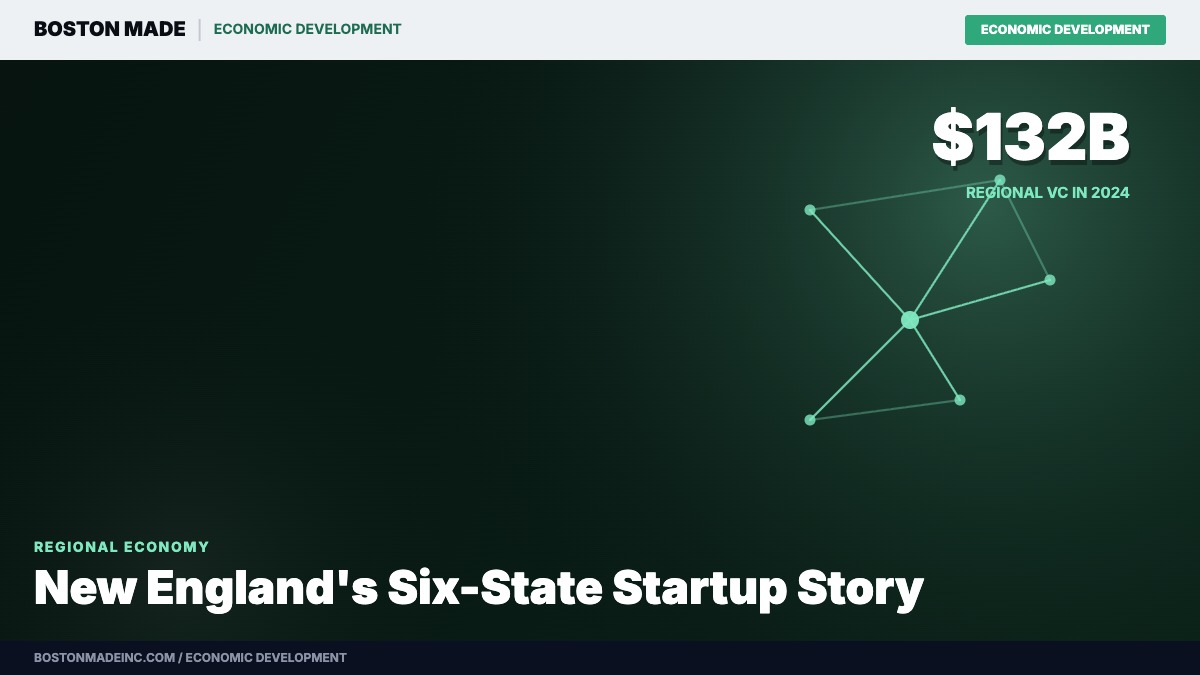
BOSTON — Zoom out from any single funding round and a bigger picture comes into focus: New England isn’t just Boston’s startup scene anymore. It’s a six-state venture capital region that, by the latest tallies from the National Venture Capital Association, is now home to roughly 2,424 VC-backed companies, 43 unicorns — good for third nationally — and annual investment that has grown from $47.8 billion in 2015 to $132.1 billion in 2024.

Massachusetts still anchors the region, but the story increasingly runs through all six states.

Biotech’s regional gravity

Healthcare and biotech remain New England’s deepest well: the region accounts for roughly 30% of all U.S. healthcare and biotech venture investment, with $78.4 billion deployed in 2024 across 863 VC-backed companies — second nationally only to the Far West. That’s the base the rest of the ecosystem builds on, feeding talent, capital, and infrastructure into everything from enterprise AI to hard tech.

Beyond biotech: fusion, defense, and the sea

Some of the region’s most ambitious bets aren’t software at all. Commonwealth Fusion Systems, spun out of MIT, continues to be one of the most closely watched fusion-energy companies in the world, working toward commercially viable fusion power from a Massachusetts base. HavocAI is building autonomous defense vessels for a Navy and allied-forces market that’s newly hungry for unmanned maritime systems. Oxylus Energy is working on converting captured carbon directly into methanol — a bet on industrial decarbonization with a real fuel at the end of it. And AutoDive is automating aquaculture, a distinctly New England industry given a distinctly modern upgrade.

Add enterprise software and AI — New England’s third-ranked sector nationally — plus a growing defense-and-aerospace cluster and serious activity in quantum and nuclear energy, and the picture is a region making concentrated bets in categories the rest of the country is only starting to take seriously.

The states outside Massachusetts are catching up on their own terms

Rhode Island has quietly built the fastest-growing investor community in the region — its base of active VC investors has grown 4.8x since 2015, a sign that capital formation is spreading well beyond Boston and Cambridge. Connecticut now ranks second in the region for VC-backed jobs, trailing only Massachusetts, evidence that the insurance and finance capital of the region is translating into real startup employment. New Hampshire, Maine, and Vermont round out a six-state footprint that, together, supports nearly 398,000 VC-backed jobs.

Why Boston Made is watching all six states

Boston Made’s own portfolio has always been built around the idea that a strong regional economy is bigger than any one city. As New England’s venture ecosystem matures beyond a Boston-only story, the companies, talent, and capital moving through Providence, Hartford, Manchester, Portland, and Burlington are increasingly part of the same story we cover here — and increasingly part of where the next generation of New England-built companies will come from.


Boston Made, Inc. tracks the companies, capital, and industries shaping the broader New England business landscape as part of its ongoing regional coverage.

Continue Reading

Small Business & Entrepreneurship

Massachusetts Small Business Owners Report Growth Ambitions Amid Persistent Cost Pressures
Nathanael Strickland

Published

on

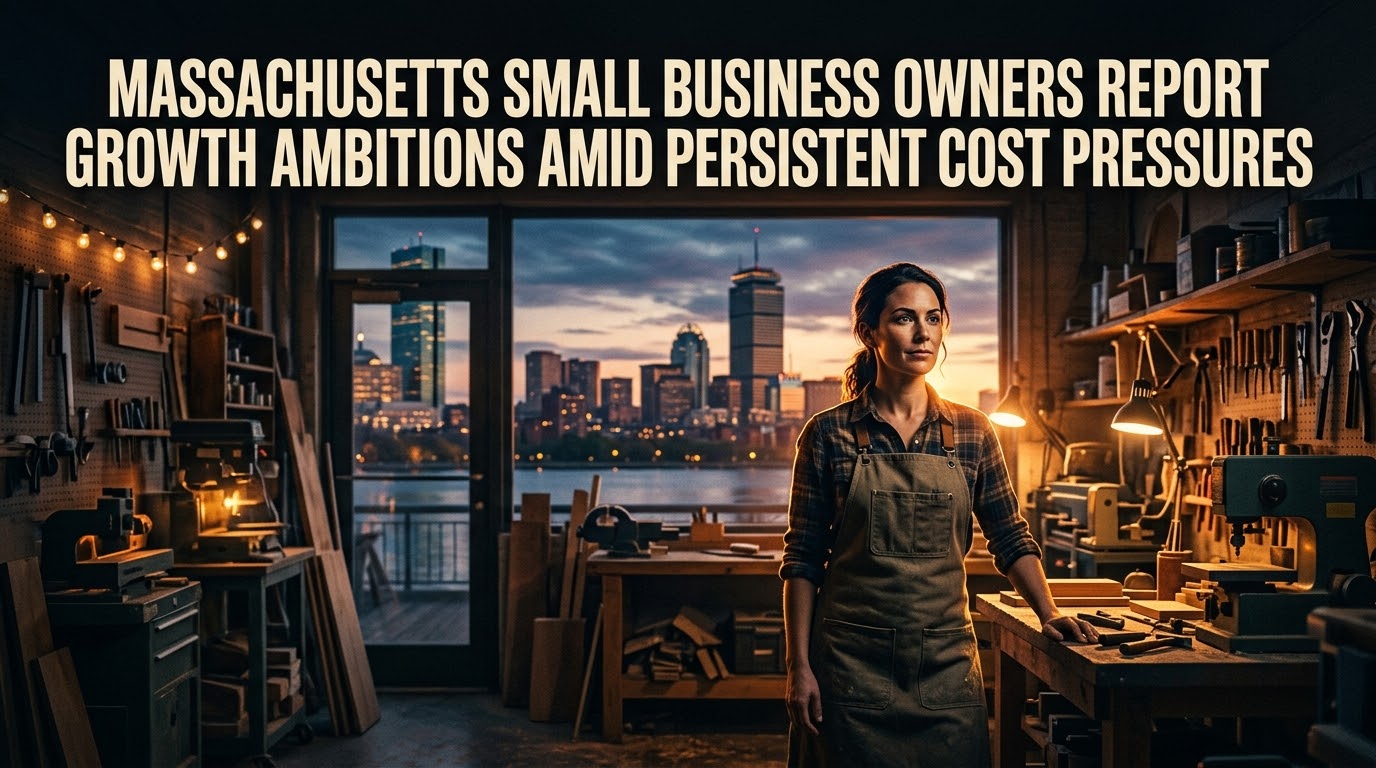
A 2025 survey of Massachusetts small businesses, conducted by the MassINC Polling Group, found a small-business landscape marked by growing diversity among ownership and generally strong growth ambitions — alongside what researchers described as critical information gaps that leave some owners underserved by existing state and local support programs. The findings, published as the “2025 Massachusetts Small Business Survey,” offer one of the more detailed recent snapshots of how the state’s smallest employers are navigating the current economic environment.

Separately, small-business advocacy organizations operating in Massachusetts, including the National Federation of Independent Business (NFIB), have continued to press state lawmakers on cost-related concerns, with NFIB’s Massachusetts chapter specifically calling for what it terms “meaningful energy reforms” to ease operating costs for small employers — a sign that energy and utility costs remain a top-of-mind issue for small business owners across the state heading into the back half of 2026.

Local business associations have echoed similar themes. The City of Boston has continued to survey business owners directly, including a summer 2026 Business Impact Survey circulated through neighborhood Main Streets organizations such as Brighton Main Streets, aimed at capturing real-time feedback from small business owners on the challenges and opportunities they are experiencing in their commercial corridors.

Taken together, the picture emerging from 2026 small-business research in Massachusetts is one of cautious optimism: owners continue to report ambitions to grow their businesses, even as they flag persistent cost pressures — particularly around energy, and more broadly around the cost of doing business in one of the country’s more expensive states. Business advocacy groups have continued to use this data to push for policy responses at both the state and municipal level.

For Boston’s small business community, which spans everything from neighborhood retail corridors to professional services firms, these survey findings offer a data-backed complement to the day-to-day experience many owners describe: a resilient but cost-constrained operating environment heading into the final months of 2026.


Sources:

Continue Reading

Economy

What Rising Costs Mean for Boston’s Small Businesses in 2026

Boston-area inflation is running at 3.7% year-over-year, led by a 16% jump in energy costs and rising shelter prices, squeezing small business margins across the region.
Nathanael Strickland

Published

on

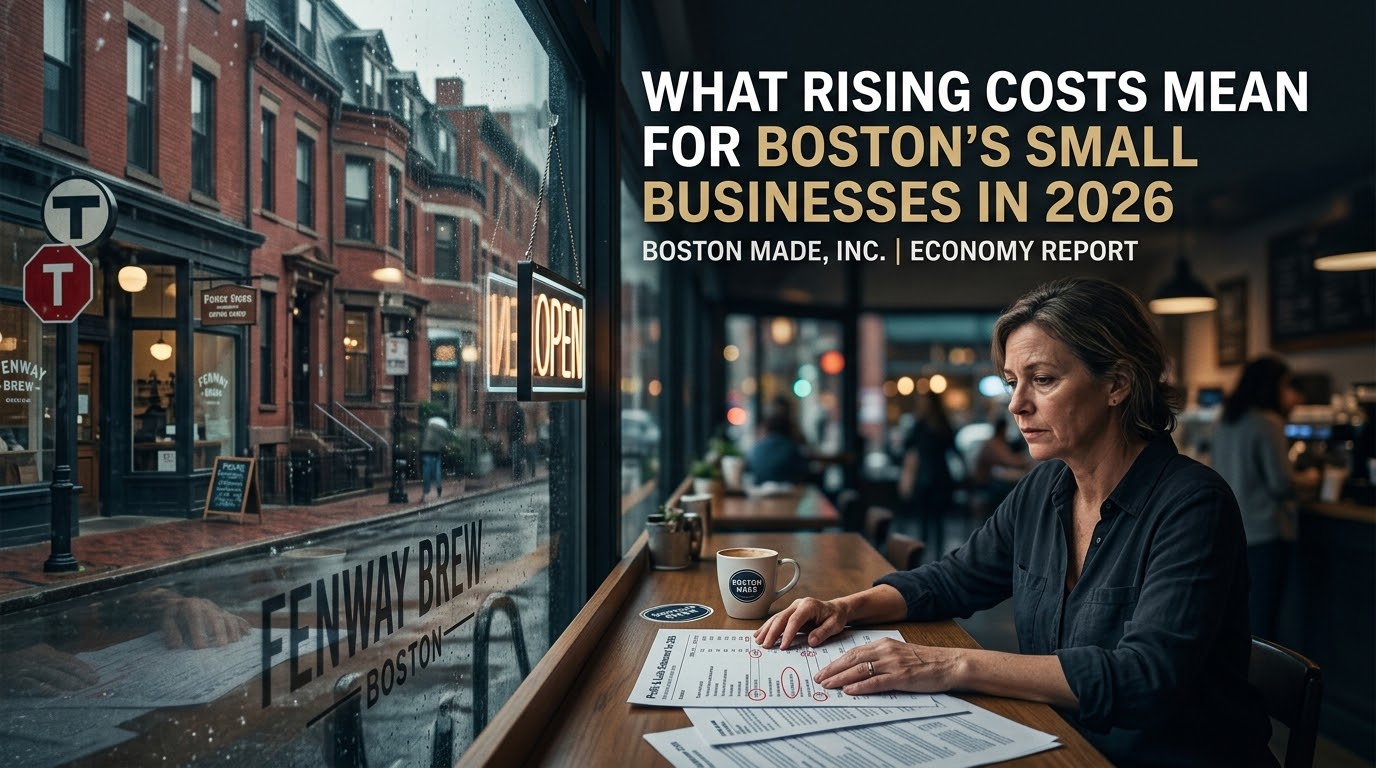
Small business owners in Greater Boston are contending with a cost environment that, while cooling in some categories, is still squeezing margins in the places that matter most: energy, rent, and labor.

What’s driving prices higher

The Boston-Cambridge-Newton metro area’s consumer price index rose 3.7% year-over-year as of July 2026, according to federal labor statistics. Energy costs are the biggest culprit, up 16.0% over the year with gasoline alone jumping 30.5%. Shelter costs — which factor into commercial as well as residential rents in many small-business leases — climbed 4.7%, and education and communication costs rose 4.5%.

Core inflation, which strips out food and energy, still expanded 3.0% over the year, with shelter again cited as the single largest contributor to price growth over the most recent two-month period.

Where businesses are catching a break

Not every cost is rising. Apparel prices actually fell 6.9% over a recent two-month stretch, and dairy prices are down 2.9% year-over-year — the lone decline among major grocery categories. For retailers and restaurants, that’s a modest offset against the bigger increases in energy and occupancy costs.

Why small businesses feel it more than big ones

Unlike large employers, most small businesses can’t hedge energy contracts or negotiate multi-year rent concessions at scale. A double-digit jump in energy costs and a near-5% rise in shelter costs hits a neighborhood restaurant or independent retailer’s bottom line directly and immediately, often faster than it shows up in headline economic data.

That squeeze is happening against the backdrop of a broader economic picture that’s sending mixed signals: statewide job growth is outpacing the national average, but biotech layoffs, corporate relocations, and population loss have all been part of the conversation about the health of the Massachusetts economy this year.

What owners can watch for

Energy and shelter costs are the two line items most likely to keep pressuring small business margins through the rest of 2026. Boston Made’s Economy desk will continue tracking regional CPI data as new releases come out, along with the state and local policy responses aimed at easing costs for small employers.

Continue Reading
Advertisement

Advertisement

Ad

Advertisement

Trending