Connect with us

Weather where you are

Choose your location or share it once. We round your coordinates to about 1 km before sending them to our site and MET Norway for your forecast. Your choice stays in this browser tab.

Stay close to Boston

Get new Boston stories and Boston Made company updates, delivered as browser notifications.

Choose Enable notifications, then allow notifications in your browser.

Your browser subscription is stored by Boston Made and delivered through your browser’s push service. You can turn notifications off in your browser’s site settings. Privacy policy

Technology

Google Moves Links Higher in AI Answers and Tests a Slot for Official Sites

Ecosystem Intelligence Desk

Published

on

tech servers

Google said on Oct. 15, 2026, that it is putting more links higher inside AI Mode and AI Overviews and testing a dedicated slot for official websites at the top of some AI answers, the clearest signal yet of which small-business pages its AI search will send people to.

What Google changed on Oct. 15

The announcement came in a post on Google’s Keyword blog titled “More ways to connect with the web from Search,” written by Hema Budaraju, a vice president of product management. It described five changes to how links appear in Google’s AI-generated answers, and they are not all at the same stage.

  • Inline links, launching. Google said it has made “continued and substantial increases” in links embedded directly in AI answer text and is now placing them higher in responses more often. It did not quantify either change.
  • Official-site section, testing. For some task-based searches, Google will test a section at the top of the answer that surfaces one or two official pages, with a short explanation of why each one is useful.
  • News carousels, rolling out. Carousels of timely articles that highlight a user’s Preferred Sources are expanding to more countries and languages. Google said use of Preferred Sources has grown more than sevenfold since the start of 2026.
  • Thumbnails on related links. Links shown at the end of some AI responses now carry image thumbnails and a more clickable design.
  • Creator names, testing. Creator and publisher names on video results in AI Mode may link to a Google Search profile.

Google gave no rollout dates, device details or country lists for the inline-link changes, the official-site test or the thumbnails, according to Search Engine Journal and The Search Spot. Google executive Nick Fox summarized the changes on X the same day and said more than 400 publications are now part of Google’s News AI pilot licensing program.

The official-site slot is the change to watch

For most local businesses, the news carousels are irrelevant and the creator test is narrow. The official-site section is different. Google described it as an extension of how it already features a site when someone searches for that business by name: for a task with only one or two authoritative destinations, the AI answer would point straight to them.

Search Engine Journal’s reading of the announcement is that clear, authoritative pages built around a specific task are the most likely to be surfaced. In practice, for a dental office that might be the page where patients book a cleaning; for a church, the page with service times and directions; for a contractor, the request-a-quote page. Google has not explained how it chooses the official page, and it has not said when the test will expand.

That uncertainty cuts both ways. A business whose booking, pricing or hours information lives in a PDF, an image or a third-party widget gives Google little to identify as the official answer. A business with one plainly written page per task gives it an obvious choice.

What Search Console will and will not show

Site owners hoping to measure the change should lower their expectations. Search Console assigns every link inside an AI Overview the overview’s single position, so a link that moves higher inside the answer will not register as a ranking improvement, Search Engine Journal noted. Google also did not commit to adding click data to its AI performance reporting. A Google representative told Search Engine Roundtable the company will “introduce additional metrics over time,” without a date.

For small businesses, that means the useful measurements will come from their own analytics: whether visits arriving from Google land on booking, quote and contact pages, and whether those visits convert.

Ads are coming to AI Mode, at least in a test

Separately, Google confirmed to Search Engine Land on Oct. 16 that it is testing ads in AI Mode for people who use Personal Intelligence, the opt-in feature that lets AI Mode draw on connected apps such as Gmail and Google Photos, according to The Keyword and other trade coverage. Google’s help documentation says those ads will not be based “directly on your Gmail inbox or your Google Photos library,” but that summaries and inferences drawn from connected apps may be used to show ads. Sensitive categories such as health, religion and sexual orientation are excluded.

Google has not announced advertiser controls, targeting options, reporting or a wider rollout. For now, the test is a signal of direction rather than a new line item in a small-business ad budget.

Meanwhile, two housekeeping items

October has also been unsettled in traditional search. Google’s September 2026 spam update began Sept. 24 and finished Oct. 8, according to Google’s Search Status Dashboard and Search Engine Roundtable. Search Engine Roundtable has since reported unconfirmed ranking volatility around Oct. 16 and again on Oct. 20 and 21, with forum reports of sharp swings in Search and Discover traffic. Google has confirmed no update for those dates.

On the WordPress side, version 7.1.3 and the 7.0.7 branch release shipped on Oct. 6. The 7.0.7 release notes list seven security fixes, including a stored cross-site scripting flaw on the Comments administration screen, a second-order SQL injection in the export tool, and a bug that disclosed comments on private and unpublished posts to unauthenticated visitors. WordPress.org says only the latest release in the 7.1 series is actively maintained, though fixes were backported to older branches.

Fenway’s Take

Every Google AI change this year has pointed in the same direction: the AI answer increasingly decides which single page deserves the click, and it rewards pages that make that decision easy. The official-site test makes the logic explicit. A small-business website now needs to be legible not only to a person skimming on a phone but to a system deciding, in a fraction of a second, which page is the authoritative place to complete a task.

That is less about clever optimization than about structure. One page per service or task, written in plain language, with the answer near the top, consistent business details across the site and its Google Business Profile, and markup that identifies the business, its location and its hours. On many small-business sites the information exists somewhere; the problem is that it is scattered across a homepage slider, a PDF menu and a contact form, none of which reads as the official answer to anything.

The measurement gap matters too. Because Search Console will not show position changes inside AI answers, owners should judge these changes by what happens on their task pages, not by rank trackers. And because ranking volatility has been unusually high this month, it is a poor time to make sweeping changes in reaction to a single week of traffic data.

What it means for you

  • List the three to five tasks customers come to your site to complete, such as booking, getting a quote or finding service times, and make sure each has one clear page that states the answer in text near the top.
  • Move critical information out of PDFs, images and embedded widgets and into crawlable page text.
  • Confirm your site is eligible for Google’s generative AI features in Search Console, which Search Engine Journal notes is a prerequisite for Preferred Source status in AI Mode and AI Overviews.
  • Update WordPress core to the latest 7.1 release if your host has not already done it, and check that comment moderation and export tools are restricted to trusted accounts.
  • Measure AI search traffic by conversions on task pages in your own analytics, and avoid redesign decisions based on this month’s ranking swings.

Test yourself

1. Which of Google’s Oct. 15 changes is still a test: inline links or the official-site section?

Answer: The official-site section; Google said it is launching more and higher inline links, but only testing the dedicated slot for official pages.

2. Why won’t a link moving higher inside an AI Overview show up as a ranking gain in Search Console?

Answer: Search Console assigns every link in an AI Overview the overview’s single position, regardless of where the link sits inside it.

3. How much has use of Google’s Preferred Sources feature grown in 2026, according to Google?

Answer: More than sevenfold since the start of the year, though Google gave no baseline figure.

4. How many security fixes did WordPress 7.0.7 include?

Answer: Seven, released Oct. 6, 2026, alongside WordPress 7.1.3.

Discussion

  1. If Google’s AI answers increasingly send people to a single official page, does that help small local businesses compete with national directories, or hurt them?
  2. Should Google be required to report clicks from AI answers in Search Console before expanding features that change where those clicks go?
  3. Would you be comfortable seeing ads in AI Mode shaped by inferences from your connected apps, even if they are not based directly on your inbox?

From the network

The post Google Moves Links Higher in AI Answers and Tests a Slot for Official Sites appeared first on Fenway Web.

The institutional news desk of the Boston Made network. Reporting is researched from wire services including The Associated Press and local sources, and written by the desk.

Technology

Flying Cars Are Getting Real: Where Air Taxis Stand in October 2026, and the Math That Lifts Them

Joby flew real routes over Dallas–Fort Worth in September, Archer named a Texas network in October and BETA joined seven of eight federal pilot programs. None is FAA-certified yet. Here is where things stand, with the four equations that decide whether a flying car works.

Ecosystem Intelligence Desk

Published

on

Joby Aviation S4 electric air taxi on a taxiway at Edwards Air Force Base, California

Electric air taxis are no longer only renderings. In September 2026, an electric air taxi flew real routes over Dallas–Fort Worth under a federal pilot program. Three U.S. developers, Joby Aviation, Archer Aviation and BETA Technologies, are flying aircraft designed for commercial service. None has an FAA type certificate for them yet. Here is where things stand, what the companies themselves have said, and the physics and math that decide whether a “flying car” can work.

What actually happened in 2026

  • A federal pilot program started. The U.S. Department of Transportation and the FAA picked the first participants in the eVTOL Integration Pilot Program (eIPP) in March 2026. The FAA lists eight participating governments: the Florida, Utah, Texas, North Carolina and Pennsylvania transportation departments, Louisiana DOTD, the City of Albuquerque and the Port Authority of New York and New Jersey. The FAA says the program “does not bypass certification” and is expected to run for three years after the first project becomes operational.
  • Joby Aviation flew in North Texas. From September 10 to 14, 2026, Joby flew a week-long campaign around Dallas–Fort Worth under TxDOT’s Project Nexus. The flights covered Perot Field Fort Worth Alliance Airport, a landing inside DFW Airport’s controlled airspace, a round trip to Arlington and the planned route to Toyota Motor North America’s Plano campus (Hillwood press release, Sept. 10, 2026).
  • Joby is in the last certification stage. Joby’s first FAA-conforming aircraft, registration N547JX, began flight testing in March 2026 (Joby press release, March 11, 2026). Joby’s Q2 2026 shareholder letter (Aug. 5, 2026) says the company has reached “the fifth and final stage” of FAA type certification. It reported $38.6 million in quarterly revenue and a $245.4 million net loss.
  • Archer named its Texas network. On October 23, 2026, Archer Aviation said it plans air taxi service linking the Dallas–Fort Worth, Houston and Austin areas. It would use its four-passenger Midnight aircraft on flights of 10 to 20 minutes. Archer did not give a start date, and Midnight has not received FAA type certification (AIAA, Oct. 23, 2026).
  • BETA Technologies was picked for the most programs. BETA said it was selected for seven of the eight eIPP launch programs, more than any other electric aircraft developer. It plans cargo and medical logistics with its ALIA aircraft, starting with conventional takeoff and landing (BETA press release, March 9, 2026).
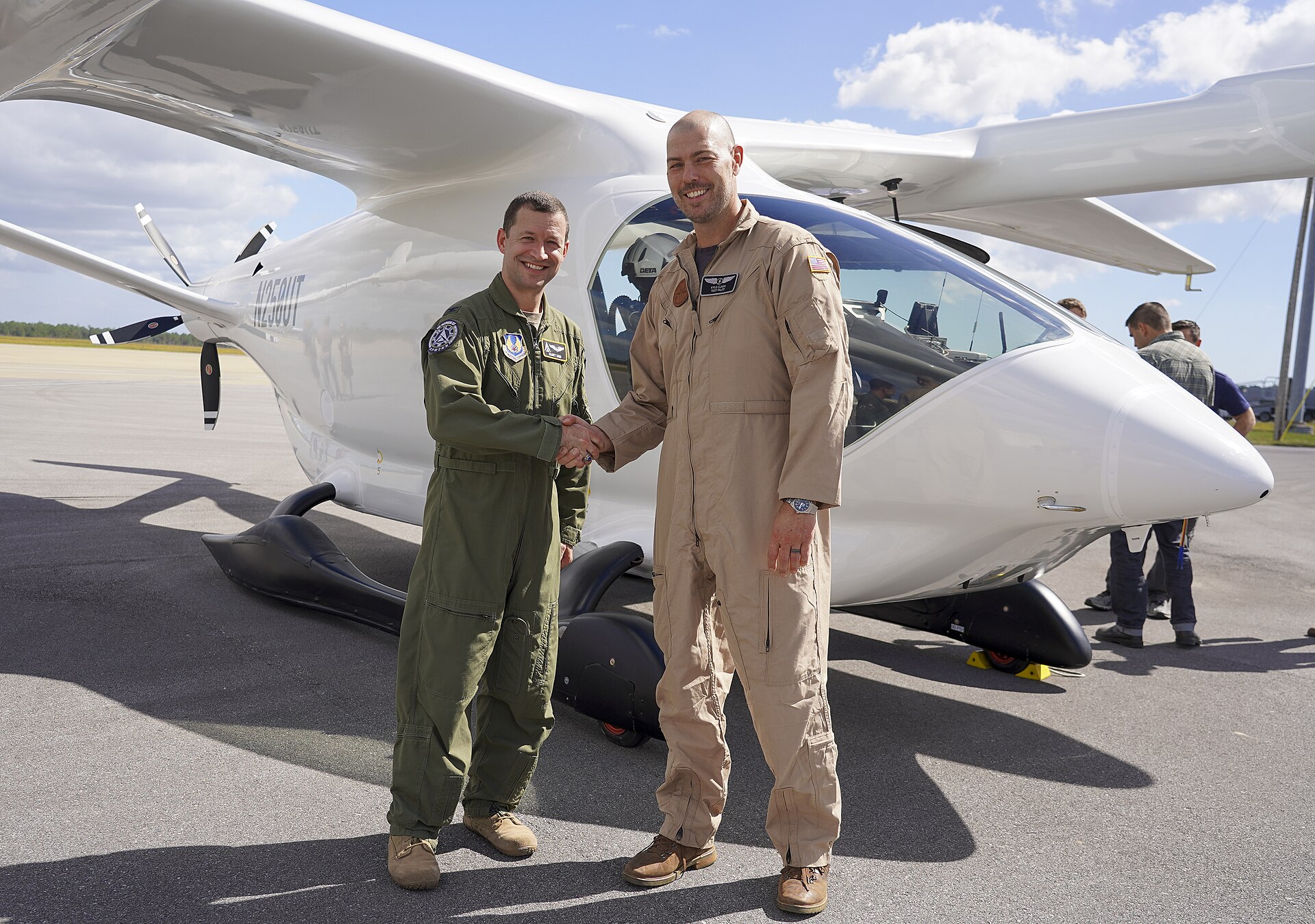
BETA Technologies ALIA electric aircraft delivered to the U.S. Air Force at Duke Field, Florida
BETA Technologies’ ALIA at Duke Field, Florida, on its delivery to the U.S. Air Force for testing, Oct. 26, 2023. U.S. Air Force photo by Jennifer Bryant (public domain).

The math of a flying car

A car only has to push itself forward. A vertical-takeoff aircraft first has to hold its whole weight up on air. Four short equations show why that is hard, and why designers lift off on rotors and then cruise on wings. The numbers below are a worked example for an imaginary 2,000 kg aircraft. They are not any company’s published figures.

Advertisement

1. Thrust to hover

T = m · g

With m = 2,000 kg and g = 9.81 m/s², the rotors must push down about 19.6 kN, about the weight of a mid-size SUV, without any help from wings.

2. Power to hover (momentum theory)

Pideal = T3/2 ÷ √(2ρA)

ρ is air density (1.225 kg/m³ at sea level) and A is the total area swept by the rotors. With 30 m² of rotor disk, the ideal answer is about 320 kW. Real rotors lose some of that. Dividing by a typical efficiency (“figure of merit”) of 0.7 gives roughly 460 kW, about the output of several family cars at full throttle. Bigger rotor area means less power, which is why these aircraft have so many propellers.

3. Why they switch to wings

L = ½ ρ v² S CL

At 150 mph (67 m/s), a wing of about 14 m² with a lift coefficient of 0.5 carries the same 19.6 kN. The power then falls to weight × speed ÷ lift-to-drag ratio. With a lift-to-drag ratio of 10 and 85% drivetrain efficiency, cruise needs about 155 kW, a third of the hover figure.

Advertisement

4. The battery budget for a 25-mile hop

E = Pcruise · tcruise + Phover · thover

Ten minutes of cruise at 155 kW is about 26 kWh. Two minutes of hovering at 460 kW for takeoff and landing adds about 15 kWh, for roughly 41 kWh plus reserves. At 250 Wh per kilogram of battery, that energy alone weighs about 165 kg. This is why short hops, fast charging and lighter batteries decide the business case.

Try it yourself: open Tools → Flight in the bar at the bottom of this page. Change the mass, rotor area or air density and the hover equations update as you type. Tools also has a trip-cost calculator comparing gas and electric, plus loan, savings and equation solvers.

What it means for Massachusetts

None of the eIPP projects named so far are in Massachusetts. The Port Authority of New York and New Jersey’s application covers operations across New England, according to Joby’s March 9, 2026 announcement. For Boston-area businesses, the near-term effects are likely to show up first in cargo and medical logistics, the work BETA and its partners are targeting. Passenger air taxis come after that. Watch for three things: FAA “for credit” test flights, the first type certificate, and local vertiport and noise rules.

What to watch next

  • Whether Joby or Archer receives an FAA type certificate. Neither has one yet.
  • More eIPP flights in the other participating states, and the data the FAA says it is collecting from them.
  • Start dates for Archer’s Texas network, which it has not announced.

Sources

Photos: U.S. Air Force photos by Harlan Huntington (Joby S4, Edwards Air Force Base, Sept. 20, 2023) and Jennifer Bryant (BETA ALIA, Duke Field, Oct. 26, 2023), both public domain via Wikimedia Commons. The worked example uses textbook physics and round, illustrative inputs. It does not describe any company’s aircraft. This article is for information only and is not investment advice.


Fenway Web Boston Made family Fenway Web Web design, development and SEO studio — custom websites for small businesses, churches and local brands. Visit site →

Advertisement

Continue Reading

Service

PHP 8.2 Loses Security Support on December 31. Here’s the 10-Week Plan for Your Website.

Ecosystem Intelligence Desk

Published

on

tech servers

Most small-business websites are built on WordPress, and WordPress runs on PHP. On December 31, 2026, PHP 8.2 reaches end of life: no more security fixes, ever. Any site still on it after that date is running software that will not be patched when the next vulnerability is found.

Where each version stands

  • 8.1 and older: support already ended Dec. 31, 2025. Upgrade now.
  • 8.2: support ends Dec. 31, 2026. Upgrade before year-end.
  • 8.3: supported through Dec. 31, 2027. A safe target.
  • 8.4: supported through Dec. 31, 2028. The best target if your plugins support it.

The 10-week plan

  1. This week: find out what you run. In WordPress, go to Tools → Site Health → Info → Server. Your host’s control panel shows it too.
  2. Weeks 2–3: back up everything. Files and database, stored off the server. Test that the backup actually restores.
  3. Weeks 3–4: update plugins and theme. Abandoned plugins, with no update in a year or more, are the most common reason an upgrade breaks a site. Replace them now.
  4. Weeks 5–6: test on staging. Most hosts let you clone a site. Switch the copy to 8.3 or 8.4 and click through forms, checkout and logins.
  5. Weeks 7–8: switch production. Pick a quiet day, change the version in your hosting panel, and watch for errors for 48 hours.
  6. Weeks 9–10: clean up. Remove unused plugins and themes, and turn on automatic minor updates.

Why it matters beyond security

Newer versions are also faster, which helps page speed and search rankings. And WordPress 7.0, released in May, raised its minimum requirement to 7.4. Very old setups are already being left behind on new features.

Advertisement

Not sure what your site runs on? Fenway Web will check your server version, plugins and backups for free and tell you exactly what needs to change. Request a site check →

Sources: HeroDevs support timeline · DreamHost on WordPress 7.0. Written by the Ecosystem Intelligence Desk.

The post PHP 8.2 Loses Security Support on December 31. Here’s the 10-Week Plan for Your Website. appeared first on Fenway Web.

Pupwear Boston Made family Pupwear Dog apparel and gear inspired by Boston the GoldenDoodle. Visit site →

Advertisement

Continue Reading

Technology

AI Stocks Rebound, but the Infrastructure Bill Is Still Coming Due

Ecosystem Intelligence Desk

Published

on

markets screen
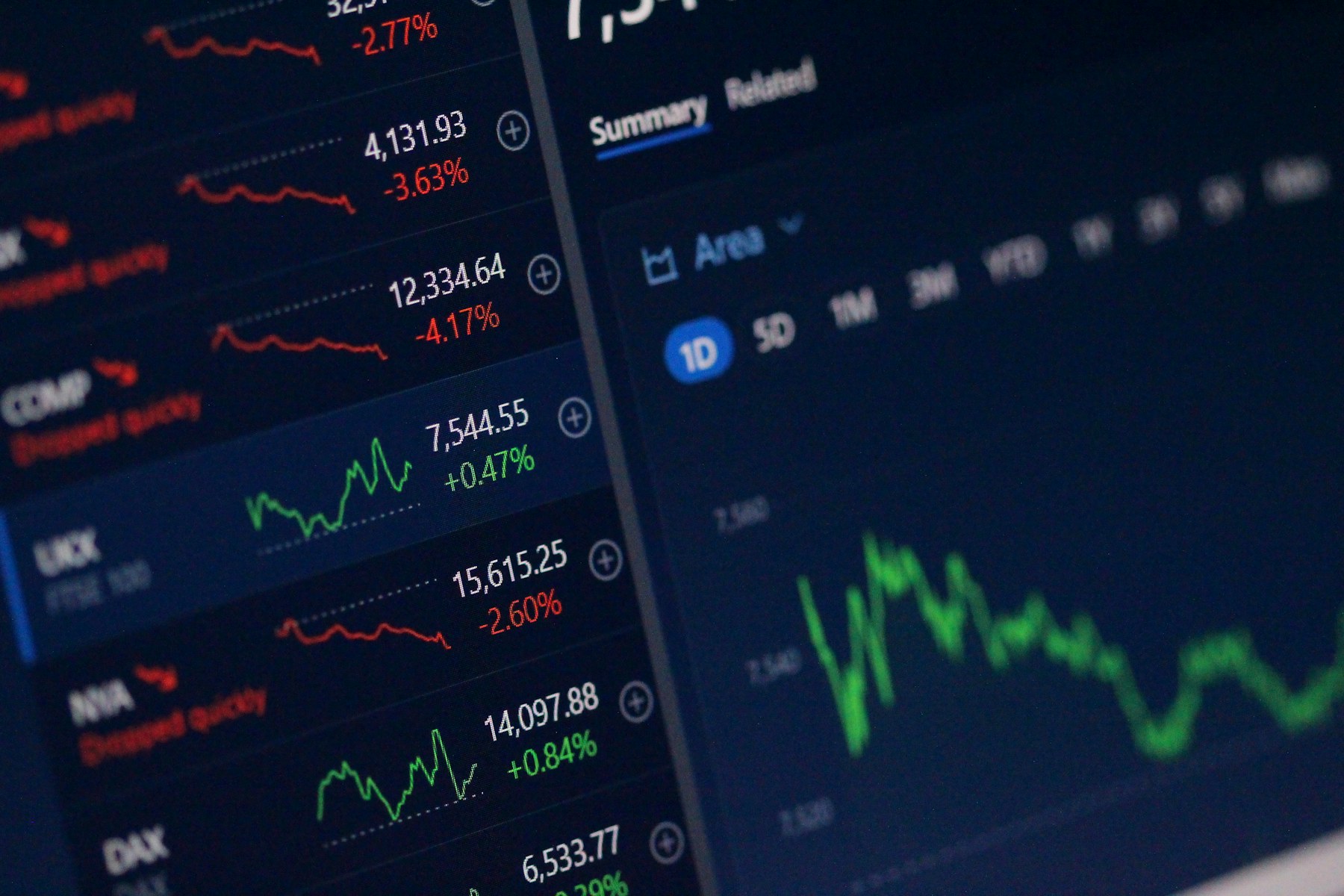
Illustrative image from Boston Made media library. Editorial analysis based on Associated Press reporting.

Boston Made Newsroom Briefing — October 21, 2026. Wall Street’s latest AI rebound came with a warning label: investors may still believe in the technology, but they are paying closer attention to the cost of building it.

Associated Press reports that the S&P 500 rose 0.7%, the Dow gained 286 points and the Nasdaq climbed 1.2% as stronger results from SpaceX, Capital One and other companies helped offset disappointing updates from Netflix and AT&T. SpaceX rose 6.9% after reporting better-than-expected summer profit, while Nvidia and Super Micro Computer also helped lift the market.

Advertisement

The broader signal is more useful than any single day’s market move. AP notes that AI-linked shares have become volatile as higher borrowing costs raise questions about how quickly data-center construction can continue. Super Micro said demand for AI platforms remained stronger than previously expected, but companies still have to finance power, cooling, networking, land and specialized equipment before those systems produce revenue.

What operators should watch

For Boston-area businesses, the infrastructure story is becoming a practical operating issue rather than a distant technology headline. Vendors that can document power availability, cooling capacity, deployment timelines and customer demand will have an easier time separating durable projects from speculative announcements.

That means the next phase of the AI market may reward execution more than excitement: reliable facilities, disciplined capital plans, and measurable productivity gains. A market rally can confirm that investors are interested; it cannot, by itself, prove that every proposed data-center buildout will earn an acceptable return.

Our read

Boston Made’s view is that AI infrastructure should be evaluated like any other major operating investment. Ask what is being built, who is paying for it, when it can run, and what evidence exists that customers will use it. The companies that answer those questions clearly will be better positioned if financing stays expensive or demand becomes more selective.

Source note: This is an original Boston Made editorial analysis based on Associated Press reporting on Wall Street, SpaceX and AI stocks. Boston Made does not reproduce AP copy. Figures and market descriptions reflect the AP report published October 21, 2026.

Kingswell Strategic Ventures Boston Made family Kingswell Strategic Ventures Holding company that owns Boston Made, Inc. and Paxton-Digital, and sets long-term strategy. Visit site →

Advertisement

Continue Reading
Advertisement

Advertisement

Ad

Advertisement

Trending

--:--·---·--°