Connect with us

Weather where you are

Choose your location or share it once. We round your coordinates to about 1 km before sending them to our site and MET Norway for your forecast. Your choice stays in this browser tab.

Stay close to Boston

Get new Boston stories and Boston Made company updates, delivered as browser notifications.

Choose Enable notifications, then allow notifications in your browser.

Your browser subscription is stored by Boston Made and delivered through your browser’s push service. You can turn notifications off in your browser’s site settings. Privacy policy

Corporate News

Boston Sports as Big Business: A Record $6.1 Billion Celtics Sale and a Hall of Fame Nod for Robert Kraft

Nathanael Strickland

Published

on

BOSTON — Boston’s sports franchises aren’t just championship machines — they’re some of the most valuable businesses in the city, and 2026 has delivered two reminders of exactly how valuable.

The Celtics sale: a record-setting transaction

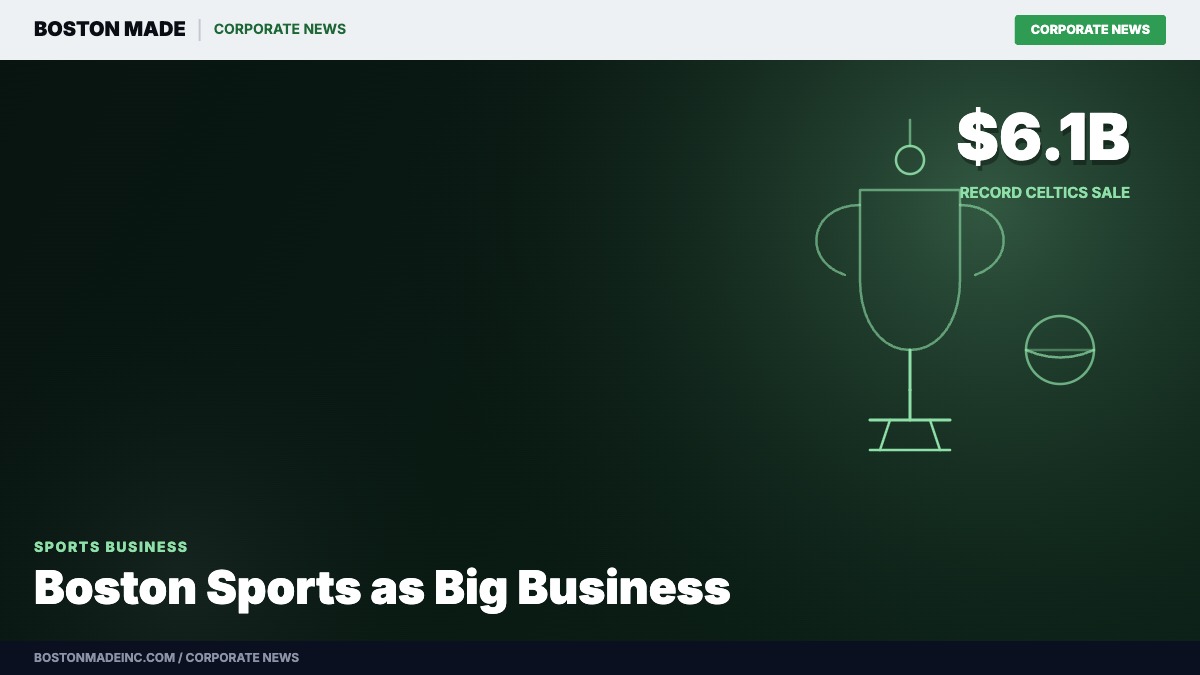
The NBA has unanimously approved the sale of the Boston Celtics at a $6.1 billion valuation — the largest sale price for an American professional sports franchise in history, surpassing the Washington Commanders’ $6.05 billion NFL sale in 2023 and nearly doubling the NBA’s previous record, the Phoenix Suns’ $4 billion deal that same year. The agreement, structured to reach as much as $7.3 billion by 2028 as the buying group assumes full control, closes the book on Wyc Grousbeck’s ownership era, which began in 2002 when his group paid $360 million for the franchise and went on to deliver NBA championships in 2008 and 2024.

The new majority owner is Bill Chisholm, a Massachusetts native and private equity executive who leads Symphony Technology Group, joined by Boston businessman Rob Hale and co-owner Bruce Beal Jr. Chisholm’s group takes at least 51% ownership immediately, with a path to full control by 2028. Sports business analysts have pointed to the Celtics’ record 18 NBA championships and one of the league’s most engaged fan bases as the foundation for a valuation that reframes what a marquee American sports franchise is actually worth.

Robert Kraft: three decades of shaping how football gets watched

A different kind of recognition landed for Robert Kraft this year. The Patriots owner since 1994 was elected to the Sports Broadcasting Hall of Fame’s Class of 2026, joining nine other inductees including Troy Aikman and Robert Iger, as voted on by a committee of more than 175 sports television professionals. The induction ceremony is set for December 15, 2026, at the New York Hilton.

The honor recognizes Kraft’s three-decade role guiding the NFL’s Broadcast and Media Committees, where he helped negotiate the broadcast and digital partnerships that turned NFL football into what the Hall of Fame’s voting body called “the gold standard of professional sports” media rights. The organization specifically credited Kraft with helping “shape the way fans consume NFL content” while balancing the interests of the league, its media partners, and fans themselves. On the field, the Kraft-owned Patriots delivered six Super Bowl championships and eleven Super Bowl appearances — a run that, combined with his broadcast-strategy influence, made the Kraft ownership era one of the most consequential in modern NFL business history.

(Kraft was also among the finalists for the separate Pro Football Hall of Fame’s Class of 2026, though he was not among those ultimately elected to that hall this cycle.)

What it says about Boston’s sports economy

Two different honors, two different institutions, one shared thread: Boston’s sports ownership groups are increasingly recognized not just for what happens on the field or court, but for how they run the business behind it. A record-breaking franchise sale and a broadcasting-industry hall of fame induction are, in their own ways, both stories about the same thing — Boston sports as serious, durable business, not just entertainment.


Boston Made, Inc. covers the business side of the New England sports industry as part of its ongoing regional business coverage.

Founder of Boston Made, Inc., a Boston-based media and business portfolio company. I lead Boston Made's independent, hyperlocal coverage of Boston's economy, businesses, and neighborhoods, alongside a growing portfolio of Boston-rooted brands — including Boston Made Pets, where my passion for dog wearables and canine wellness lives on. I’m an avid reader and journaler who believes in reporting that's closer to home.

Corporate News

Boston-Based BOSSTOX Launches AI Infrastructure Intelligence Platform for Analysts and Investors

Boston-based BOSSTOX has released a new subscription platform tracking the evidence behind the AI infrastructure buildout — power, cooling, compute, and the companies making it possible.

Nathanael Strickland

Published

on

Boston-based BOSSTOX has launched a new subscription intelligence platform focused on the physical and digital infrastructure underpinning the artificial intelligence buildout, the company announced this month.

The product, called BOSSTOX AI Infrastructure Intelligence, tracks evidence across power generation and grid interconnection, transformer supply chains, data center construction, cooling technology, servers and networking equipment, and cloud capacity commitments from major hyperscalers.

Rather than forecasting where artificial intelligence models or applications are headed, the platform is built around what the company calls an “evidence layer” — a structured, citation-backed database of public filings, procurement records, construction permits, operator announcements and company disclosures. BOSSTOX says the system is configured with OpenAI-powered analysis but maintained with human review at every step, and that no relationship in the dataset is inferred without a cited source.

BOSSTOX is offering the product across three subscription tiers: a $299-per-month Monitor plan built around bottleneck monitoring and a weekly signal digest; a $799-per-month Signal plan aimed at deeper intelligence briefs and analyst-ready research; and a $1,500-per-month Enterprise plan that includes managed intelligence, private briefings and portal access.

The launch is aimed at analysts, researchers and investors looking for a structured view of where AI infrastructure capital is flowing and where supply constraints are forming, according to the company. BOSSTOX, part of the Boston Made, Inc. family of brands, also operates an educational membership site at info.bosstox.com offering source-grounded market-literacy content; the company notes that its educational content and tools are for informational purposes only and do not constitute investment, financial, legal or tax advice.

The AI Infrastructure Intelligence platform is available now at bosstox.com.

Continue Reading

Banking & Finance

Two Massachusetts IPOs, One Regulatory Road: Understanding S-1s, Red Herrings, and the Lawyers Behind the Deal
Nathanael Strickland

Published

on

BOSTON — Two very different Massachusetts companies filed to go public this year, and together they’re a useful crash course in how the public-markets side of business actually works — the paperwork, the terminology, and the lawyers behind both.

Two real IPOs, two different stories

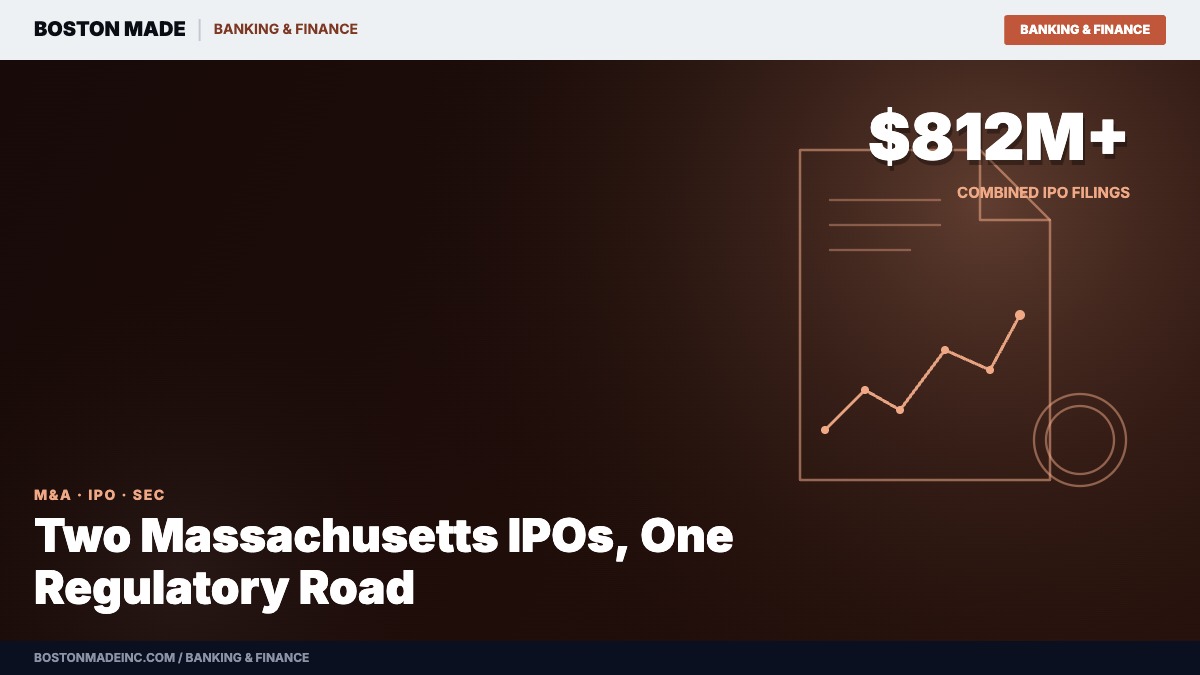
Hometown Financial Group, the Easthampton-based parent of several Massachusetts community banks, filed an S-1 registration statement with the SEC on September 10, 2026, seeking to raise between roughly $510 million and $690 million — with room to grow to nearly $794 million — in an offering priced at $10.00 per share under the ticker HFG on Nasdaq. The offering is tied to a mutual-to-stock conversion: Hometown Financial Group, MHC will cease to exist as a mutual entity, replaced by a newly incorporated public holding company. The proceeds are earmarked for a specific purpose — financing the company’s $160 million acquisition of Bedford, New Hampshire-based Primary Bank, repaying a $135 million senior note coming due in 2027, and covering an Employee Stock Ownership Plan obligation.

A few miles away, Seaport Therapeutics, a Boston-based biotech developing antidepressant and anti-anxiety treatments, filed its own registration with the SEC for a $212.4 million IPO, offering 11.8 million shares in a $16–$18 range that would value the company near $912 million at the top end. Founded in 2024 and roughly half-owned by PureTech Health, Seaport is led by CEO Daphne Zohar, who previously co-founded Karuna Therapeutics — the company Bristol-Myers Squibb acquired for $14 billion in 2024. Seaport expects Phase 2 depression-treatment trial results in the first half of 2027.

Different industries, different sizes, same regulatory road: an S-1 filed with the SEC, a roadshow, and a market that will ultimately decide the price.

What a “Red Herring” actually is

The M&A and IPO world is full of jargon that sounds more mysterious than it is. Boston Made’s own brand-advisory arm puts it plainly on its Mergers & Acquisitions page: “A ‘Red Herring’ is the industry term for a preliminary prospectus — a red-flagged draft disclosure document, named for the red-ink notice on its cover, used ahead of a formal public offering to describe a company’s business, financials, and risks before pricing is finalized.” Both Hometown Financial Group’s and Seaport Therapeutics’ S-1 filings are, at this stage, functioning exactly like that — public, but explicitly preliminary, with final pricing still to come.

Where attorneys and privilege fit in

Every serious M&A process or public offering runs on legal infrastructure most outside observers never see. Company counsel drafts and negotiates the disclosure documents. Attorney-client privilege protects the internal deliberations — valuation debates, risk disclosures, negotiating strategy — that happen before anything becomes public. Due diligence generates enormous volumes of documentation: cap tables, material contracts, litigation history, IP assignments, regulatory filings — all of it reviewed by counsel on both sides before terms are finalized. None of that is unique to Hometown Financial Group or Seaport Therapeutics; it’s simply how public offerings and acquisitions get done, at every scale.

Boston Made’s own M&A process, outlined on the page linked above, mirrors that structure: a submission, an automatic NDA, a documentation request that explicitly includes preliminary Red Herring materials where relevant, a structuring-and-terms phase conducted “with you and your counsel,” and finally a close-and-integration stage — or, for companies pursuing a public listing rather than an acquisition, a hand-off to Bosstox.com. As that page notes plainly: it describes a process, not legal, financial, or investment advice.

Why it’s worth understanding

Boston’s public-markets activity this year — from a 100-plus-year-old community bank going public to fund an acquisition, to a four-year-old biotech chasing a $900 million valuation — shows the range of companies working through this exact machinery right now. Understanding the vocabulary doesn’t require a law degree. It just requires someone willing to explain it plainly, which is what this page is for.


This article is for informational purposes only and does not constitute legal, financial, or investment advice. Boston Made, Inc. is not affiliated with Hometown Financial Group or Seaport Therapeutics. Businesses considering a sale, acquisition, or capital raise can learn more about Boston Made’s own process at brands.bostonmade.com/mergers-acquisitions.

Continue Reading

Corporate News

Boston Made Debuts “Live Life Smartly,” a New Fiction Saga Spotlighting Bosstox and Lumo

Boston Made has published the first chapter of “Live Life Smartly,” a new fiction saga about smart money, hosted on Boston Made and inspired by Bosstox and Lumo.

Nathanael Strickland

Published

on

Boston Made has published the opening chapter of “Live Life Smartly,” the newest entry in its Fiction series — joining The Kingswell Chronicles and The Paxton-Digital Chronicles as narrative stories inspired by real brands across the Boston Made network.

Boston street

A Story About Two Kinds of Smart

Unlike the previous two Chronicles, this saga is hosted on Boston Made’s flagship site rather than the Newsroom. “Live Life Smartly” follows Dana Reyes, a Dorchester barbershop owner learning to navigate money the hard way — first through Bosstox‘s philosophy of diversifying deliberately, then through Lumo‘s transparent, local marketplace for unlocking the value of gold she already owns instead of settling for a lowball pawn-shop offer.

Part of a Growing Fiction Series

Boston Made’s Fiction series pairs dramatized storytelling with the real products and philosophy behind its portfolio companies — each story closing with a reminder that the narrative is fiction, but the tools underneath it aren’t. “Live Life Smartly” is Book One of an ongoing story, with future chapters planned as the series continues.

Read the full story on Boston Made →


This is a news item about a work of fiction. “Live Life Smartly” does not depict real people or events, and nothing in it is financial advice.

Continue Reading
Advertisement

Advertisement

Ad

Advertisement

Trending