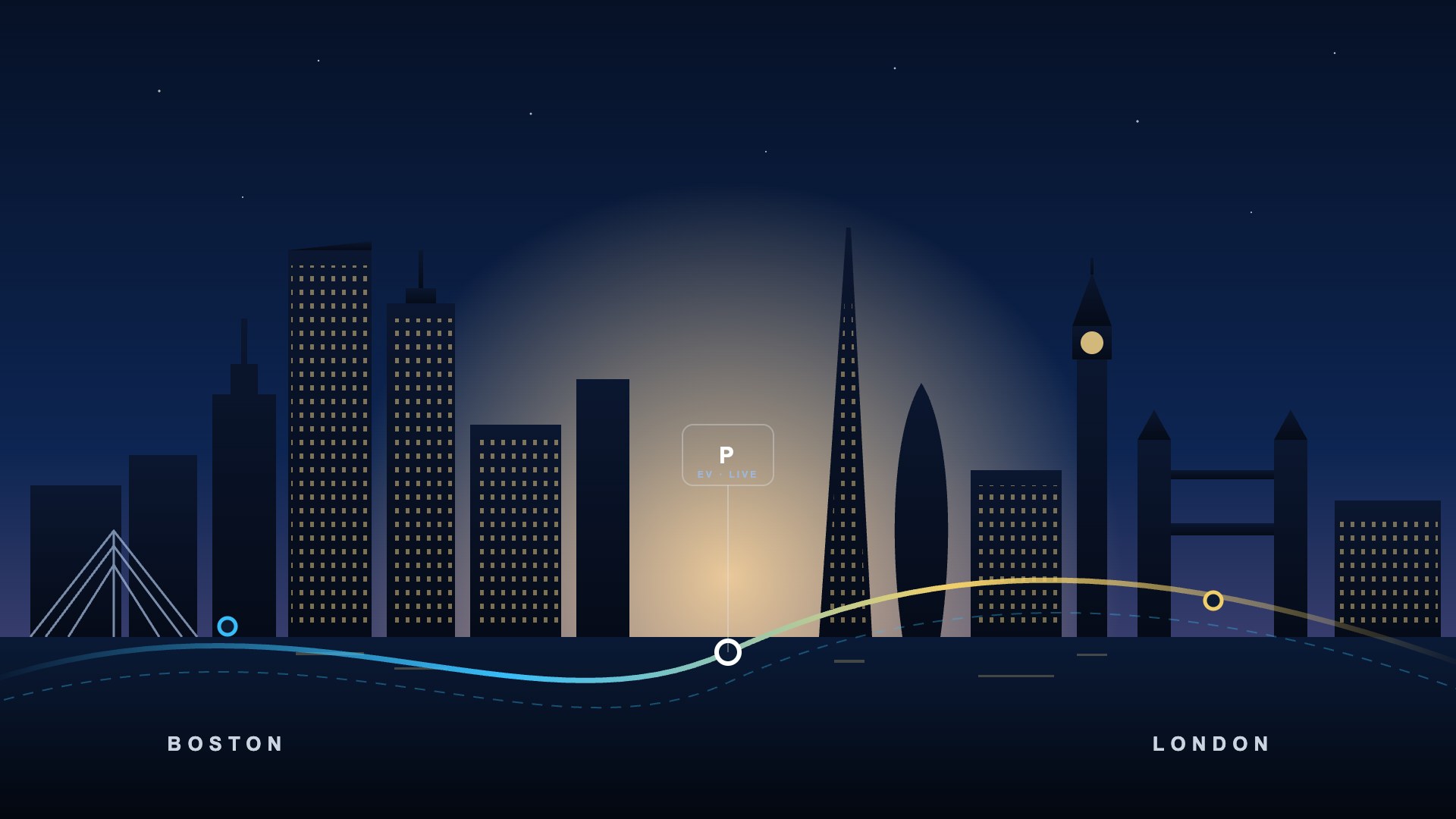
Two and a half centuries after Boston dumped British tea into its harbour, the conversation between Boston and Britain is about something else entirely: how to move people through old, beautiful places without letting cars take them over.
From George III to Charles III
Boston’s relationship with the British Crown began with a dispute about trade. The Townshend Acts of 1767 put duties on glass, paper and tea. The Tea Act of 1773 revived the argument over taxation without representation, and on 16 December 1773 colonists emptied 340 chests of East India Company tea into Boston Harbor. London answered with the Boston Port Act of 1774, which closed the harbour to commerce until the tea was paid for. (Massachusetts Historical Society)
The relationship today looks very different. The United Kingdom is among the largest foreign employers in Massachusetts (Global Business Alliance), and ideas now cross the Atlantic as readily as goods. One of the most interesting of those ideas concerns the street itself: who it is for, and how much of it the car should be allowed to take.
Why British towns need a different kind of mobility
Many British cities and market towns were laid out long before the car. Their streets are narrow, their centres are protected, and every surface car park or new gantry competes with the character people value. Congestion is real: INRIX’s 2025 Global Traffic Scorecard found London drivers lost 91 hours to traffic, with Bristol (64 hours), Manchester (62) and Leeds (59) close behind, and the average UK driver lost 59 hours, at a cost of about £822 each. (INRIX)
At the same time the vehicle fleet is changing. Under the UK’s zero emission vehicle mandate, 33% of new cars sold in 2026 must be zero-emission. Sales of new pure petrol and diesel cars are set to end in 2030, with hybrids allowed until 2035, although the 2030 trajectory is currently under review. (GOV.UK) By 1 July 2026 there were 121,171 public charging devices in the UK. (DfT)
The question for British towns is therefore not whether cars will change, but where they will park and charge without cluttering the streets people want to walk on.
The King’s long argument about the street
Few public figures have argued about the built environment for as long as King Charles III. As Prince of Wales he told the Royal Institute of British Architects in 1984 that a proposed National Gallery extension was “a monstrous carbuncle on the face of a much-loved and elegant friend”, and in 1989 he set out his principles in the book A Vision of Britain: human scale, local character, and places designed around people rather than traffic. (RIBA Journal)
Poundbury: the experiment
Those ideas were tested at Poundbury, an urban extension of Dorchester in Dorset built on Duchy of Cornwall land. Léon Krier was appointed masterplanner in 1988 and building began in 1993. Irregular street layouts slow traffic, every neighbourhood is designed to be within about a five-minute walk of its centre, homes sit alongside shops and workshops, and utilities run underground rather than on poles. (Institution of Civil Engineers) The Duchy has since applied similar principles at Nansledan, near Newquay.
Poundbury has its critics, and the evidence is worth taking seriously. A 2023 Centre for Cities review found that residents still rely heavily on cars: only 17% of households have no car and 55% drive to work, largely because there are not enough local jobs. (Centre for Cities) Good street design, in other words, changes how a place feels, but it does not by itself remove the car. The car still has to go somewhere.
Stewardship, not endorsement
The King has also spent decades on environmental causes, from the Sustainable Markets Initiative launched in 2020 to the Terra Carta of 2021. As monarch he has said he can no longer give his time to those causes as before, and he remains politically neutral. Nothing here suggests he endorses any company, including ours. What we take from his work is a design principle: infrastructure should serve a place quietly, not dominate it.
Smart parking as the invisible grid
That principle points to a practical conclusion. If historic streets are to stay walkable while the fleet electrifies, parking and charging need to move off the kerb and into places that are dense, safe and largely out of sight. That is the problem Boston Made is planning to work on in the UK.
Boston knows something about hiding infrastructure. The Central Artery/Tunnel Project, the Big Dig, replaced an elevated highway through downtown with tunnels, created more than 300 acres of open land including the Rose Kennedy Greenway, and, according to the state, cut vehicle hours of congestion by 62%. (Mass.gov) It was also famously expensive and late, which is its own lesson: invisible infrastructure pays off only when it is planned carefully.
Our concept combines three layers:
- Booking and hospitality. Drivers reserve a space or EV charging slot in advance, priced in pounds, so fewer cars circle looking for a space.
- Sensing. Pressure-sensitive flooring and cameras confirm where vehicles are and that people have walked clear before any automated equipment moves.
- Automated storage. Caster-based guided vehicles move cars into dense storage, so a site can hold more vehicles in less space, and charging bays can be monitored for heat and isolated automatically.
The details, including the UK rules we would build around, are on our UK smart parking page.
A roadmap for working with British places
Public-private alignment
Any UK site starts with the local planning authority and, where relevant, heritage and conservation guidance. Private parking in England also runs under the industry’s Private Parking Single Code of Practice, which sets grace periods, signage standards and caps on charges, and which all existing sites must meet by 31 December 2026. We would design every site to those standards from the outset, and treat parking charges as a last resort rather than a business model.
What we would measure
We are not going to promise numbers before a single site is built. These are the outcomes we would measure and publish for each project:
- Kerbside spaces and surface parking returned to pedestrians, trees or trade.
- Time drivers spend searching for a space, before and after.
- EV charging sessions delivered and the share of electricity from renewable tariffs.
- Footfall and spending on nearby high streets.
- Complaints and appeals as a share of visits, as a measure of fairness.
The new bridge
The first transatlantic argument about Boston was about who controlled trade. The next one can be about how two old places, each proud of its streets, make room for the future without losing what makes them worth visiting. We think the answer is infrastructure that serves quietly, and we would like to build it with British partners.
If you own or manage a car park, hotel or venue in the UK, or work in planning or mobility, talk to us. UK readers can also find prices in pounds and shipping details on our UK page.
Boston Made’s UK parking services are in development. This article reflects our plans and publicly reported facts as of September 2026; it is not legal or planning advice.

























 Corporate News22 hours ago
 E-Commerce9 months ago
 Pet Industry8 months ago
 Education9 months ago
 Technology8 months ago