Connect with us

Weather where you are

Choose your location or share it once. We round your coordinates to about 1 km before sending them to our site and MET Norway for your forecast. Your choice stays in this browser tab.

Stay close to Boston

Get new Boston stories and Boston Made company updates, delivered as browser notifications.

Choose Enable notifications, then allow notifications in your browser.

Your browser subscription is stored by Boston Made and delivered through your browser’s push service. You can turn notifications off in your browser’s site settings. Privacy policy

Economic Development

The New Atlantic Bridge: Aligning Boston’s Smart Infrastructure With King Charles III’s Urban Philosophy

From George III’s tea taxes to King Charles III’s Poundbury, what Boston and Britain can learn from each other about keeping historic streets walkable, and where smart parking and EV charging fit in.

Ecosystem Intelligence Desk

Published

on

The New Atlantic Bridge: Aligning Boston’s Smart Infrastructure With King Charles III’s Urban Philosophy

Two and a half centuries after Boston dumped British tea into its harbour, the conversation between Boston and Britain is about something else entirely: how to move people through old, beautiful places without letting cars take them over.

From George III to Charles III

Boston’s relationship with the British Crown began with a dispute about trade. The Townshend Acts of 1767 put duties on glass, paper and tea. The Tea Act of 1773 revived the argument over taxation without representation, and on 16 December 1773 colonists emptied 340 chests of East India Company tea into Boston Harbor. London answered with the Boston Port Act of 1774, which closed the harbour to commerce until the tea was paid for. (Massachusetts Historical Society)

Advertisement

Advertisement

The relationship today looks very different. The United Kingdom is among the largest foreign employers in Massachusetts (Global Business Alliance), and ideas now cross the Atlantic as readily as goods. One of the most interesting of those ideas concerns the street itself: who it is for, and how much of it the car should be allowed to take.

Why British towns need a different kind of mobility

Many British cities and market towns were laid out long before the car. Their streets are narrow, their centres are protected, and every surface car park or new gantry competes with the character people value. Congestion is real: INRIX’s 2025 Global Traffic Scorecard found London drivers lost 91 hours to traffic, with Bristol (64 hours), Manchester (62) and Leeds (59) close behind, and the average UK driver lost 59 hours, at a cost of about £822 each. (INRIX)

At the same time the vehicle fleet is changing. Under the UK’s zero emission vehicle mandate, 33% of new cars sold in 2026 must be zero-emission. Sales of new pure petrol and diesel cars are set to end in 2030, with hybrids allowed until 2035, although the 2030 trajectory is currently under review. (GOV.UK) By 1 July 2026 there were 121,171 public charging devices in the UK. (DfT)

The question for British towns is therefore not whether cars will change, but where they will park and charge without cluttering the streets people want to walk on.

The King’s long argument about the street

Few public figures have argued about the built environment for as long as King Charles III. As Prince of Wales he told the Royal Institute of British Architects in 1984 that a proposed National Gallery extension was “a monstrous carbuncle on the face of a much-loved and elegant friend”, and in 1989 he set out his principles in the book A Vision of Britain: human scale, local character, and places designed around people rather than traffic. (RIBA Journal)

Advertisement

Poundbury: the experiment

Those ideas were tested at Poundbury, an urban extension of Dorchester in Dorset built on Duchy of Cornwall land. Léon Krier was appointed masterplanner in 1988 and building began in 1993. Irregular street layouts slow traffic, every neighbourhood is designed to be within about a five-minute walk of its centre, homes sit alongside shops and workshops, and utilities run underground rather than on poles. (Institution of Civil Engineers) The Duchy has since applied similar principles at Nansledan, near Newquay.

Poundbury has its critics, and the evidence is worth taking seriously. A 2023 Centre for Cities review found that residents still rely heavily on cars: only 17% of households have no car and 55% drive to work, largely because there are not enough local jobs. (Centre for Cities) Good street design, in other words, changes how a place feels, but it does not by itself remove the car. The car still has to go somewhere.

Stewardship, not endorsement

The King has also spent decades on environmental causes, from the Sustainable Markets Initiative launched in 2020 to the Terra Carta of 2021. As monarch he has said he can no longer give his time to those causes as before, and he remains politically neutral. Nothing here suggests he endorses any company, including ours. What we take from his work is a design principle: infrastructure should serve a place quietly, not dominate it.

Smart parking as the invisible grid

That principle points to a practical conclusion. If historic streets are to stay walkable while the fleet electrifies, parking and charging need to move off the kerb and into places that are dense, safe and largely out of sight. That is the problem Boston Made is planning to work on in the UK.

Boston knows something about hiding infrastructure. The Central Artery/Tunnel Project, the Big Dig, replaced an elevated highway through downtown with tunnels, created more than 300 acres of open land including the Rose Kennedy Greenway, and, according to the state, cut vehicle hours of congestion by 62%. (Mass.gov) It was also famously expensive and late, which is its own lesson: invisible infrastructure pays off only when it is planned carefully.

Advertisement

Our concept combines three layers:

  • Booking and hospitality. Drivers reserve a space or EV charging slot in advance, priced in pounds, so fewer cars circle looking for a space.
  • Sensing. Pressure-sensitive flooring and cameras confirm where vehicles are and that people have walked clear before any automated equipment moves.
  • Automated storage. Caster-based guided vehicles move cars into dense storage, so a site can hold more vehicles in less space, and charging bays can be monitored for heat and isolated automatically.

The details, including the UK rules we would build around, are on our UK smart parking page.

A roadmap for working with British places

Public-private alignment

Any UK site starts with the local planning authority and, where relevant, heritage and conservation guidance. Private parking in England also runs under the industry’s Private Parking Single Code of Practice, which sets grace periods, signage standards and caps on charges, and which all existing sites must meet by 31 December 2026. We would design every site to those standards from the outset, and treat parking charges as a last resort rather than a business model.

What we would measure

We are not going to promise numbers before a single site is built. These are the outcomes we would measure and publish for each project:

  • Kerbside spaces and surface parking returned to pedestrians, trees or trade.
  • Time drivers spend searching for a space, before and after.
  • EV charging sessions delivered and the share of electricity from renewable tariffs.
  • Footfall and spending on nearby high streets.
  • Complaints and appeals as a share of visits, as a measure of fairness.

The new bridge

The first transatlantic argument about Boston was about who controlled trade. The next one can be about how two old places, each proud of its streets, make room for the future without losing what makes them worth visiting. We think the answer is infrastructure that serves quietly, and we would like to build it with British partners.

If you own or manage a car park, hotel or venue in the UK, or work in planning or mobility, talk to us. UK readers can also find prices in pounds and shipping details on our UK page.

Boston Made’s UK parking services are in development. This article reflects our plans and publicly reported facts as of September 2026; it is not legal or planning advice.


Fenway Web Boston Made family Fenway Web Web design, development and SEO studio — custom websites for small businesses, churches and local brands. Visit site →

Advertisement

Latest stories

View all

The institutional news desk of the Boston Made network. Reporting is researched from wire services including The Associated Press and local sources, and written by the desk.

Continue Reading

Economic Development

State Financing Tools Remain Central to Massachusetts’ Economic Development Push

Ecosystem Intelligence Desk

Published

on

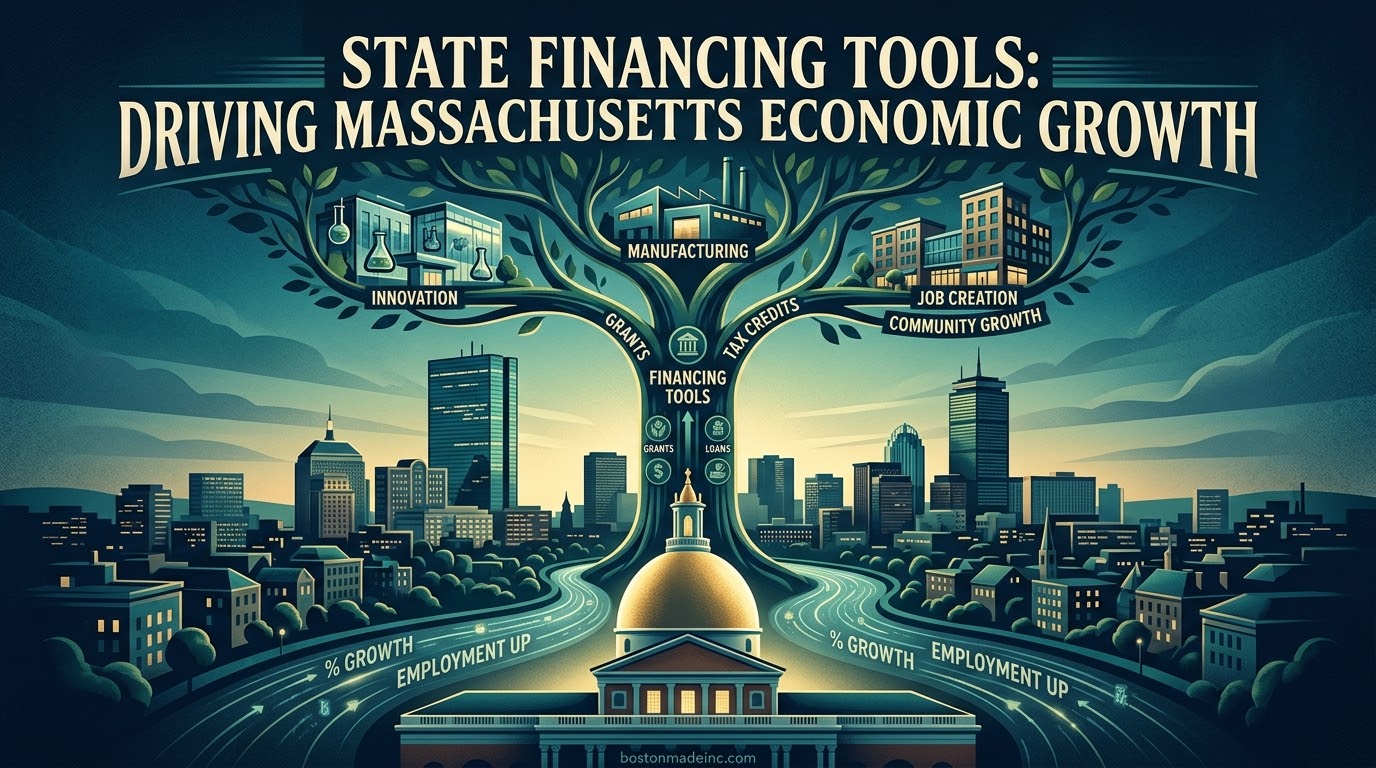
Illustration for “State Financing Tools Remain Central to Massachusetts’ Economic Development Push”

Massachusetts continues to lean on a network of state financing and development programs, anchored by the Massachusetts Development Finance Agency (MassDevelopment), to support business growth, infrastructure, and job creation across the Commonwealth. MassDevelopment, the state’s quasi-public economic development agency, provides financing, real estate development, and technical assistance to businesses, nonprofits, and municipalities, and continues to serve as one of the state’s primary tools for supporting projects that traditional lenders may not fully finance on their own.

State officials have continued to frame long-term economic competitiveness as a priority through 2026, with the Healey-Driscoll administration’s economic development initiatives emphasizing what state materials describe as “powering a high-growth economy” — language used in state economic development communications to describe efforts spanning workforce development, infrastructure, and support for key industries such as life sciences, clean energy, and advanced manufacturing.

Advertisement

Advertisement

MassDevelopment’s role includes both direct financing — such as bonds and loans for qualifying projects — and support for small businesses navigating financing gaps, an area the agency has continued to highlight in outreach and educational programming aimed at smaller Massachusetts employers throughout 2026. That small-business-facing work sits alongside the agency’s larger real estate and infrastructure development projects across the state.

Beyond MassDevelopment, the state legislature has continued to consider broader economic development legislation, with the Governor’s office filing economic development bills aimed at addressing competitiveness concerns raised by business groups such as the Massachusetts Taxpayers Foundation and the Massachusetts Municipal Association. These groups have continued to weigh in on the state’s approach to taxation, permitting, and infrastructure investment as components of the Commonwealth’s broader competitiveness.

For Boston-area businesses, the practical effect of these state-level tools is most visible in specific financed projects — from small-business loans to larger real estate developments — that collectively shape the pace and geography of growth across Greater Boston and the rest of the Commonwealth.


Sources:

Background

Many states use public or quasi-public agencies to support economic development. A quasi-public agency is created by state law and serves a public purpose, but it operates with more independence than a typical government department, often with its own board and its own sources of revenue. These agencies can fill roles that neither ordinary government offices nor private lenders handle easily on their own.

Advertisement

One common tool is bond financing. Certain projects, such as facilities for qualifying nonprofits or some manufacturing projects, may be eligible for tax-exempt bonds. In many such cases, a state agency acts as a conduit issuer: it issues the bonds on behalf of the borrower, and the borrower is responsible for repaying them. Because interest on qualifying bonds is generally exempt from federal income tax, borrowers may be able to obtain lower interest rates than they could with taxable financing.

Another role is gap financing. A project may be viable but unable to secure all of its funding from traditional lenders, perhaps because of its location, its size or the risk lenders perceive. A development agency may provide loans, guarantees or other support that helps close the remaining gap, often alongside private lenders rather than replacing them.

What it means for small businesses

For small business owners, state development programs are one part of a broader set of resources. A few general steps help any business explore its options:

  • Start with your current lender. Banks and credit unions can often explain whether a project might fit a state or federal program, and some work regularly with development agencies.
  • Use free counseling. Small Business Development Centers and SCORE mentors can help prepare financial statements and loan applications.
  • Consider community lenders. Community development financial institutions focus on borrowers and areas that may be underserved by traditional banks.
  • Learn federal programs too. The U.S. Small Business Administration guarantees certain loans made by participating lenders.
  • Prepare documentation. Clear business plans, financial statements and project budgets make it easier for any lender or agency to evaluate a request.
  • Ask about timelines. Public financing can involve applications, reviews and approvals that take longer than a conventional loan.

Key terms

  • Quasi-public agency: A body created by law to serve a public purpose, operating with some independence from regular government departments.
  • Conduit issuer: An agency that issues bonds on behalf of a borrower, which is responsible for repayment.
  • Tax-exempt bond: A bond whose interest is generally not subject to federal income tax, available only for qualifying purposes.
  • Gap financing: Funding that covers the difference between a project’s cost and what other sources will provide.
  • Technical assistance: Advice, planning help or training provided to businesses, nonprofits or municipalities.
  • Economic development bill: Legislation that sets policy and often authorizes spending or borrowing for programs supporting business growth and infrastructure.

What to watch

Several public sources can help Boston-area businesses follow developments, without assuming any particular outcome:

  • The progress of economic development legislation through the Legislature, including committee hearings and votes.
  • Program announcements and application windows from state agencies.
  • Published lists of financed projects, which show where and how state tools are being used.
  • Reports and testimony from business groups, municipal associations and research organizations.
  • Local planning and permitting decisions that affect specific projects in your community.

Quick check: When an agency acts as a conduit issuer, who is responsible for repaying the bonds?

  1. The agency’s employees
  2. The borrower on whose behalf the bonds were issued
  3. The federal government
Show answer

B. A conduit issuer issues bonds for a borrower, and the borrower is responsible for repayment.

PupWear (.org) Boston Made family PupWear (.org) Dog apparel and gear inspired by Boston the GoldenDoodle. Visit site →

Advertisement

Continue Reading

Economic Development

Boston’s Innovation Economy at a Crossroads as Venture Capital Pulls Back

Massachusetts’ life sciences and startup ecosystem is facing a funding pullback, with venture capital share and the number of funded companies both declining in 2026.

Ecosystem Intelligence Desk

Published

on

Boston’s Innovation Economy at a Crossroads as Venture Capital Pulls Back

Boston built its reputation as an innovation hub on a simple formula: world-class research institutions feeding a steady pipeline of venture-backed startups, especially in biotech. That formula is under more pressure than it’s faced in years.

Fewer companies are getting funded

Massachusetts’ share of national venture capital dollars has slipped, and the number of companies in the state receiving funding has fallen by 13%. For a regional economy where early-stage funding rounds often determine whether a lab-based startup can hire its next ten employees, that decline matters well beyond the venture world itself.

Advertisement

Advertisement

Empty lab space tells the same story

Much of the lab and life-sciences real estate built during the pandemic-era expansion now sits vacant at record levels. Developers who bet heavily on continued biotech growth in Cambridge, the Seaport, and along Route 128 are now absorbing that space more slowly than projected, which in turn has made landlords and lenders more cautious about financing the next wave of lab construction.

Layoffs compound the funding slowdown

The funding pullback is landing at the same time hiring in the sector has turned negative: 745 life sciences jobs were cut across 14 Massachusetts companies in the first quarter of 2026 alone. Fewer new funding rounds and fewer open positions together make it harder for laid-off scientists and executives to find their next role without leaving the state entirely — a dynamic that feeds directly into the broader population and talent-retention concerns policymakers have been raising this year.

The state’s response

Governor Healey’s $4 billion Mass Leads Act is designed specifically to shore up life sciences and technology, and the state’s new Competitiveness Council has been tasked with identifying regulatory and tax changes that could make Massachusetts more attractive to venture investors and the companies they fund. More than 30 companies have expanded in the state recently, evidence that the ecosystem hasn’t stalled entirely — but the funding and real estate data both point to a market that has cooled meaningfully from its pandemic-era highs.

What it means for founders and workers

For entrepreneurs building in Boston right now, the practical takeaway is that capital is more selective and runways matter more than they did two or three years ago. Boston Made’s Economy desk will continue tracking funding, lab vacancy, and hiring data across the innovation sector as it develops.

Advertisement

Background

Massachusetts’ innovation economy grew around a set of reinforcing strengths: research universities that produce discoveries and graduates, teaching hospitals that run clinical research, and investors willing to fund early-stage companies. Biotech in particular depends on long timelines. A drug can take many years to move from the lab through clinical trials to approval, and most candidates do not succeed. Venture capital fills the gap by funding companies through those years in exchange for ownership.

Lab space is a distinctive part of the picture. Life sciences buildings need specialized ventilation, plumbing, power and safety features, which makes them more expensive to build than ordinary offices and harder to convert to other uses. When demand for lab space falls, those buildings can remain vacant longer than general office space might.

How venture funding works

Startups typically raise money in stages. Early rounds fund research and prototypes. Later rounds fund larger trials, hiring and commercialization. Each round is priced based on the company’s progress and investors’ view of its prospects. When investors become more cautious, companies may find it harder to raise new money, may raise at lower valuations or may cut costs to extend the time their existing funds will last.

  • Seed and Series A: early funding for initial research and team building.
  • Later rounds: larger amounts for clinical trials, scale-up or market entry.
  • Bridge funding: smaller amounts to carry a company to its next milestone.
  • Exits: acquisitions or public offerings that return money to investors.

What it means for founders and workers

For founders, a more selective funding environment usually rewards clear milestones, careful spending and realistic plans. For workers, it can mean fewer openings and more competition for roles, but also opportunities at companies that are still growing. Professional networks, industry associations and university career resources can help people navigate a slower market.

  • Track runway carefully and plan for funding to take longer than expected.
  • Keep relationships with investors active even between fundraising rounds.
  • Explore grants and nondilutive funding sources where available.
  • For job seekers, consider adjacent roles that use similar skills.

Key terms

  • Venture capital: investment in young, high-growth companies in exchange for equity.
  • Runway: how long a company can operate before it runs out of cash.
  • Lab vacancy: the share of laboratory space that is unoccupied.
  • Nondilutive funding: money, such as grants, that does not require giving up ownership.
  • Valuation: the value assigned to a company in a funding round.
  • Life sciences: fields including biotechnology, pharmaceuticals and medical devices.

What to watch

  • Quarterly venture funding reports for Massachusetts and national comparisons.
  • Lab vacancy and leasing trends in Cambridge, the Seaport and suburban markets.
  • Hiring and layoff announcements in the life sciences sector.
  • Implementation of the Mass Leads Act and recommendations from the Competitiveness Council.
  • Company expansions and relocations into or out of the state.

Funding data is often reported by quarter, and a single very large round can lift a total sharply, so looking at the number of deals alongside the dollar amount gives a clearer sense of how broadly capital is reaching companies across the ecosystem.

Quick check: By how much has the number of Massachusetts companies receiving venture funding fallen, according to the article?

  1. 3%
  2. 13%
  3. 30%
Show answer

B. The article says the number of companies in the state receiving funding has fallen by 13%.

BOSSTOX Boston Made family BOSSTOX AI-infrastructure news and research covering power, cooling, chips and capital. Visit site →

Advertisement

Continue Reading

Economic Development

Is the Massachusetts Economy in Trouble? Inside the Population and Business Exodus

Population loss, corporate relocations, and strain across education, health care, and biotech are fueling a debate over whether the Bay State’s economic foundation is cracking.

Ecosystem Intelligence Desk

Published

on

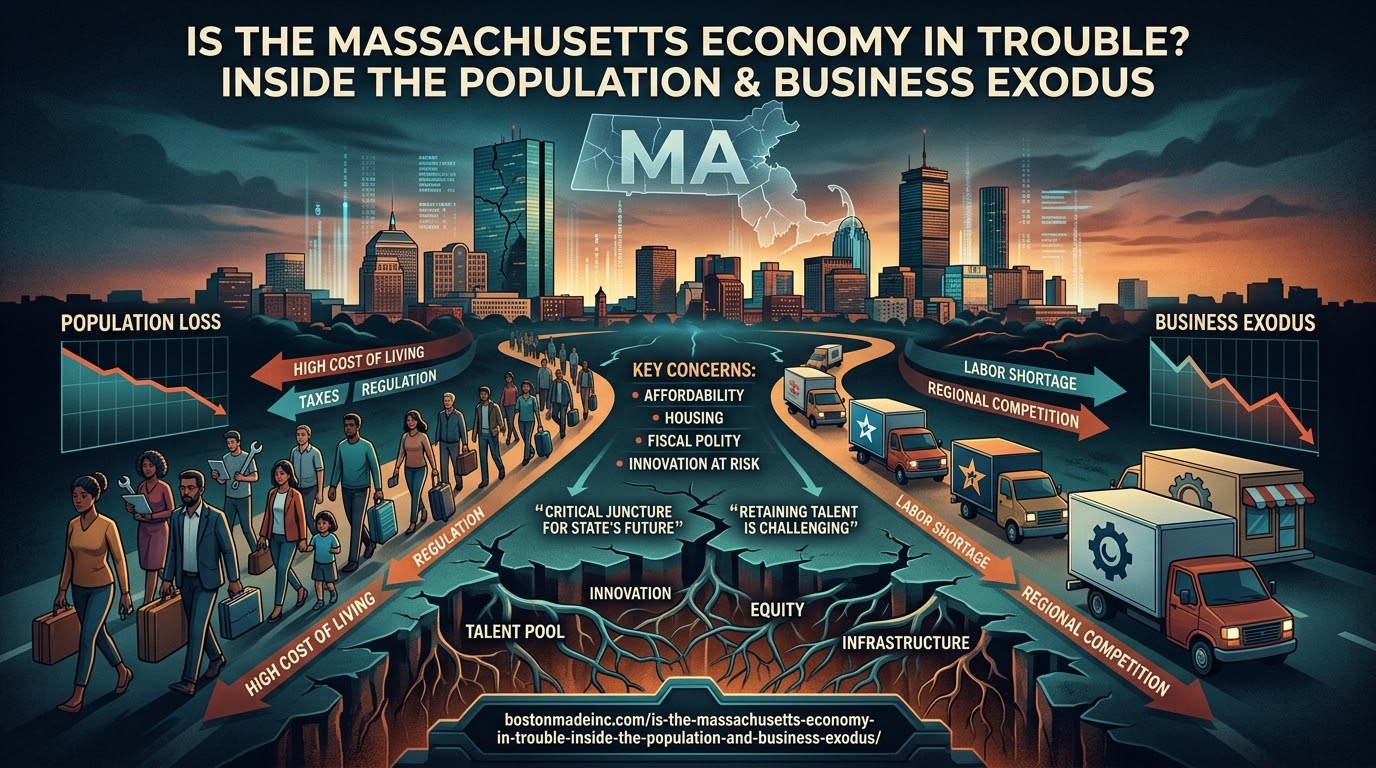
Illustration for “Is the Massachusetts Economy in Trouble? Inside the Population and Business Exodus”

For a state built on world-class hospitals, universities, and a biotech cluster that draws talent from around the globe, 2026 has brought an uncomfortable question: is the Massachusetts economic model starting to crack?

People and companies are leaving

Massachusetts lost 33,340 net residents in the year ending July 2025, with young adults leading the departures. The exits haven’t been limited to individuals. SynQor relocated with roughly 250 jobs, Analogic moved about 500 positions out of state, and both Zipcar and Panera have shifted operations elsewhere. In January 2026 alone, ten companies eliminated a combined 905 jobs. The state is now one of only four in the country with fewer private-sector jobs than it had before the pandemic — a shortfall of roughly 24,000 jobs since January 2020.

Advertisement

Advertisement

Three pillars, all under strain at once

What makes this moment different from past slowdowns is that higher education, health care, and biotech — the three industries that have anchored the state’s economy for a generation — are all showing stress simultaneously.

Higher education: Twelve Massachusetts colleges have closed or merged over the past decade. UMass Chan Medical School’s PhD admissions fell from 73 students to just 13 in a single year, and Harvard is cutting its science PhD enrollment roughly in half.

Health care: Only six of the state’s nearly two dozen hospital systems turned a profit last year. Mass General Brigham has been managing a $250 million budget gap, while UMass Memorial lost $86 million in the first half of fiscal 2025 alone.

Biotech: Venture capital’s share of funding to Massachusetts life sciences companies has declined, the number of funded companies has dropped by 13%, and lab space built during the pandemic-era boom now sits vacant at record levels — a backdrop to the 745 biotech layoffs recorded in the first quarter of 2026 alone.

Federal policy adds pressure

Boston University economist Mark Williams has estimated that tariffs alone could eliminate nearly 80,000 Massachusetts jobs and cost the state $1 billion in tax revenue. State officials have also flagged federal funding being redirected toward other states, along with a proposed $424 million in Medicaid cuts that would hit Massachusetts hospitals directly.

Advertisement

The cost-of-living squeeze

Housing remains the biggest single driver of people leaving the state, compounding the pressure on employers trying to hire. A four-year degree at a private Massachusetts university now commonly exceeds $400,000 all-in, and the state has the third-highest electricity rates in the country — both of which show up in household budgets long before they show up in state economic data.

What the state is doing about it

Governor Maura Healey’s administration has rolled out a $4 billion Mass Leads Act aimed at the life sciences and technology sectors, a $400 million DRIVE Initiative, and a new Competitiveness Council, while pointing to more than 30 companies that have recently expanded in the state. House Ways and Means Chair Aaron Michlewitz has highlighted resilience in state revenue numbers as a counterpoint to the more alarming headlines.

Those efforts have run into resistance, though: a broader tax-cut package was significantly scaled back, new revenue-raising proposals didn’t survive the legislative process, and a commercial property tax proposal from Boston Mayor Michelle Wu was rejected in the Senate.

Where this leaves Massachusetts

None of this means the state’s economy is collapsing — job growth is still outpacing the national average on a monthly basis, and the “millionaires tax” continues to generate billions more than originally projected, evidence that high earners aren’t fleeing en masse. But the simultaneous strain across education, health care, and biotech, layered on top of a real (if modest) population decline, is a meaningfully different economic story than the one Massachusetts told about itself for most of the past two decades. Boston Made’s Economy desk will keep following each of these threads as new data comes in.

Pupwear Boston Made family Pupwear Dog apparel and gear inspired by Boston the GoldenDoodle. Visit site →

Advertisement

Continue Reading
Advertisement

Advertisement

Ad

Advertisement

Trending

--:--·---·--°