Connect with us

Weather where you are

Choose your location or share it once. We round your coordinates to about 1 km before sending them to our site and MET Norway for your forecast. Your choice stays in this browser tab.

Stay close to Boston

Get new Boston stories and Boston Made company updates, delivered as browser notifications.

Choose Enable notifications, then allow notifications in your browser.

Your browser subscription is stored by Boston Made and delivered through your browser’s push service. You can turn notifications off in your browser’s site settings. Privacy policy

Boston Made Eats

Wahlburgers Leaves Fenway After 11 Years, Shrinking the Burger Chain to Four Massachusetts Counters

Wahlburgers closed its Fenway restaurant as its lease ran out, leaving four Massachusetts locations. What the exit says about Boston dining.

Ecosystem Intelligence Desk

Published

on

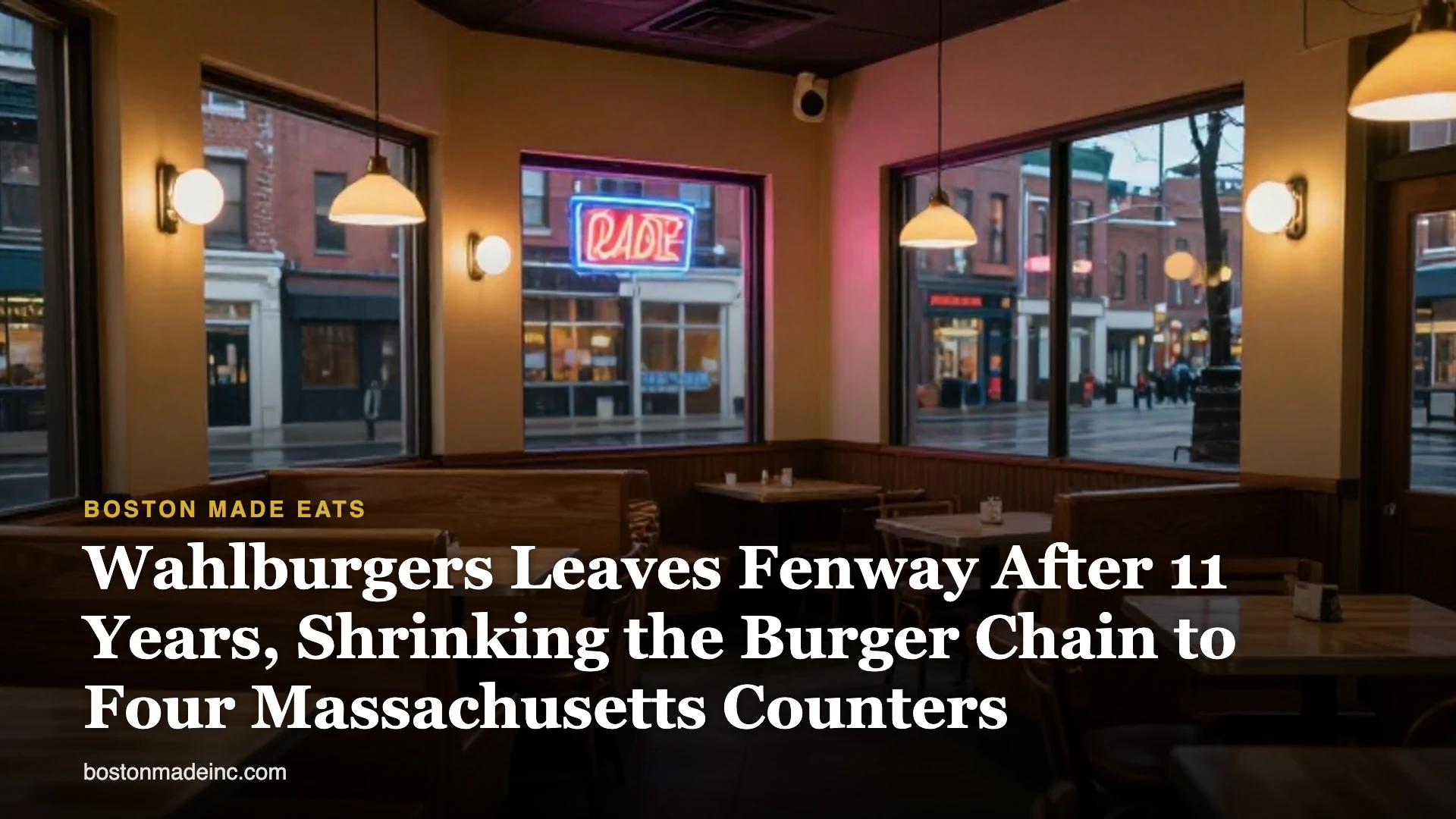
Empty burger restaurant dining room with booths at dusk, AI-generated illustration

One of the most recognizable burger brands to come out of Greater Boston has cleared out of one of the city’s busiest dining neighborhoods. Wahlburgers, the chain started by Dorchester-raised brothers Paul, Mark and Donnie Wahlberg, closed its Fenway restaurant at the end of October after 11 years, according to reporting by Boston.com and Boston 25 News. The company said the closure lines up with the end of the building’s lease.

The exit is the latest in a string of Massachusetts departures for the brand. Its original restaurant at the Hingham Shipyard, which Paul Wahlberg and his brothers opened in 2011, closed in September after roughly 15 years. A Lynnfield location closed in April after almost a decade, Boston.com reported. With Fenway gone, the chain is down to four restaurants in its home state.

Advertisement

What happened

Wahlburgers announced the closure on social media on Thursday, Oct. 29, thanking customers for years of celebrations and everyday meals. Reports differ slightly on the final day of service: Boston.com said the restaurant would close Saturday, Oct. 31, while Boston 25 News reported it closed Friday, Oct. 30. Both outlets agree on the reason the company gave, an expiring lease, and on the restaurant’s 11-year run in the neighborhood.

The company did not describe the closing as a retreat from Boston. It told customers it is “actively pursuing a new home in the Boston area,” according to Boston.com, and Boston 25 News reported that Wahlburgers hopes to share details about a new site soon. No address, timeline or format for a replacement location has been made public, so any return to the city should be treated as a plan rather than a commitment until a lease is signed and announced.

Where Wahlburgers is still open in Massachusetts

  • Logan International Airport: two counters, in Terminal C and Terminal E.
  • Plainville: the location at Plainridge Park Casino.
  • Springfield: the chain’s western Massachusetts outpost.

That footprint is telling. Every remaining Massachusetts location sits inside a destination that delivers its own crowd, whether travelers waiting on a flight or visitors to a casino or entertainment complex. None is a stand-alone neighborhood restaurant of the kind the brand was built on in Hingham.

A chain growing elsewhere

The Massachusetts contraction is happening while the company says it is expanding nationally. Wahlburgers told Boston.com it opened 10 new restaurants across the country in 2026 and now operates in more than a dozen states and four countries, including Australia and New Zealand. Its announced 2027 pipeline leans heavily on partnerships: a location in Puerto Rico, one at The Orleans Hotel & Casino in Las Vegas, restaurants inside Bass Pro Shops stores in California and Colorado, and additional counters inside Home Depot stores, according to both outlets.

That list points to a strategy that has become common among mid-sized restaurant brands: let a landlord or partner with steady foot traffic carry much of the cost of drawing customers, and keep the menu tight enough to run in a smaller space. For a burger concept, the formula can work well in airports, casinos and big-box stores, where diners want something quick and familiar.

The Newsroom Take

The Newsroom sees the Fenway closing less as a verdict on burgers and more as a verdict on what it costs to keep a large, full-service room open in a neighborhood where rents and redevelopment pressure have climbed for years. When a lease comes up, an operator has to decide whether a location earns its keep every day of the week, not just on the busiest nights. A brand with a growing menu of partnership deals elsewhere has an easy alternative to signing another long commitment on prime Fenway real estate.

The Newsroom also notes the pattern across this fall’s Boston-area restaurant news: long-running places are closing at lease or sale moments, while new openings tend to come from operators who arrive with deep pockets or a clear, compact format. Wahlburgers fits that picture from both sides. It is shrinking its traditional sit-down presence at home while adding counters inside other companies’ buildings. Whether its promised new Boston-area home looks like the old Fenway dining room, or like a smaller counter tucked into a busier venue, will say a lot about where the brand believes local diners are headed.

For the Fenway neighborhood itself, the bigger question is what replaces the space. A large, ground-floor restaurant footprint in a high-traffic area rarely stays dark for long, and the next tenant could be a local independent, another national chain or a mixed-use redevelopment. The Newsroom will follow any permits or announcements for the site.

What it means for you

  • Fans of the brand can still order at Logan’s Terminals C and E, at Plainridge Park Casino in Plainville and in Springfield.
  • Gift card holders should check the card’s terms and confirm with the company which locations will honor it before making a special trip.
  • Fenway diners who relied on the restaurant for group meals may want to book ahead at nearby spots on busy weekends, since one large room is now off the map.
  • Anyone tracking the brand’s promised return should watch Wahlburgers’ official channels; no new Boston address has been announced.

Test yourself

How long had Wahlburgers operated in Fenway?

Answer: About 11 years.

What reason did the company give for the closing?

Answer: The building’s lease was expiring at the end of October.

Where was the original Wahlburgers, and when did it close?

Answer: At the Hingham Shipyard; it closed in September 2026 after roughly 15 years.

How many Wahlburgers locations remain in Massachusetts?

Answer: Four: two at Logan Airport, one in Plainville and one in Springfield.

Discussion

  1. Do airport, casino and big-box-store counters offer the same experience as a neighborhood restaurant, or something different?
  2. What kind of tenant would you most like to see take over the former Fenway space?
  3. Would a smaller, counter-service Wahlburgers in Boston bring you back to the brand?

Lumo Kingswell Lumo Precious-metals education and a two-sided gold exchange with a live gold price. Visit site →

Advertisement

The institutional news desk of the Boston Made network. Reporting is researched from wire services including The Associated Press and local sources, and written by the desk.

Boston Made Eats

Cambridge Common and the Lizard Lounge Will Close Next May After Three Decades on Mass. Ave.

The Mass. Ave. pub and its basement music club will close at the end of May 2027 as the owners plan to sell the building. What it means for diners.

Ecosystem Intelligence Desk

Published

on

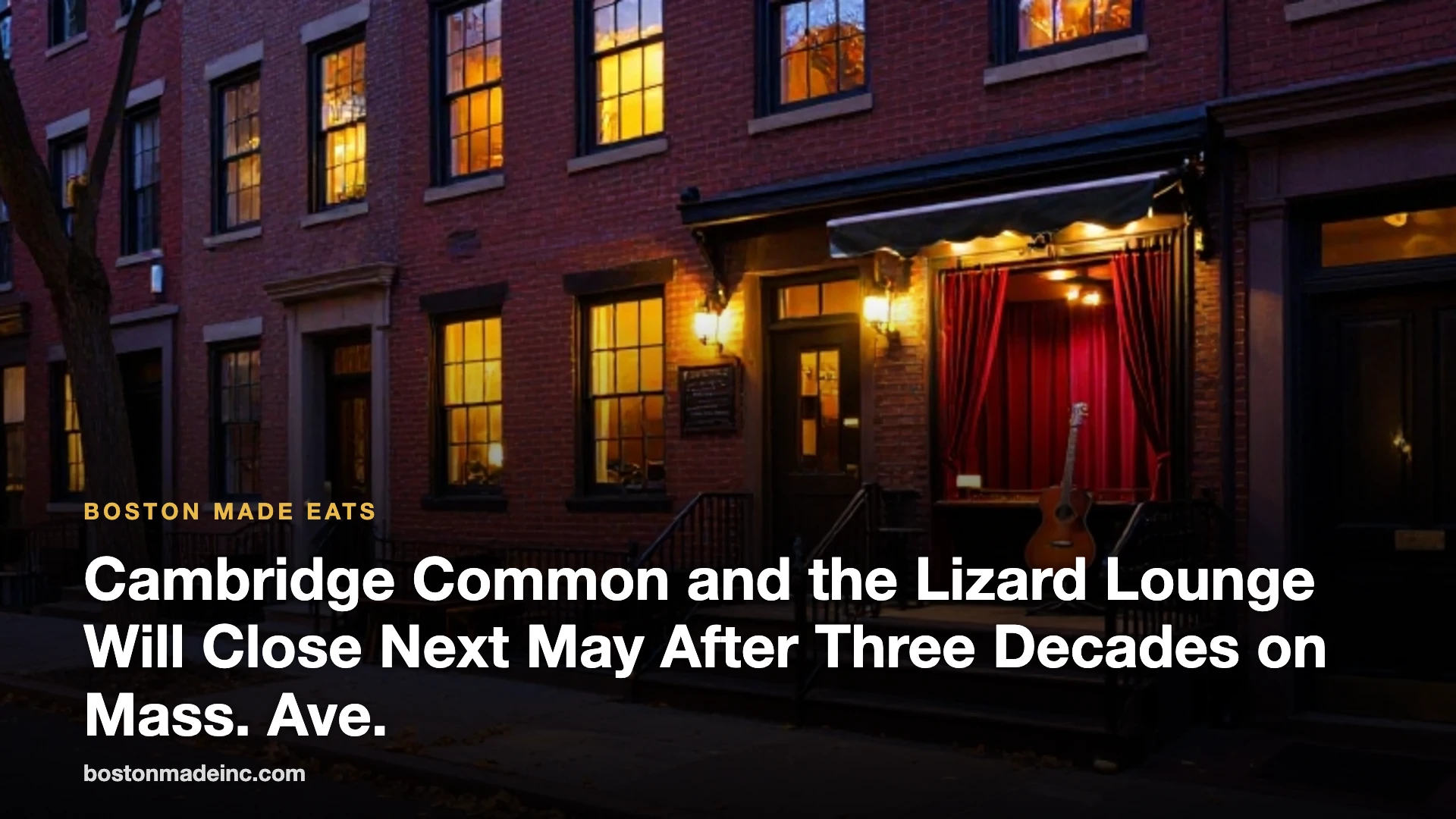
Illustration of a brick pub on a Cambridge avenue at dusk, with a basement music room glowing red behind a stairway.

One of the longest-running pairings of pub food and live music between Harvard and Porter squares has set an end date. Cambridge Common, the American-fare restaurant at 1667 Massachusetts Avenue, and the Lizard Lounge, the intimate music club in its basement, will both close at the end of May 2027, according to reporting by WBUR, the Boston Globe and Boston.com. Owners Holly Heslop and Charlie Christopher plan to sell the building and are in talks with a buyer, WBUR reported.

That leaves roughly seven months of burgers, pints and Sunday poetry nights before a Cambridge fixture that opened in 1996 turns off the lights. For a dining scene that has lost a string of independent, owner-run rooms in recent years, the news is another reminder of how much neighborhood character rests on a small number of longtime proprietors.

Advertisement

What is closing, and when

Both businesses will close at the end of May 2027. WBUR first reported the decision on October 30, and Boston.com and the Globe followed the same day. A public farewell is planned for the spring, according to WBUR and Boston.com. Staff learned of the plan about a month before it became public, and the restaurant’s three managers intend to make the final months their best, WBUR reported.

The parcel, listed in Cambridge city records as 1667-1673 Massachusetts Avenue, carries an assessed value of about $3.6 million, according to WBUR and the local outlet CSIndie. Neither outlet named the prospective buyer, and no plans for the site have been announced.

Why now

By the owners’ account, the reasons are personal rather than financial. Heslop is 77 and Christopher is 82, and Christopher has ongoing health problems, WBUR and Boston.com reported. The kitchen is also losing its anchor: Arcesio Suarez, the restaurant’s chef for 28 years, plans to return to Colombia. Heslop told WBUR the business has had “a long run,” adding that she would have liked to keep going but had to face the facts.

A restaurant that paid for the music

The closing matters to diners partly because of how the two businesses fit together. The couple opened Cambridge Common in 1996 and turned the basement, once a function hall, into the Lizard Lounge a year later. According to WBUR and Boston.com, revenue from the restaurant upstairs effectively subsidized the club downstairs, covering the liquor license and insurance for both. Every plate of food and every round at the bar helped keep a small room, with a capacity of about 105 according to CSIndie, open for touring and local musicians.

That arrangement is rarer than it used to be. A full-service restaurant with a steady neighborhood crowd can absorb the thin margins of a small music room; a stand-alone club often cannot. When the pairing ends, the dining room and the stage tend to disappear together.

The club’s reputation stretched well beyond Cambridge. WBUR reported that it hosted early shows by Lake Street Dive and sets by artists including Patty Griffin and Guster, along with a long-running Sunday poetry night backed by a jazz band. Matt Smith, managing director of Club Passim, told Boston.com the Lounge has been “an essential part of the Cambridge/Somerville music ecosystem.”

A familiar pattern on Mass. Ave.

This is not the owners’ first exit. They previously ran Christopher’s restaurant and the Toad music bar in Porter Square and sold those businesses in 2024 for $2.9 million, according to CSIndie. The restaurant reopened in 2025 as McCarthy’s under the owners of the Burren in Davis Square, and Toad was preserved, WBUR and CSIndie reported. That outcome offers one hopeful template for 1667 Mass. Ave., though nothing has been decided.

The news also caps a busy week of turnover in Greater Boston dining. Boston Restaurant Talk reports that Cafe Barada, the Lebanese restaurant in North Cambridge, will end full-service dining on December 5, while newcomers include Old Friend Pizza, a Detroit-style spot in West Roxbury, and a planned Crisscross Bakehouse next to Honeycomb Creamery, also on Mass. Ave. between Porter and Harvard.

The Newsroom Take

The Boston Made Newsroom sees this closing as a succession problem more than a market problem. Cambridge Common is not shutting because diners stopped coming; it is closing because its founders are ready to step back and its longtime chef is heading home. Many of the region’s best-loved neighborhood restaurants share that profile: owner-operators who started decades ago, built loyal crowds and never planned a handoff. When those owners also hold the real estate, as they do here, selling the building can be the most rational exit even when the business still works.

The newsroom also notes that the next owner of the property will largely decide whether this stretch between Harvard and Porter keeps a casual place to eat and hear music. The Porter Square sale shows that a buyer who values the existing use can keep it alive under a new name. Residents who want that outcome have about seven months to show, with their visits, that the demand is real.

What it means for you

  • Regulars have until the end of May 2027 to visit; watch the venue’s official channels for details of the spring farewell.
  • Music fans should keep an eye on the Lizard Lounge calendar; WBUR reports that the band Club D’Elf hopes to return for a residency in 2027.
  • Neighbors can follow any sale or redevelopment through Cambridge city records and permitting notices.
  • Diners who want to support independents can spread their spending across other owner-run rooms, from Cafe Barada before December 5 to newcomers such as Old Friend Pizza.

Test yourself

In what years did Cambridge Common and the Lizard Lounge open?

Answer: Cambridge Common opened in 1996, and the Lizard Lounge followed in 1997.

Who is the restaurant’s longtime chef, and how long has he cooked there?

Answer: Arcesio Suarez, for 28 years.

About how much is the property assessed at?

Answer: Roughly $3.6 million.

Which band got an early start at the Lizard Lounge?

Answer: Lake Street Dive.

Discussion

  1. Should cities do more to help long-running restaurants and music rooms find buyers who will keep them going?
  2. Is pairing a restaurant with a small music venue still a workable business model in Greater Boston?
  3. What would you most like to see at 1667 Massachusetts Avenue after May 2027?

Boston Made Pets Boston Made family Boston Made Pets Pet apparel and gear inspired by Boston the GoldenDoodle. Visit site →

Advertisement

Continue Reading

Boston Made Eats

Xi’an Famous Foods Brings Hand-Ripped Noodles to Downtown Crossing

The New York noodle chain opens its first Boston dining room at 255 Washington St., steps from where Potbelly just closed. What to order and when.

Ecosystem Intelligence Desk

Published

on

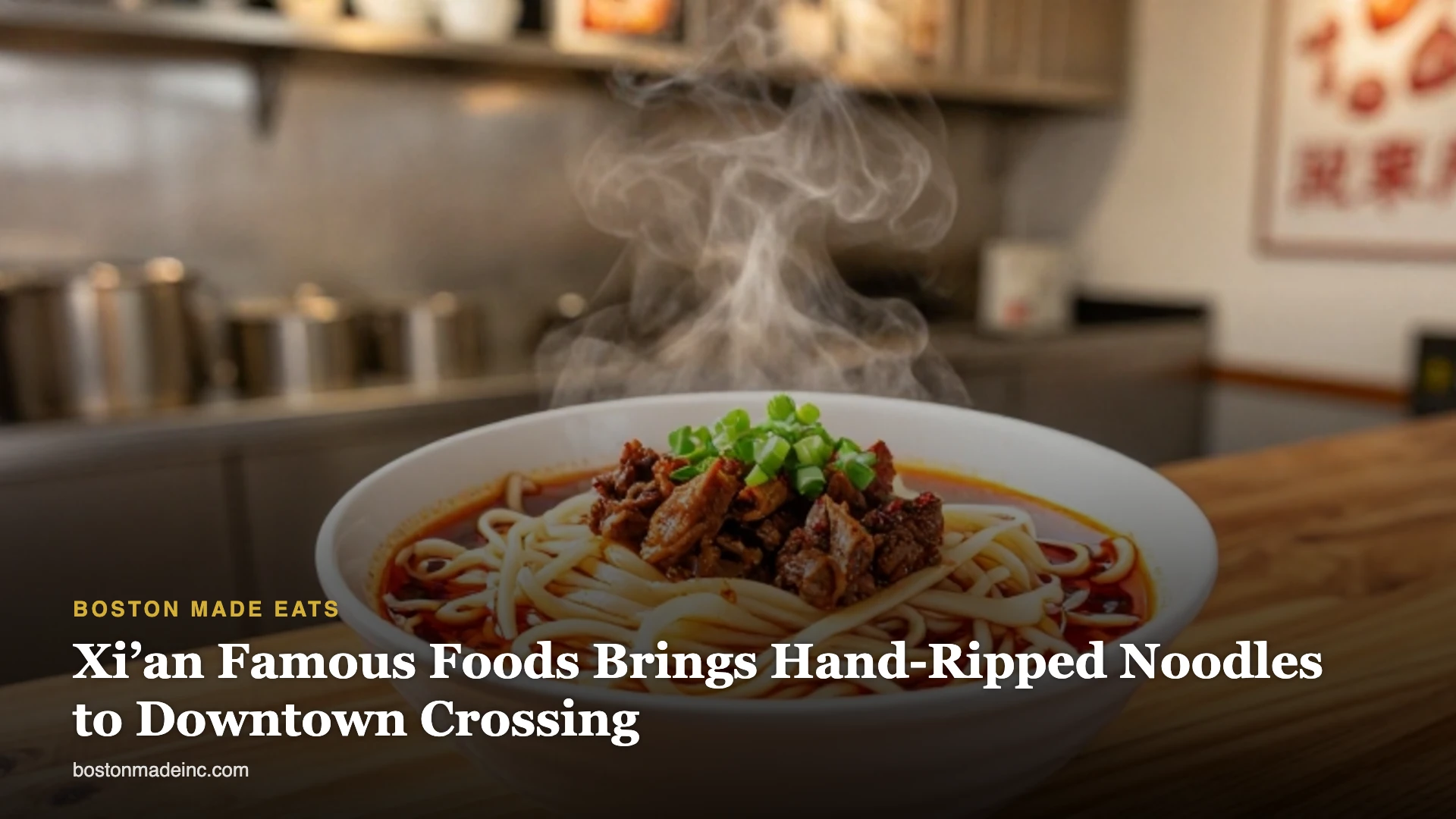
A steaming bowl of hand-pulled noodles with chili oil and cumin lamb in a modern noodle shop

Downtown Crossing is getting a bowl of noodles it has never had before. Xi’an Famous Foods, the family-run New York chain known for hand-ripped noodles and cumin-spiced lamb, has moved into 255 Washington Street for its first full Boston restaurant, with a soft opening scheduled for late October and a grand opening planned for the first week of November.

The arrival lands on the same stretch of Washington Street where Potbelly Sandwich Works served its last sandwiches on October 25, a few doors away at No. 263. For a shopping district that has spent years trying to convince office workers, students and theatergoers to linger after dark, the swap is a small but telling sign of where downtown dining is heading: away from interchangeable lunch chains and toward food with a specific point of view.

Advertisement

What is opening, and when

According to the Boston Globe, the Downtown Crossing restaurant has 49 seats and plans to keep daily hours of 11 a.m. to 9 p.m. Boston.com reports the space covers roughly 1,700 square feet. Chief executive Jason Wang told the Globe the company is planning a grand-opening event with promotions and free dishes, and Boston.com reports that celebration is set for the first week of November.

The opening has been a long time coming. WhatNow Boston first reported in July 2025 that the company had quietly launched a takeout-and-delivery kitchen at 94 Shirley Street in Roxbury and had a full restaurant under construction downtown, at the time targeted for late 2025. The company also held pop-up events in Roxbury while the Washington Street build-out continued, according to Boston.com.

Who is behind it

Xi’an Famous Foods traces back to 2005, when founder David Wang opened a small stall in a basement food court in Flushing, Queens, cooking the dishes of Xi’an, the capital of Shaanxi Province in northwest China, where he grew up. His son Jason Wang later took over as CEO and led the brand’s expansion. Boston.com reports the chain now operates nearly 20 restaurants across New York, Pennsylvania, Virginia and Washington, D.C. The Boston location is its first in New England.

The chain’s early reputation was built partly on word of mouth and partly on television: the late Anthony Bourdain visited the original stall in 2007 and singled out the cumin lamb burger, a moment that helped turn a basement counter into a destination.

What is on the menu

The heart of the menu is noodles. Boston.com reports that hand-ripped noodles will be pulled to order in an open kitchen, a bit of theater that doubles as a freshness guarantee. “Our noodles are pulled to order right in front of you,” Jason Wang told the outlet. Cold liang pi “cold-skin” noodles, spicy and sour pork dumplings, a cucumber salad, Chang’an spicy tofu custard and spicy beef round out the list, along with two sandwiches served on house-made flatbread: the spicy cumin lamb burger and a stewed pork burger.

Diners who worry about heat have less to fear than the chili-red photos suggest. Boston.com reports the imported Shaanxi peppers the kitchen uses measure about 3,000 Scoville heat units, well under the roughly 8,000 of a typical jalapeño. The signature character comes instead from a chili oil built from close to 30 ingredients, including Sichuan peppercorns, cardamom and star anise, and from the tingling, numbing sensation of the peppercorns themselves. The menu leans spicy and sour, but the goal, the company says, is flavor rather than a dare.

A busy week across the region

Xi’an Famous Foods is one of several openings that kept Boston’s food pages full this week:

  • Old Friend Pizza began a soft opening on October 28 at 5272 Washington Street in West Roxbury, according to Boston Restaurant Talk. The Detroit-style pizza business grew out of pop-ups, an Airstream trailer and the Roslindale Farmers Market.
  • Crisscross Bakehouse, from the team behind Honeycomb Creamery, is preparing to open at 1700A Massachusetts Avenue in Cambridge. Until it does, it is running a pastry pop-up inside Honeycomb on Thursdays through Sundays from 8 a.m. to noon, according to Boston.com and Boston Restaurant Talk.
  • Danish Coffee Studio has replaced Danish Pastry House at 330 Boston Avenue in Medford under new owner Benjamin Morales, Boston Restaurant Talk reports.

The Newsroom Take

The Boston Made Newsroom sees the Xi’an Famous Foods opening as a vote of confidence in Downtown Crossing at a moment when the district needs one. National sandwich and salad chains built their downtown footprint around the five-day office week; as that week has shrunk, several have pulled back. Destination-style fast-casual restaurants with a distinct regional cuisine draw a broader crowd: students from nearby campuses, Chinatown regulars, shoppers and theatergoers heading to the Opera House and the Paramount. A restaurant that stays open until 9 p.m. every day also helps the block feel alive after the office crowd leaves.

The newsroom also notes the path the company took to get here. A delivery-only kitchen in Roxbury and a series of pop-ups gave the brand a chance to test Boston demand before signing up for a full dining room. That is a model more local operators are using, as Old Friend Pizza’s journey from farmers market to storefront shows this same week. The newsroom expects more openings to follow that low-risk, prove-it-first route while rents and labor costs stay high.

What it means for you

  • Downtown workers and students gain a sit-down noodle option with 49 seats, open seven days a week from 11 a.m. to 9 p.m., according to the Globe.
  • Deal seekers should watch the company’s official channels for the grand-opening promotions planned for the first week of November.
  • Spice-shy diners can order with some confidence: the peppers used are milder than a jalapeño, and the menu includes non-spicy choices such as the stewed pork burger.
  • Former Potbelly regulars at 263 Washington Street can still find the chain on Federal Street and at Logan Airport, according to Boston Restaurant Talk.

Test yourself

In what year, and where, did Xi’an Famous Foods begin?

Answer: 2005, in a basement food court in Flushing, Queens.

What is the address of the new Downtown Crossing restaurant?

Answer: 255 Washington Street, Boston.

How hot are the imported Shaanxi peppers compared with a jalapeño?

Answer: About 3,000 Scoville heat units, versus roughly 8,000 for a typical jalapeño.

Which dish did Anthony Bourdain famously praise at the original location?

Answer: The spicy cumin lamb burger.

Discussion

  1. What kinds of restaurants would most help Downtown Crossing stay busy after 6 p.m.?
  2. Do pop-ups and delivery-only kitchens make it easier or harder for new restaurants to succeed in Boston?
  3. Which regional cuisine is still missing from Boston’s dining scene?

Keep Up With Nate Boston Made family Keep Up With Nate The personal site of Boston Made founder Nathan Strickland. Visit site →

Advertisement

Continue Reading

Boston Made Eats

Rosebud’s 1941 Dining Car Goes Dark for Good as Davis Square Waits for Its Next Act

Rosebud Bar & Kitchen in Somerville’s Davis Square has surrendered its license and liquor license. The landlord is now courting new restaurant operators.

Ecosystem Intelligence Desk

Published

on

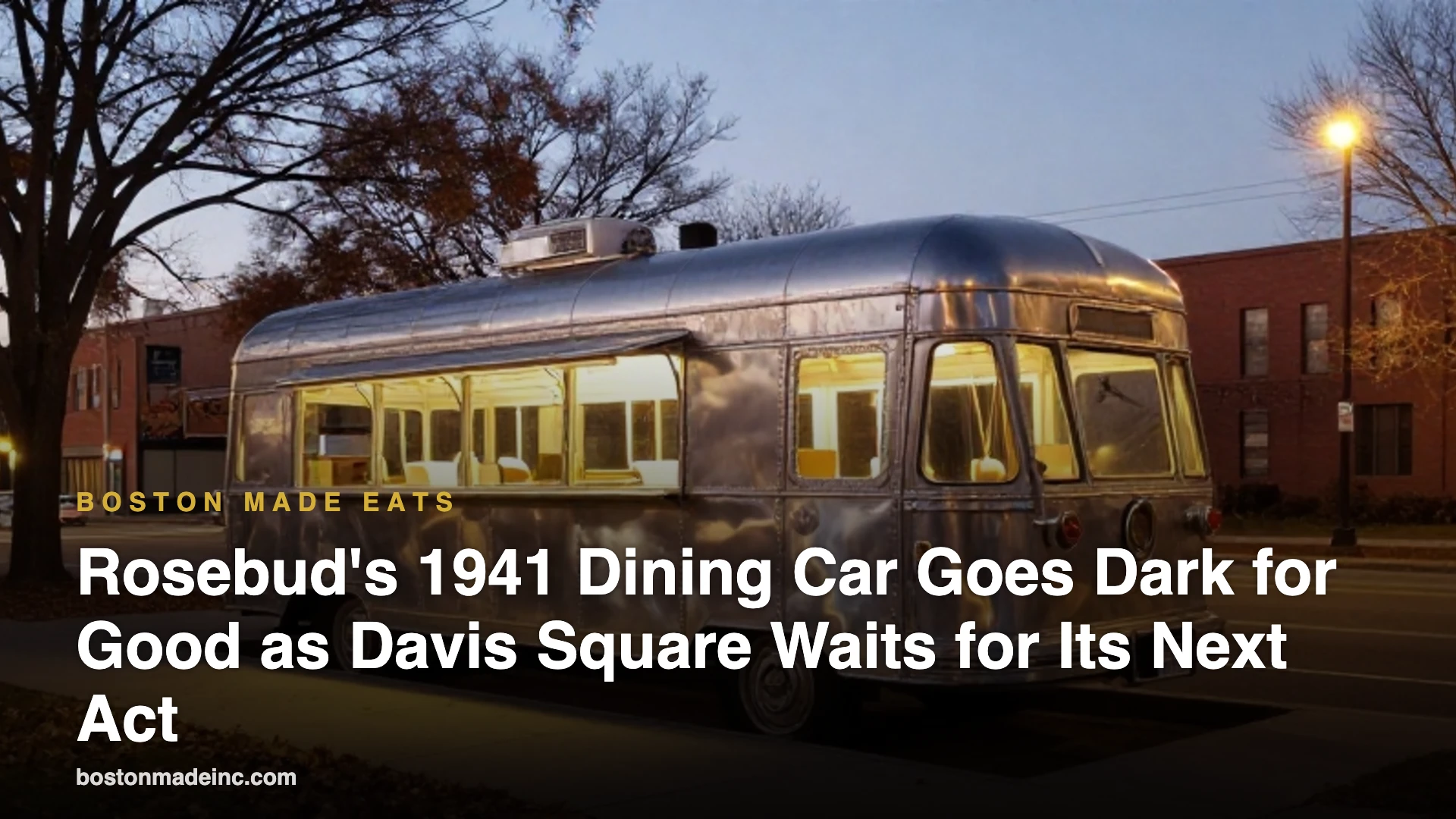
Illustration of a vintage stainless-steel lunch car diner on a city corner at dusk, lights off

One of the most photographed restaurant buildings in Greater Boston is officially between tenants. Rosebud Bar & Kitchen, the restaurant built around a stainless-steel 1941 lunch car on Summer Street near Davis Square in Somerville, has given up its operating license, and the city’s License Commission has now treated the business as permanently closed. The property owner says he is already talking with local restaurateurs about who comes next.

For a building that has outlasted rationing, urban renewal, a pandemic and at least three different restaurant concepts, the moment is less an ending than a pause. But it is a pause that matters for a square still working to fill storefronts, and for diners who have watched one of New England’s best-known roadside landmarks sit dark since spring.

Advertisement

What happened

According to reporting by Boston.com, Rosebud stopped serving unexpectedly in May 2026. The restaurant’s operator, Koushik “Babu” Koganti of Bindaas Concepts, initially described the closure as a pause for renovations, but the doors stayed locked through the summer.

At a July 21 hearing before the Somerville License Commission, Koganti said the space still needed maintenance and that he was negotiating to buy the property from the landlord. By the commission’s October 20 hearing, that picture had changed. Koganti told the board the purchase talks had stalled and that he had canceled his lease. His company also handed the restaurant’s liquor license back to the landlord, and the commission concluded the business had closed for good. Boston.com reported that Koganti did not respond to its request for comment.

The landlord, Martin Bloom, told the outlet he is in discussions with several local restaurant owners and is “working diligently to get it back online.” No new operator has been named, and any newcomer would need its own approvals from the city before opening.

A landmark with a long menu of owners

The dining car itself is the constant. It was manufactured in 1941 by the Worcester Lunch Car Company, the Massachusetts builder behind many of the region’s classic diners, and was added to the National Register of Historic Places in 1999 as part of a statewide survey of historic diners. For roughly four decades it operated as a traditional diner under family ownership.

That era ended in 2013. Boston Magazine reported at the time that Bloom, a restaurateur best known as the founder of Vinny Testa’s, had acquired the property, with plans to keep the exterior and the Rosebud name while reworking the menu and interior. The result was Rosebud American Kitchen & Bar, a table-service restaurant with a bar in the rear addition.

In 2023, Koganti’s group took over the restaurant business, closed it briefly for renovations, and reopened it as Rosebud Bar & Kitchen with a menu that blended American diner staples and Indian flavors. The Tufts Daily covered the ownership change and the short closure, which drew criticism at the time because staff were let go during the transition. Koganti is also associated with the Madras Dosa Co. chain and the Don’t Tell Aunty restaurant in Back Bay, according to Boston.com.

Why Davis Square cares

Bloom told Boston.com that Davis Square has been slow to recover from the pandemic, and that a proposed building of about 500 housing units had made some businesses hesitant to commit to the area. Those plans have since fallen through, he said. That combination of uncertainty and vacancy is familiar across inner-ring Boston suburbs, where landlords have struggled to match post-pandemic rents with what independent restaurants can afford.

A historic, highly visible building with an existing kitchen can be an easier sell than a raw storefront. But it also comes with constraints. Dining cars are narrow, and the original seating area is small; the rear addition carries most of the kitchen and bar capacity. Any operator will be weighing the charm of the building against the realities of labor costs, food costs and a liquor license that will have to be re-approved for a new business.

The Newsroom Take

The Boston Made Newsroom views the Rosebud situation as a test of whether landmark buildings can carry their own weight in today’s restaurant economy. The dining car has always been the draw; the concepts inside it have changed every decade or so. The most durable version of Rosebud, the original diner, succeeded because it was simple, affordable and open long hours. The newsroom expects the next tenant to succeed or struggle on similar terms. A concept that leans into the building’s history and keeps prices within reach of students, families and commuters stands a better chance than another reinvention that asks the room to be something it is not.

The newsroom also notes that the license commission’s quick, public process is working as intended. Residents who want a say in what comes next will have a venue: the hearing at which any new operator seeks a license.

What it means for you

  • Somerville residents can follow the License Commission’s agendas on the city website; a new operator’s application will appear there before any reopening.
  • Gift card holders from Rosebud Bar & Kitchen should contact the former operator directly; a new tenant is unlikely to honor them.
  • Diner fans can still see the 1941 car from the sidewalk at 381 Summer Street; it remains listed on the National Register of Historic Places.
  • Restaurateurs scouting space should note that the landlord is actively seeking proposals now.

Test yourself

Which company built the Rosebud dining car, and in what year?

Answer: The Worcester Lunch Car Company, in 1941.

When was the Rosebud added to the National Register of Historic Places?

Answer: 1999.

At which hearing did the License Commission conclude the restaurant had permanently closed?

Answer: The October 20, 2026 hearing.

What did the outgoing operator do with the liquor license?

Answer: It was handed back to the landlord.

Discussion

  1. Should a historic dining car go back to being a classic diner, or is a new concept the better bet?
  2. What kind of restaurant does Davis Square need most right now?
  3. How much should a building’s history factor into a city’s licensing decisions?

Paxton-Digital Boston Made family Paxton-Digital Enterprise technology for IP protection and portfolio management · a Kingswell company. Visit site →

Advertisement

Continue Reading
Advertisement

Advertisement

Ad

Advertisement

Trending

--:--·---·--°