Connect with us

Weather where you are

Choose your location or share it once. We round your coordinates to about 1 km before sending them to our site and MET Norway for your forecast. Your choice stays in this browser tab.

Stay close to Boston

Get new Boston stories and Boston Made company updates, delivered as browser notifications.

Choose Enable notifications, then allow notifications in your browser.

Your browser subscription is stored by Boston Made and delivered through your browser’s push service. You can turn notifications off in your browser’s site settings. Privacy policy

Boston Made Eats

Uchi Is Coming to Fort Point: What a 210-Seat Austin Sushi House Says About Boston Dining

Austin’s Uchi plans a 210-seat Japanese restaurant at 374 Congress St. in Fort Point. Here’s what is confirmed, what isn’t, and what it means for diners.

Ecosystem Intelligence Desk

Published

on

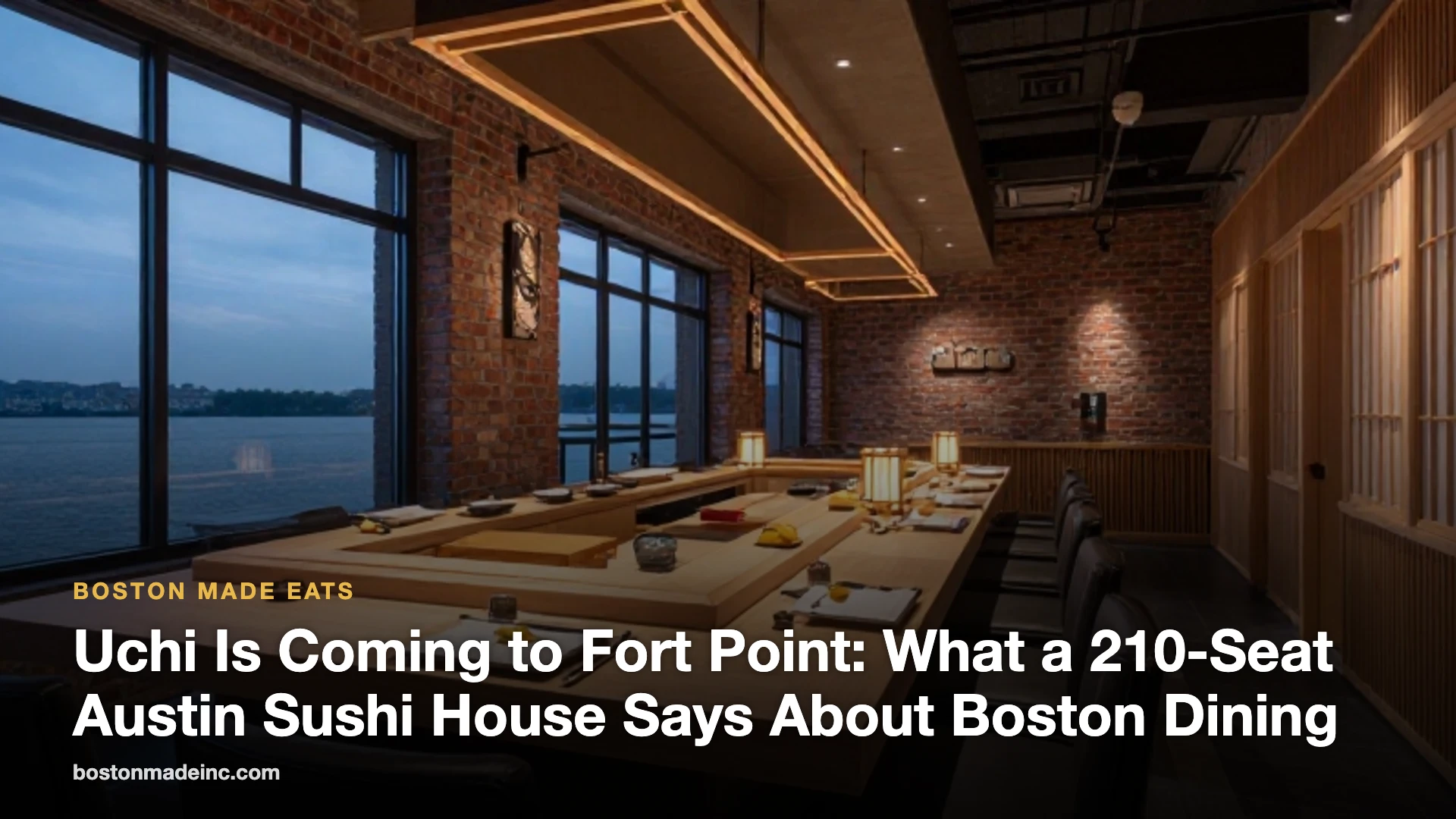
Illustration of a modern Japanese restaurant interior with a wooden sushi counter and harbor windows at dusk

One of the country’s best-known modern Japanese restaurants is planning a Boston debut. Hai Hospitality, the Austin, Texas, company behind chef Tyson Cole’s Uchi, has signed on for a 7,100-square-foot space at 374 Congress St. in Fort Point, according to Nation’s Restaurant News, with the plan later echoed by Boston Restaurant Talk and NBC Boston. The restaurant is not expected to open until 2027, but it was the headline item in Boston Restaurant Talk’s roundup for the week ending Nov. 1, and it is the largest new-restaurant commitment to land in the neighborhood in some time.

The news arrives in a stretch when Greater Boston’s dining map is being redrawn from both ends. Long-running local names have announced closings in recent weeks, while national and international groups keep signing leases in the city’s newest districts. Uchi sits squarely in the second camp, and its arrival says something about where restaurant money is flowing in 2026.

Advertisement

Advertisement

What is confirmed

The core details come from the company’s announcement as reported by Nation’s Restaurant News on Oct. 23 and repeated in Boston coverage that followed:

  • The address: 374 Congress St., in Boston’s Fort Point neighborhood, between the Fort Point Channel and the Seaport. The landlord is Eastern Real Estate.
  • The size: 7,100 square feet and 210 seats, including 11 at a sushi counter, 17 at the bar and 26 in a private dining room that can be split in two.
  • The timeline: Nation’s Restaurant News reported a late-2027 opening. Boston Restaurant Talk described the plan as reported and pointed to sometime in 2027.
  • The design team: Islyn Studio is handling interiors, with Corgan as architect of record. The look is meant to suggest a seaside antique shop, mixing Colonial-era architecture with Japanese-inspired craftsmanship.
  • The scale: Boston would be the 11th Uchi. Hai Hospitality also runs five Uchiko restaurants, two Uchiba cocktail-forward spots, the Houston omakase room Oheya and a three-unit Asian smokehouse concept called Loro.

Hai Hospitality CEO Tony Montero framed the move as part of a wider regional push, telling Nation’s Restaurant News, “We’ve been looking to grow our presence in the Northeast.”

What is still unknown

Several things have not been announced. The company has not published a Boston menu, prices, hours or a hiring timeline, and no opening date more precise than 2027 has been given. Boston Restaurant Talk said diners can expect the chain’s familiar territory, including nigiri and sashimi, tempura, shishito peppers and bluefin specials, along with likely tasting menus, but those are expectations based on the brand’s other locations rather than a confirmed Boston menu. Any liquor license and local permitting steps also have yet to play out in public.

Who is behind it

Cole opened the first Uchi in Austin in 2003 and shared the James Beard Award for Best Chef: Southwest in 2011. The restaurant built its reputation on what its owners call non-traditional Japanese cooking: raw fish paired with unexpected sauces, citrus and chilies, and small plates designed for sharing. Over two decades the brand grew into Houston, Dallas, Denver, Scottsdale, Miami and Washington, D.C., among other cities. Islyn Studio, the design firm on the project, also designed the D.C. Uchi and the Miami Uchiko.

Hai Hospitality’s chief development officer, Todd Reppert, told Nation’s Restaurant News that Fort Point was chosen partly because it reflects Boston’s nautical history and its role as a gateway to New England, which helps explain the antique-shop design theme.

Advertisement

The rest of the week in Boston openings

Uchi was not the only arrival on the radar. Boston Restaurant Talk’s weekly roundup also flagged:

  • Komorebi, a sushi and bento ghost kitchen that has run online pickup and delivery from Revere, plans its first storefront on Beacon Street in Brookline’s Coolidge Corner area. Job listings point to a possible opening in mid-November, NBC Boston reported, with a counter, a dining area and omakase-style bentos built on seasonal ingredients.
  • Mattie’s Provisions & Spirits, a gourmet market with wine, spirits, craft beer and snacks, is slated to open in November at 2193 Commonwealth Ave. in Brighton.
  • Old Friend Pizza is opening in West Roxbury, according to the same roundup.

Against that list sit the recent goodbyes: Cafe Barada in North Cambridge ends full-service dining Dec. 5, the Cambridge Common and Lizard Lounge plan to close in May 2027, and the Fenway Wahlburgers has already shut its doors.

The Newsroom Take

The Newsroom sees Uchi’s lease as a clear marker of how Boston’s restaurant economy is sorting itself. Groups with multiple successful locations, deep capital and in-house design and development teams can commit to a 210-seat room more than a year before it opens. Independent operators, by contrast, are increasingly squeezed by short leases, aging equipment and rising costs, as several recent closings illustrate.

That is not a reason to dismiss Uchi. A serious, chef-founded Japanese restaurant with a long track record adds depth to a neighborhood that has plenty of office lunches and hotel bars but relatively few destination dinners. It also brings jobs, and its sushi counter will raise the bar for local competitors. The open question is whether Fort Point and the Seaport will keep drawing the evening foot traffic that justifies big rooms when office attendance remains uneven.

The Newsroom also notes the long runway. A late-2027 target leaves plenty of time for plans to shift, and diners should treat the date as a goal rather than a promise until a permit filing or a hiring push makes it concrete.

What it means for you

  • Do not plan a birthday dinner yet. Uchi Boston is a 2027 project; watch for permit hearings and hiring notices as the real signs of progress.
  • Want the style sooner? Komorebi’s Brookline counter, if it opens on its mid-November target, offers seasonal omakase-style bentos much closer to home.
  • Expect a splurge. Uchi’s other locations are known for tasting menus and premium fish; budget accordingly once Boston prices are announced.
  • Support the regulars. If a long-running neighborhood spot matters to you, the recent closings are a reminder that steady business is what keeps the lights on.

Test yourself

Where will Uchi’s Boston restaurant be located?

Answer: 374 Congress St., in the Fort Point neighborhood.

How many seats is the restaurant planned to have?

Answer: 210, including 11 at the sushi counter and 17 at the bar.

In what city and year did the first Uchi open?

Answer: Austin, Texas, in 2003.

Which sushi ghost kitchen is planning a Brookline storefront?

Answer: Komorebi, which has operated out of Revere.

Discussion

  1. Do national restaurant groups strengthen Boston’s dining scene, or crowd out local independents?
  2. Is Fort Point ready for a 210-seat destination restaurant, or is the evening crowd still too thin?
  3. What kind of restaurant do you think the Seaport and Fort Point are still missing?

Boston Made UK Boston Made family Boston Made UK Boston Made across the Atlantic. Visit site →

Advertisement

The institutional news desk of the Boston Made network. Reporting is researched from wire services including The Associated Press and local sources, and written by the desk.

Boston Made Eats

Cafe Barada to Close Dec. 5 as a Short Lease Outruns a Four-Decade Lebanese Kitchen

North Cambridge’s Cafe Barada ends full-service dining Dec. 5, citing an aging kitchen and no long lease, as bakeries and markets open nearby.

Ecosystem Intelligence Desk

Published

on

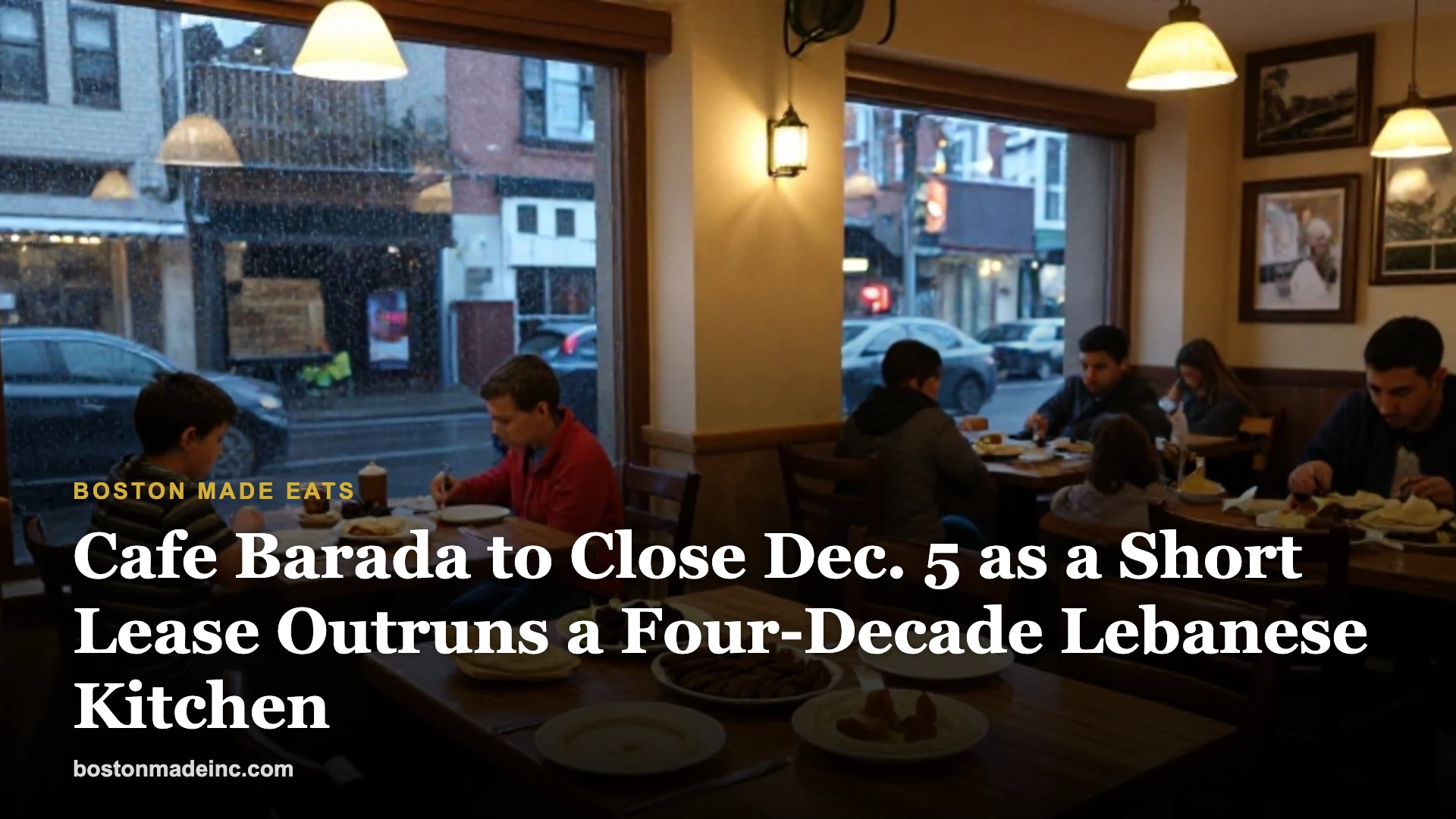
Warmly lit family-run Lebanese restaurant dining room with plates of hummus, falafel and kebabs

Cafe Barada, the family-run Lebanese restaurant that has fed North Cambridge for decades, will end full-service dining on Friday, Dec. 5. The owners told customers in an email on Thursday, Oct. 29, that an aging kitchen and the lack of a long-term lease had left them without a workable path forward at 2269 Massachusetts Ave., according to Boston.com and Boston Restaurant Talk.

The closing lands in a fall that has already taken several long-running names off the Greater Boston dining map. It also comes in the same week that a handful of newcomers, from a Brookline sushi counter to a Brighton gourmet market, announced plans to open. Together, the two lists say a lot about who can afford to sign a lease in Greater Boston right now, and who cannot.

Advertisement

Advertisement

What is confirmed

Several outlets independently reported the same core facts from the restaurant’s announcement:

  • The date: Dec. 5 is the last day of full-service dining at the Mass. Ave. location, near the Arlington line.
  • The history: The restaurant began in Arlington in 1985 and later moved to its current Cambridge address. Charbel Salameh and his parents, Sami and Claude, took it over roughly two decades ago, Boston.com reported.
  • The reasons: The kitchen equipment is aging and needs a major overhaul, and the building’s new owners would not offer a long lease. Salameh told Boston.com that a five- or 10-year term would be needed to justify that kind of investment.
  • The menu: Barada built its following on Lebanese and Middle Eastern staples, including its hoummos, lebany, falafel and kafta and shish kebab plates.

What is still open

The family has not said what comes next. Salameh declined to share details with Boston.com, saying only that the family plans to take a break and refresh the business before deciding on its next step. The restaurant’s statement, as quoted by WhatNow Boston, said the family hopes to keep sharing its food “through future endeavors.” Neither the owners nor the reports have said whether catering, takeout or a new location are on the table, and the restaurant says updates will be posted on its website.

Nothing has been announced about what will replace Barada in the storefront.

Why a lease, not a lack of customers

Barada’s story follows a pattern that has repeated across the region this fall. The restaurant is not closing because diners stopped coming. It is closing because a capital decision came due. A full kitchen rebuild can run well into six figures for a small restaurant, and that spending only pays off over many years of operation. Without a lease long enough to recover it, an owner is effectively being asked to renovate someone else’s building on a short-term bet.

That math is tightening for independents. Food costs have stayed elevated, labor is expensive in Greater Boston, and commercial property along busy corridors like Mass. Ave. has changed hands as owners chase redevelopment value. A building sale often resets the relationship between landlord and tenant, and a new owner with long-range plans for a parcel may prefer flexibility over a 10-year commitment to a restaurant.

Advertisement

Meanwhile, who is opening

The same week brought a steady stream of opening news. Some of these items rest on a single report or on job listings, so details could shift:

  • Crisscross Bakehouse, Cambridge: The team behind Honeycomb Creamery plans a bakery next door at 1700A Mass. Ave., between Porter and Harvard squares, with savory and sweet pastries plus coffee and tea. Boston.com and Boston Restaurant Talk both reported it is running a pop-up inside the ice cream shop Thursday through Sunday mornings until it opens.
  • Komorebi, Brookline: The sushi and bento ghost kitchen plans a storefront on Beacon Street in Coolidge Corner, with job listings pointing to a mid-November opening, according to Boston Restaurant Talk.
  • Mattie’s Provisions & Spirits, Brighton: A gourmet market with wine, spirits, craft beer, coffee and pastries is planned for 2193 Commonwealth Ave. in November, Boston Restaurant Talk reported, citing a job listing.
  • Antojitos Gourmet, Malden: A Colombian and Latin American restaurant is now open at 251 Broadway on Route 99 and also offers catering, per Boston Restaurant Talk.
  • Dandelion at Wink & Nod, South End: A New England seafood concept with French influences is now open in the culinary incubator’s space at 3 Appleton St., Boston.com reported.

Notice the shape of that list. Several of the newcomers are either expanding from an existing business, starting in a shared or incubator space, or opening a compact retail format. Those are lower-risk ways into the market than taking on a large, full-service dining room with a kitchen that must be built or rebuilt from scratch.

The Newsroom Take

The Newsroom reads Barada’s announcement as another sign that lease length has become one of the most important ingredients in Greater Boston dining. A restaurant can have loyal regulars, a recognizable menu and family ownership willing to keep working, and still run out of road when the building’s owner will not commit to the years needed to pay off a new kitchen.

The Newsroom also notes that the openings arriving this fall skew toward bakeries, markets, counters and incubator concepts. That is not a criticism of those businesses, which add real value to their neighborhoods. It does suggest that the classic sit-down neighborhood restaurant, the kind that takes years to build a following, faces a higher bar than it did a decade ago. Cities and towns that want to keep such places may need to think about tools such as small-business lease support, kitchen equipment grants, or zoning that rewards owners for keeping long-standing tenants.

For now, the practical story is simpler. Barada has just over a month of service left, and longtime customers have a window to say goodbye.

What it means for you

  • Regulars have until Dec. 5 for a final sit-down meal; holiday-season weekends are likely to be busy, so plan ahead.
  • Catering and takeout customers should not assume any service continues after Dec. 5 until the family announces it on the restaurant’s own channels.
  • Gift card holders should use their balances before the last day.
  • Diners hunting for something new can try the Crisscross pop-up at Honeycomb on weekend mornings or watch for Komorebi’s Coolidge Corner debut later this month.

Test yourself

When is Cafe Barada’s last day of full-service dining?

Answer: Friday, Dec. 5, 2026.

In which town did the restaurant first open, and in what year?

Answer: Arlington, in 1985.

What two problems did the owners cite?

Answer: An aging kitchen that needs a full overhaul and no long-term lease from the building’s new owners.

Which ice cream shop’s team is opening Crisscross Bakehouse?

Answer: Honeycomb Creamery, on Mass. Ave. in Cambridge.

Discussion

  1. Should cities offer help, such as equipment grants or lease incentives, to keep long-running family restaurants in place?
  2. Is a short lease a fair choice for a landlord weighing future redevelopment, or does it shortchange the neighborhood?
  3. Which Greater Boston restaurant would you most hate to see close, and why?

PupWear (.org) Boston Made family PupWear (.org) Dog apparel and gear inspired by Boston the GoldenDoodle. Visit site →

Advertisement

Continue Reading

Boston Made Eats

Wahlburgers Leaves Fenway After 11 Years, Shrinking the Burger Chain to Four Massachusetts Counters

Wahlburgers closed its Fenway restaurant as its lease ran out, leaving four Massachusetts locations. What the exit says about Boston dining.

Ecosystem Intelligence Desk

Published

on

Empty burger restaurant dining room with booths at dusk, AI-generated illustration

One of the most recognizable burger brands to come out of Greater Boston has cleared out of one of the city’s busiest dining neighborhoods. Wahlburgers, the chain started by Dorchester-raised brothers Paul, Mark and Donnie Wahlberg, closed its Fenway restaurant at the end of October after 11 years, according to reporting by Boston.com and Boston 25 News. The company said the closure lines up with the end of the building’s lease.

The exit is the latest in a string of Massachusetts departures for the brand. Its original restaurant at the Hingham Shipyard, which Paul Wahlberg and his brothers opened in 2011, closed in September after roughly 15 years. A Lynnfield location closed in April after almost a decade, Boston.com reported. With Fenway gone, the chain is down to four restaurants in its home state.

Advertisement

Advertisement

What happened

Wahlburgers announced the closure on social media on Thursday, Oct. 29, thanking customers for years of celebrations and everyday meals. Reports differ slightly on the final day of service: Boston.com said the restaurant would close Saturday, Oct. 31, while Boston 25 News reported it closed Friday, Oct. 30. Both outlets agree on the reason the company gave, an expiring lease, and on the restaurant’s 11-year run in the neighborhood.

The company did not describe the closing as a retreat from Boston. It told customers it is “actively pursuing a new home in the Boston area,” according to Boston.com, and Boston 25 News reported that Wahlburgers hopes to share details about a new site soon. No address, timeline or format for a replacement location has been made public, so any return to the city should be treated as a plan rather than a commitment until a lease is signed and announced.

Where Wahlburgers is still open in Massachusetts

  • Logan International Airport: two counters, in Terminal C and Terminal E.
  • Plainville: the location at Plainridge Park Casino.
  • Springfield: the chain’s western Massachusetts outpost.

That footprint is telling. Every remaining Massachusetts location sits inside a destination that delivers its own crowd, whether travelers waiting on a flight or visitors to a casino or entertainment complex. None is a stand-alone neighborhood restaurant of the kind the brand was built on in Hingham.

A chain growing elsewhere

The Massachusetts contraction is happening while the company says it is expanding nationally. Wahlburgers told Boston.com it opened 10 new restaurants across the country in 2026 and now operates in more than a dozen states and four countries, including Australia and New Zealand. Its announced 2027 pipeline leans heavily on partnerships: a location in Puerto Rico, one at The Orleans Hotel & Casino in Las Vegas, restaurants inside Bass Pro Shops stores in California and Colorado, and additional counters inside Home Depot stores, according to both outlets.

That list points to a strategy that has become common among mid-sized restaurant brands: let a landlord or partner with steady foot traffic carry much of the cost of drawing customers, and keep the menu tight enough to run in a smaller space. For a burger concept, the formula can work well in airports, casinos and big-box stores, where diners want something quick and familiar.

Advertisement

The Newsroom Take

The Newsroom sees the Fenway closing less as a verdict on burgers and more as a verdict on what it costs to keep a large, full-service room open in a neighborhood where rents and redevelopment pressure have climbed for years. When a lease comes up, an operator has to decide whether a location earns its keep every day of the week, not just on the busiest nights. A brand with a growing menu of partnership deals elsewhere has an easy alternative to signing another long commitment on prime Fenway real estate.

The Newsroom also notes the pattern across this fall’s Boston-area restaurant news: long-running places are closing at lease or sale moments, while new openings tend to come from operators who arrive with deep pockets or a clear, compact format. Wahlburgers fits that picture from both sides. It is shrinking its traditional sit-down presence at home while adding counters inside other companies’ buildings. Whether its promised new Boston-area home looks like the old Fenway dining room, or like a smaller counter tucked into a busier venue, will say a lot about where the brand believes local diners are headed.

For the Fenway neighborhood itself, the bigger question is what replaces the space. A large, ground-floor restaurant footprint in a high-traffic area rarely stays dark for long, and the next tenant could be a local independent, another national chain or a mixed-use redevelopment. The Newsroom will follow any permits or announcements for the site.

What it means for you

  • Fans of the brand can still order at Logan’s Terminals C and E, at Plainridge Park Casino in Plainville and in Springfield.
  • Gift card holders should check the card’s terms and confirm with the company which locations will honor it before making a special trip.
  • Fenway diners who relied on the restaurant for group meals may want to book ahead at nearby spots on busy weekends, since one large room is now off the map.
  • Anyone tracking the brand’s promised return should watch Wahlburgers’ official channels; no new Boston address has been announced.

Test yourself

How long had Wahlburgers operated in Fenway?

Answer: About 11 years.

What reason did the company give for the closing?

Answer: The building’s lease was expiring at the end of October.

Where was the original Wahlburgers, and when did it close?

Answer: At the Hingham Shipyard; it closed in September 2026 after roughly 15 years.

How many Wahlburgers locations remain in Massachusetts?

Answer: Four: two at Logan Airport, one in Plainville and one in Springfield.

Discussion

  1. Do airport, casino and big-box-store counters offer the same experience as a neighborhood restaurant, or something different?
  2. What kind of tenant would you most like to see take over the former Fenway space?
  3. Would a smaller, counter-service Wahlburgers in Boston bring you back to the brand?

Paxton-Digital Boston Made family Paxton-Digital Enterprise technology for IP protection and portfolio management · a Kingswell company. Visit site →

Advertisement

Continue Reading

Boston Made Eats

Cambridge Common and the Lizard Lounge Will Close Next May After Three Decades on Mass. Ave.

The Mass. Ave. pub and its basement music club will close at the end of May 2027 as the owners plan to sell the building. What it means for diners.

Ecosystem Intelligence Desk

Published

on

Illustration of a brick pub on a Cambridge avenue at dusk, with a basement music room glowing red behind a stairway.

One of the longest-running pairings of pub food and live music between Harvard and Porter squares has set an end date. Cambridge Common, the American-fare restaurant at 1667 Massachusetts Avenue, and the Lizard Lounge, the intimate music club in its basement, will both close at the end of May 2027, according to reporting by WBUR, the Boston Globe and Boston.com. Owners Holly Heslop and Charlie Christopher plan to sell the building and are in talks with a buyer, WBUR reported.

That leaves roughly seven months of burgers, pints and Sunday poetry nights before a Cambridge fixture that opened in 1996 turns off the lights. For a dining scene that has lost a string of independent, owner-run rooms in recent years, the news is another reminder of how much neighborhood character rests on a small number of longtime proprietors.

Advertisement

Advertisement

What is closing, and when

Both businesses will close at the end of May 2027. WBUR first reported the decision on October 30, and Boston.com and the Globe followed the same day. A public farewell is planned for the spring, according to WBUR and Boston.com. Staff learned of the plan about a month before it became public, and the restaurant’s three managers intend to make the final months their best, WBUR reported.

The parcel, listed in Cambridge city records as 1667-1673 Massachusetts Avenue, carries an assessed value of about $3.6 million, according to WBUR and the local outlet CSIndie. Neither outlet named the prospective buyer, and no plans for the site have been announced.

Why now

By the owners’ account, the reasons are personal rather than financial. Heslop is 77 and Christopher is 82, and Christopher has ongoing health problems, WBUR and Boston.com reported. The kitchen is also losing its anchor: Arcesio Suarez, the restaurant’s chef for 28 years, plans to return to Colombia. Heslop told WBUR the business has had “a long run,” adding that she would have liked to keep going but had to face the facts.

A restaurant that paid for the music

The closing matters to diners partly because of how the two businesses fit together. The couple opened Cambridge Common in 1996 and turned the basement, once a function hall, into the Lizard Lounge a year later. According to WBUR and Boston.com, revenue from the restaurant upstairs effectively subsidized the club downstairs, covering the liquor license and insurance for both. Every plate of food and every round at the bar helped keep a small room, with a capacity of about 105 according to CSIndie, open for touring and local musicians.

That arrangement is rarer than it used to be. A full-service restaurant with a steady neighborhood crowd can absorb the thin margins of a small music room; a stand-alone club often cannot. When the pairing ends, the dining room and the stage tend to disappear together.

Advertisement

The club’s reputation stretched well beyond Cambridge. WBUR reported that it hosted early shows by Lake Street Dive and sets by artists including Patty Griffin and Guster, along with a long-running Sunday poetry night backed by a jazz band. Matt Smith, managing director of Club Passim, told Boston.com the Lounge has been “an essential part of the Cambridge/Somerville music ecosystem.”

A familiar pattern on Mass. Ave.

This is not the owners’ first exit. They previously ran Christopher’s restaurant and the Toad music bar in Porter Square and sold those businesses in 2024 for $2.9 million, according to CSIndie. The restaurant reopened in 2025 as McCarthy’s under the owners of the Burren in Davis Square, and Toad was preserved, WBUR and CSIndie reported. That outcome offers one hopeful template for 1667 Mass. Ave., though nothing has been decided.

The news also caps a busy week of turnover in Greater Boston dining. Boston Restaurant Talk reports that Cafe Barada, the Lebanese restaurant in North Cambridge, will end full-service dining on December 5, while newcomers include Old Friend Pizza, a Detroit-style spot in West Roxbury, and a planned Crisscross Bakehouse next to Honeycomb Creamery, also on Mass. Ave. between Porter and Harvard.

The Newsroom Take

The Boston Made Newsroom sees this closing as a succession problem more than a market problem. Cambridge Common is not shutting because diners stopped coming; it is closing because its founders are ready to step back and its longtime chef is heading home. Many of the region’s best-loved neighborhood restaurants share that profile: owner-operators who started decades ago, built loyal crowds and never planned a handoff. When those owners also hold the real estate, as they do here, selling the building can be the most rational exit even when the business still works.

The newsroom also notes that the next owner of the property will largely decide whether this stretch between Harvard and Porter keeps a casual place to eat and hear music. The Porter Square sale shows that a buyer who values the existing use can keep it alive under a new name. Residents who want that outcome have about seven months to show, with their visits, that the demand is real.

What it means for you

  • Regulars have until the end of May 2027 to visit; watch the venue’s official channels for details of the spring farewell.
  • Music fans should keep an eye on the Lizard Lounge calendar; WBUR reports that the band Club D’Elf hopes to return for a residency in 2027.
  • Neighbors can follow any sale or redevelopment through Cambridge city records and permitting notices.
  • Diners who want to support independents can spread their spending across other owner-run rooms, from Cafe Barada before December 5 to newcomers such as Old Friend Pizza.

Test yourself

In what years did Cambridge Common and the Lizard Lounge open?

Answer: Cambridge Common opened in 1996, and the Lizard Lounge followed in 1997.

Who is the restaurant’s longtime chef, and how long has he cooked there?

Answer: Arcesio Suarez, for 28 years.

About how much is the property assessed at?

Answer: Roughly $3.6 million.

Which band got an early start at the Lizard Lounge?

Answer: Lake Street Dive.

Discussion

  1. Should cities do more to help long-running restaurants and music rooms find buyers who will keep them going?
  2. Is pairing a restaurant with a small music venue still a workable business model in Greater Boston?
  3. What would you most like to see at 1667 Massachusetts Avenue after May 2027?

Keep Up With Nate Boston Made family Keep Up With Nate The personal site of Boston Made founder Nathan Strickland. Visit site →

Advertisement

Continue Reading
Advertisement

Advertisement

Ad

Advertisement

Trending

--:--·---·--°