Connect with us

Weather where you are

Choose your location or share it once. We round your coordinates to about 1 km before sending them to our site and MET Norway for your forecast. Your choice stays in this browser tab.

Stay close to Boston

Get new Boston stories and Boston Made company updates, delivered as browser notifications.

Choose Enable notifications, then allow notifications in your browser.

Your browser subscription is stored by Boston Made and delivered through your browser’s push service. You can turn notifications off in your browser’s site settings. Privacy policy

Service

Orange Line Closure September 10–14: What Boston Riders Need to Know

Shuttles replace Orange Line trains between Forest Hills and Back Bay September 10–14, with a fare-free Commuter Rail alternative.

Published

on

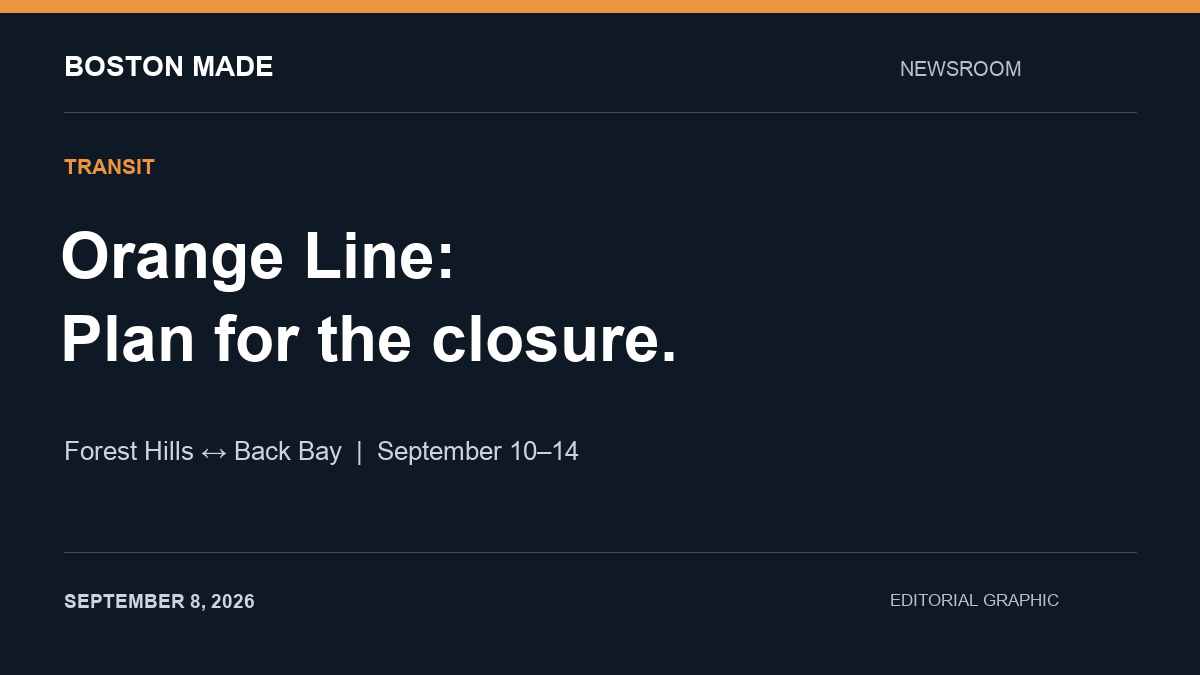
Editorial graphic: Orange Line closure between Forest Hills and Back Bay, September 10–14.

Orange Line riders should plan for a five-day interruption between Forest Hills and Back Bay from September 10 through 14, the MBTA says. The closure supports concrete repairs at Ruggles, including platforms, stair walls and the Ruggles Street Bridge.

How to get around

Free accessible shuttles will connect the affected stations. Commuter Rail service between Forest Hills, Ruggles, Back Bay and South Station will also be fare-free during the diversion.

Advertisement

Advertisement

The MBTA estimates the Forest Hills–Back Bay rail trip at about 10 minutes. Shuttle users should allow extra time: the agency’s example adds at least 30 minutes to a Forest Hills–Downtown Crossing journey.

Check before leaving

The closure follows the return to school and work after Labor Day. Confirm your route before traveling, especially when making a timed connection.

Source: MBTA September service advisory, updated August 19 and checked September 8, 2026. Consult MBTA alerts for changes.

Background

The Orange Line is one of the MBTA’s rapid transit lines, running between Oak Grove in Malden and Forest Hills in Jamaica Plain. Its southern section runs through the Southwest Corridor, a route the line moved to in the late 1980s, alongside a linear park and parallel Commuter Rail and Amtrak tracks. That shared corridor is why Commuter Rail can serve as an alternative for some riders when part of the Orange Line is closed.

Advertisement

Ruggles station, the focus of this closure, sits near Northeastern University and is a major connection point. Several bus routes meet there, and the station serves both Orange Line and Commuter Rail riders. Concrete structures such as platforms, stair walls and bridges are exposed to freeze-thaw cycles, water and salt over many years, which makes periodic repair a normal part of keeping older transit infrastructure safe.

Planned closures, sometimes called diversions, have become a regular tool for transit agencies doing major work. Shutting a section for several days lets crews work around the clock without the constraints of running trains, which can finish certain projects faster than working only during short overnight windows. The Orange Line had a month-long full shutdown in 2022 for track and other work, and shorter diversions on several lines have followed in the years since.

Advertisement

What it means for Boston-area readers

For daily riders, a closure means planning ahead. The options described in the advisory, shuttle buses and fare-free Commuter Rail, serve different needs. Commuter Rail between the affected stations is faster, according to the MBTA’s estimate, but runs on a schedule rather than at frequent intervals, so checking departure times matters. Shuttles stop at each affected station but are slower, particularly at busy times.

  • Check the schedule: look up Commuter Rail departures for your trip before leaving.
  • Allow extra time: the MBTA’s own example adds at least 30 minutes for some shuttle trips.
  • Consider other routes: some riders may find a bus, another subway line or a different station works better.
  • Plan accessible trips: riders who use mobility devices can check the advisory for accessible shuttle details and station information.
  • Tell your employer or school: if your schedule is tight, let them know about possible delays.
  • Look for signs and staff: stations affected by diversions usually have extra signage and personnel to help.

For businesses near the affected stations, the closure may change foot traffic for a few days. Letting customers and employees know about the service change, and about alternative ways to reach the location, can reduce confusion.

Why the timing matters

The advisory notes that the closure follows the return to school and work after Labor Day. Early September is typically a period when ridership picks up as students return and vacation season ends, so travel patterns may be less predictable than in midsummer. Riders who have not used the Orange Line regularly over the summer may want to review their usual route and backup options before the diversion begins, rather than discovering the change on the platform.

Key terms

  • Diversion: a planned change to normal service, often replacing trains with shuttles while work is done.
  • Shuttle bus: a bus that replaces train service between specific stations during a closure.
  • Commuter Rail: the MBTA’s regional rail network connecting Boston with surrounding communities.
  • Fare-free: riders do not need to pay for the specified service during the diversion.
  • Accessible shuttle: a shuttle bus designed to accommodate riders with disabilities, including those using wheelchairs.
  • Timed connection: a transfer that depends on arriving by a specific time, such as a scheduled train or appointment.
  • Freeze-thaw cycle: repeated freezing and thawing of water in materials, which can crack concrete over time.

What to watch

  • MBTA alerts for any changes to dates, hours or the affected stations.
  • Commuter Rail schedules for trains serving Forest Hills, Ruggles and Back Bay during the diversion.
  • Updates on the repair work at Ruggles once service resumes.
  • Announcements of future planned diversions on the Orange Line and other lines.
  • Information about how service performs after the work is completed.

Advisories can be updated close to the date, so checking the MBTA’s official alerts on the day of travel remains the safest way to plan a trip. Riders with flexible schedules may also find it easier to travel outside peak hours, when shuttles and trains are less crowded. Checking the return trip as well as the outbound one helps avoid surprises later in the day, especially for evening travel.

Quick check: Which stretch of the Orange Line is affected by the September 10 to 14 closure?

  1. Oak Grove to North Station
  2. Forest Hills to Back Bay
  3. Downtown Crossing to Haymarket
Show answer

B. The closure affects service between Forest Hills and Back Bay.

Keep Up With Nate Boston Made family Keep Up With Nate The personal site of Boston Made founder Nathan Strickland. Visit site →

Advertisement

Latest stories

View all

Service

A Short Pre-Holiday Audit for Your Website’s Download Links

Published

on

food restaurant

A downloadable menu, guide or specification sheet can outlive the page that introduced it. Before a holiday rush, check whether visitors are still receiving the right version and whether the file is usable on a phone. The useful audit is more than a search for broken links. A working link can still deliver an obsolete document.

Start with downloads connected to active products, bookings and campaigns. Record the visible link label, the file it opens and the owner of the content. Check dates, contact details and any prices or policies inside the file against the maintained source. Do not assume that a recently modified filename means the contents were reviewed.

Advertisement

Advertisement

Make the link descriptive. Tell readers what they are opening and include the file type when it helps set expectations. If the document is essential to completing a task, consider whether the information also belongs on an ordinary web page. A download should not be the only usable route to a basic answer.

Open the file on a phone, enlarge the text and check whether important content remains readable. Follow its links and inspect the final page. When replacing a file, account for existing bookmarks and shared URLs. Keep a record of the old and new destination so the team can trace any customer report without guessing.

A practical review

A useful entry can describe a specific use without pretending to know the recipient personally. For example, a desk accessory may suit someone who needs a compact writing surface, but its dimensions and care instructions still matter. Explain those practical considerations in the same paragraph as the recommendation. If the product is shown with accessories that are not included, say so near the image or link. Review the guide after any product substitution because the explanation may no longer fit. Keep a list of the products included and the person responsible for checking them. That small editorial record makes it easier to update the guide without turning an old recommendation into an accidental claim about a different item.

Before you finish

  • Check the content version, not only whether the file opens.
  • Verify contact details, conditions and any time-sensitive information.
  • Use descriptive links that make the download’s purpose clear.
  • Preserve a sensible path for people using older shared URLs.

Quick check

How much did you catch? Tap a question to see the answer.

1. Can a working link still be a problem?

Answer: Yes. It can deliver an outdated document.

Advertisement
2. Does a recent file name prove the contents were reviewed?

Answer: No. Check the dates, contacts, prices and policies inside.

3. Should a download be the only way to get a basic answer?

Answer: No. Essential information also belongs on an ordinary web page.

Building a Download Register in Under an Hour

An audit is much easier when the files are listed in one place. A simple spreadsheet is enough, and it becomes a tool you can reuse every season rather than a one-off clean-up.

  1. Gather the links. Search the site for common document extensions such as PDF, DOCX and XLSX, and check the media library or file manager for documents that may be linked from emails or printed material rather than pages.
  2. Record five fields for each file. The page or pages linking to it, the visible link text, the file name and location, the content owner and the date someone last checked the contents.
  3. Mark each file’s status. Current, needs update, replace with a web page, or retire. Retire only after considering who might still be using the address.
  4. Prioritize by consequence. Files that affect bookings, orders, safety instructions or holiday arrangements come first. A historical newsletter can wait.
  5. Schedule the next review. Add a review date beside each active file so the register prompts the next check without anyone needing to remember.

A worked example

A café offers a downloadable holiday catering menu. The link still works, but the document lists last year’s collection dates and an old phone extension that now rings an empty desk. The file name contains this year’s date because someone renamed it, which is why nobody noticed. In the register, this file is marked “needs update” with the owner named. When the new version is ready, it is uploaded to the same address if the platform allows, so links in previous emails now deliver the corrected menu. The key details, such as order deadlines and collection times, are also written on the catering page itself, so a customer on a phone does not need to open the file at all to know when to order.

Mistakes That Make Downloads Hard to Trust

  • Link text that says “click here” or “download.” It tells the reader nothing about what they will get. “Holiday catering menu (PDF)” is clearer.
  • Several versions with similar names. Files called “menu-final,” “menu-final-2” and “menu-new” invite the wrong one to be linked. Replace rather than accumulate where possible.
  • Documents designed only for print. Small type, multi-column layouts and scanned images of text are difficult to read on a phone and often unreadable to screen readers.
  • Deleting old files without a plan. A removed document produces an error page for anyone using a saved link. Redirect the old address to the replacement or to a page that explains where the information now lives.
  • Prices and conditions duplicated in files. Every copy of a policy is another place it can go out of date. Keep the authoritative version on a maintained page and refer to it.

Questions to Ask Before the Holiday Rush

  • Which downloads would cause a customer real trouble if they were out of date this month?
  • Who is responsible for each one, and do they know it?
  • Can a customer complete the most common task without opening any file?
  • Do the files contain contact details that will be unattended over the break?
  • If we replace a file, will old links in past emails still reach the right version?
  • Has anyone opened the most important files on a phone this season?

Working through these questions a few weeks before the busiest period leaves time to fix problems calmly. The same register then makes the January review faster, because the list of files and owners already exists.

Fenway Web is coming to iPhone

Client news, portfolio work and the Fenway Journal in one app for iPhone, iPad and Apple Watch.

See Fenway Web

The post A Short Pre-Holiday Audit for Your Website’s Download Links appeared first on Fenway Web.

Boston Made Foundation Boston Made family Boston Made Foundation The philanthropic arm of the Boston Made family. Visit site →

Advertisement

Continue Reading

Service

Make a Closure Notice Work for Visitors Who Skip the Homepage

Published

on

Diverse business team collaborating in a modern office

A holiday closure notice on the homepage may never reach the person using a saved booking link. Many customer journeys begin on an interior page, an email link or a search result. Important temporary information needs to appear where it affects the task, not merely where the team first thinks to announce it.

List the actions affected by the closure. Perhaps appointments pause while orders remain available, or inquiries wait until the team returns. Place a short, accurate explanation near each affected action. Avoid adding a broad warning to unrelated pages if it makes an available service look unavailable.

Advertisement

Advertisement

Use complete dates and explain the practical consequence. Tell customers when a request will be reviewed or which collection arrangements remain in place. If a form can still accept submissions, say so. Do not suggest that submitting it guarantees a place in the next working day’s schedule.

Test a direct visit to the booking page, contact page and any active campaign destination. Read the confirmation email as well, because it may contain an outdated response promise. Assign responsibility for returning the ordinary wording after the closure. A notice is finished only when both its installation and its removal are planned, and the customer-facing journey tells one consistent story.

A practical review

A practical review can use one realistic customer scenario. Imagine a person clicking an email about a service package while comparing options on a phone. They should be able to identify what the package covers, whether it suits their situation and whether the next button requests information or starts a purchase. Ask a reviewer to describe those three things before completing the action. If the answers differ from the operational team’s understanding, revise the page before changing the campaign budget. Capture the approved offer wording in the campaign record so a later email does not silently introduce a different promise. This keeps creative work, website content and measurement connected to the same actual proposition instead of three slightly different versions of it.

Before you finish

  • Identify affected actions rather than placing an indiscriminate sitewide warning.
  • Test direct links that bypass the homepage notice.
  • Check confirmation emails for inconsistent response expectations.
  • Assign an owner for restoring the ordinary wording afterward.

Quick check

How much did you catch? Tap a question to see the answer.

1. Why isn’t a homepage notice enough?

Answer: Many visitors arrive on an interior page, a saved booking link or a search result.

Advertisement
2. Where should a closure explanation go?

Answer: Next to each action the closure affects.

3. Which page outside the website should you check?

Answer: The confirmation email, which may promise an outdated response time.

Mapping Every Door Into the Site

Before writing a single line of notice text, it helps to know where visitors actually enter. With the late-November and December holidays approaching, this is a good week to build that list, because the same map can be reused for every closure in the year ahead.

  1. Start with your analytics landing pages. Look at which pages people arrive on first, not just which pages get the most views. Booking pages, individual service pages and blog posts that rank in search often appear near the top.
  2. Add every link you have sent out. Recent email campaigns, social posts, printed materials with a web address, and any links in an email signature all lead somewhere. Write down each destination.
  3. Include the pages outside your website. Online booking tools, business listings, automated replies and confirmation messages all carry promises about timing. They are part of the customer’s journey even if they are not on your domain.
  4. Mark each entry point with the action it supports. Is it a place to book, buy, ask, pick up or simply learn? Only the entry points tied to an affected action need a notice.

The result is a short table in your own notes: entry point, action, affected or not, and the wording that will go there. That one list keeps the notice from being either missing where it matters or scattered where it does not.

Writing the Notice Itself

A closure notice has one job: help a person decide what to do next. That means it should answer three questions in as few words as possible: what is paused, for how long, and what still works.

A pattern that holds up

Appointment booking is paused from Thursday, November 26 through Sunday, November 29. You can still send a request using this form; we will review requests in the order received starting Monday, November 30. Online orders continue as normal.

Notice what the example does. It uses full dates with days of the week, so nobody has to count. It says plainly that the form still works. It describes what happens to a request without promising a particular appointment. And it tells the visitor about the service that remains available, so they do not assume everything is closed. Adjust the dates and services to your own situation, but keep that structure.

Phrases to avoid

  • “We’ll be back soon.” Soon means something different to everyone. Use a date.
  • “Closed for the holidays.” Which holidays, and which services? Be specific.
  • “We’ll get back to you first thing.” If several days of requests arrive at once, “first thing” may not be realistic. Describe the order, not the speed.

Planning the Removal Before You Install

Expired notices are surprisingly common, and they do quiet damage. A visitor who sees a closure message weeks after the team has returned may simply leave. Removing the notice deserves the same care as adding it.

Advertisement

  • Put the removal date on a shared calendar with a named person beside it.
  • Keep a copy of the ordinary wording for each page so it can be restored exactly, rather than rewritten from memory.
  • If your website tools allow a scheduled end time for a banner or notice, use it, and still check manually afterward.
  • Revisit the confirmation email and automated replies on the first working day back. These are the places most often forgotten.
  • Run the same direct-link test you ran before the closure, this time confirming that every trace of the notice is gone.

Quick Answers for Busy Teams

Should the homepage still carry a notice? Yes, if the closure is significant. It just should not be the only place. Think of it as one of several entry points on your map.

What about partial closures, like reduced hours? Treat them the same way. Reduced hours affect specific actions, such as same-day pickup or phone support, so place the explanation beside those actions.

How early should the notice go up? Early enough that someone booking ahead will see it. For many small businesses, a week or two before the closure is a sensible starting point, but your own booking patterns are the better guide.

Fenway Web is coming to iPhone

Client news, portfolio work and the Fenway Journal in one app for iPhone, iPad and Apple Watch.

See Fenway Web

The post Make a Closure Notice Work for Visitors Who Skip the Homepage appeared first on Fenway Web.

Pupwear Boston Made family Pupwear Dog apparel and gear inspired by Boston the GoldenDoodle. Visit site →

Advertisement

Continue Reading

Service

Separate AI Brainstorming From Facts in a Campaign Brief

Published

on

weather storm

An AI brainstorming session can produce many possible campaign angles quickly. That speed makes it easy for a plausible suggestion to become an assumed fact. A better brief separates creative possibilities from statements that someone has checked. This keeps the tool useful without asking the reader to trust its confidence.

Create two areas in the working document: ideas and verified inputs. Ideas can include headline directions, audience questions and alternative page structures. Verified inputs should identify the responsible person or source for prices, availability, specifications and policies. Never move a suggestion into the factual section just because it sounds familiar.

Advertisement

Advertisement

Give the tool a narrow job using approved material. Ask for different ways to explain a known service, not invented customer success stories. Exclude private customer records, credentials and confidential plans from prompts unless the organization has explicitly approved the tool and the use. A useful output is a set of options an editor can assess.

Before design begins, have a human owner resolve every claim the campaign will make. Keep rejected suggestions out of the final brief so a designer does not accidentally reuse them. The finished brief should state what is confirmed, what still needs approval and which creative direction was chosen. AI can expand the options; it cannot supply missing business authorization.

A practical review

Suppose the business has two services with similar names, but only one is appropriate for a short lead time. The seasonal panel can explain that difference without claiming that an appointment is guaranteed. Give the reader a question they can answer, such as whether they need an initial assessment or are ready to request the work itself. Follow both routes during testing. Check that the page reached by the unsuitable visitor offers a useful explanation rather than simply sending them back. Keep the route names consistent with the page headings. When the seasonal panel is removed, retain any clearer service wording that helped the tester. Seasonal preparation can leave a permanent improvement when the underlying customer question is handled properly.

Before you finish

  • Keep creative suggestions visibly separate from verified business inputs.
  • Give each factual claim a source or an accountable owner.
  • Avoid private data and unapproved confidential material in prompts.
  • Remove rejected claims before handing the brief to a designer.

Quick check

How much did you catch? Tap a question to see the answer.

1. What two areas should a campaign brief have?

Answer: Ideas, and verified inputs with a named source or owner.

Advertisement
2. When can an AI suggestion move into the facts section?

Answer: Only after a person checks it. Sounding familiar is not enough.

3. What should stay out of prompts?

Answer: Private customer records, credentials and confidential plans, unless the use is approved.

A Simple Layout for the Working Brief

The two-area idea is easier to follow when the document itself makes the boundary obvious. One workable layout uses four labeled blocks in a fixed order, so anyone opening the file knows where to look and where not to borrow from.

  1. Objective. One or two sentences on what the campaign must achieve and for whom. This is written by the person who owns the campaign, not generated.
  2. Verified inputs. Each line is a single claim followed by its source or owner and the date it was confirmed. For example: “Service A is available for short lead times — confirmed by operations lead.” If a line has no owner, it does not belong here yet.
  3. Open questions. Claims the campaign would like to make but nobody has confirmed. These are not failures; they are a to-do list. Each one should name who is expected to answer it.
  4. Creative options. Headline directions, angles, page structures and tone experiments, including anything produced in a brainstorming session. Mark the chosen direction clearly once a decision is made, and delete the rest before handoff.

The order matters. Putting verified inputs above the creative options signals that the creative work is built on top of confirmed facts, not the other way around.

A short worked example

Imagine a brainstorming session returns the line “Trusted by homeowners across the region for fast, same-week service.” It reads well. It also contains at least three claims: that the audience is homeowners, that the coverage is regional, and that service happens within a week. None of those has been checked. The editor’s job is to split the sentence apart, move each claim to Open questions with an owner, and keep only the tone of the line in Creative options. If operations later confirms one of the three, that single claim moves up to Verified inputs. The others stay out of the campaign.

Where Plausible Suggestions Slip Through

Most mistakes do not come from someone deliberately using an unverified claim. They come from small handoffs where the label falls off.

  • Copying a headline into a design file. Once a line appears in a mockup, it looks approved. Keep draft copy visibly marked until the campaign owner signs off.
  • Summaries of summaries. Asking a tool to “tidy up” the whole brief can blend the creative section into the factual one. Edit the sections separately.
  • Familiar phrasing. A claim that resembles last year’s campaign may feel verified because the team has seen it before. Prices, availability and policies change; check them again for each campaign.
  • Specifications by inference. A tool may infer a product dimension or a service limit from similar businesses. Inferred is not confirmed.
  • Quiet edits after approval. If a claim is reworded after sign-off, the new wording needs the same review. “Usually available” and “always available” are different promises.

Questions to Ask Before the Brief Leaves Your Hands

A quick self-review before handoff catches most problems. Read the brief and ask:

  • Could a designer reading only this document tell which statements are confirmed?
  • Does every price, date, availability statement and policy have a named owner?
  • Are there any comparisons with competitors, and if so, has someone with authority approved them?
  • Did any prompt include material the organization has not approved for that tool?
  • Is there anything in the creative section that a reader could mistake for a commitment?

If any answer is uncertain, fix the brief rather than leaving a note for the next person. Notes get lost; structure tends to survive.

Advertisement

Reader questions

Does this slow down the campaign? Usually by minutes, not days. The time saved by not reworking a finished design around a claim that turned out to be wrong is almost always larger.

Who should own verification? The person closest to the fact. Pricing belongs with whoever sets prices; availability with whoever schedules the work. A marketer can collect confirmations but should not be the source of them.

Should we keep the rejected ideas anywhere? If they are useful for future campaigns, keep them in a separate ideas file that is never attached to a live brief. That way they remain available without the risk of resurfacing by accident.

Fenway Web is coming to iPhone

Client news, portfolio work and the Fenway Journal in one app for iPhone, iPad and Apple Watch.

See Fenway Web

The post Separate AI Brainstorming From Facts in a Campaign Brief appeared first on Fenway Web.

Lumo Kingswell Lumo Precious-metals education and a two-sided gold exchange with a live gold price. Visit site →

Advertisement

Continue Reading
Advertisement

Advertisement

Ad

Advertisement

Trending

--:--·---·--°