BOSTON — Boston Made, Inc. has added two consumer platforms to its portfolio, both aimed at the same 60-mile stretch of South Carolina coastline: Grand Strand App, a live local guide and trip concierge, and Spot Check App, a peer-to-peer parking marketplace. A look at the tourism and parking data behind the region shows why the company chose to launch them together, and what the two products will have to prove.
A large market that had a softer year
The Grand Strand is one of the biggest leisure-travel markets on the East Coast. According to Visit Myrtle Beach, the area drew about 18.2 million visitors in 2024, who spent roughly $13.2 billion, up 5.3% from the year before. The organization puts the total economic impact at more than $26 billion and credits tourism with more than 82,000 direct and indirect jobs across the region.
The trend did not hold into 2025. Data released by Visit Myrtle Beach and the Myrtle Beach Area Chamber of Commerce showed tourism down 3% for the year, WMBF News reported in February. Explanations varied, including severe-weather worries, negative social-media attention, and household budgets that kept some travelers home. Local tourism leaders said the recovery would depend on the experiences the destination offers, such as live music, theater, the beach, and food.
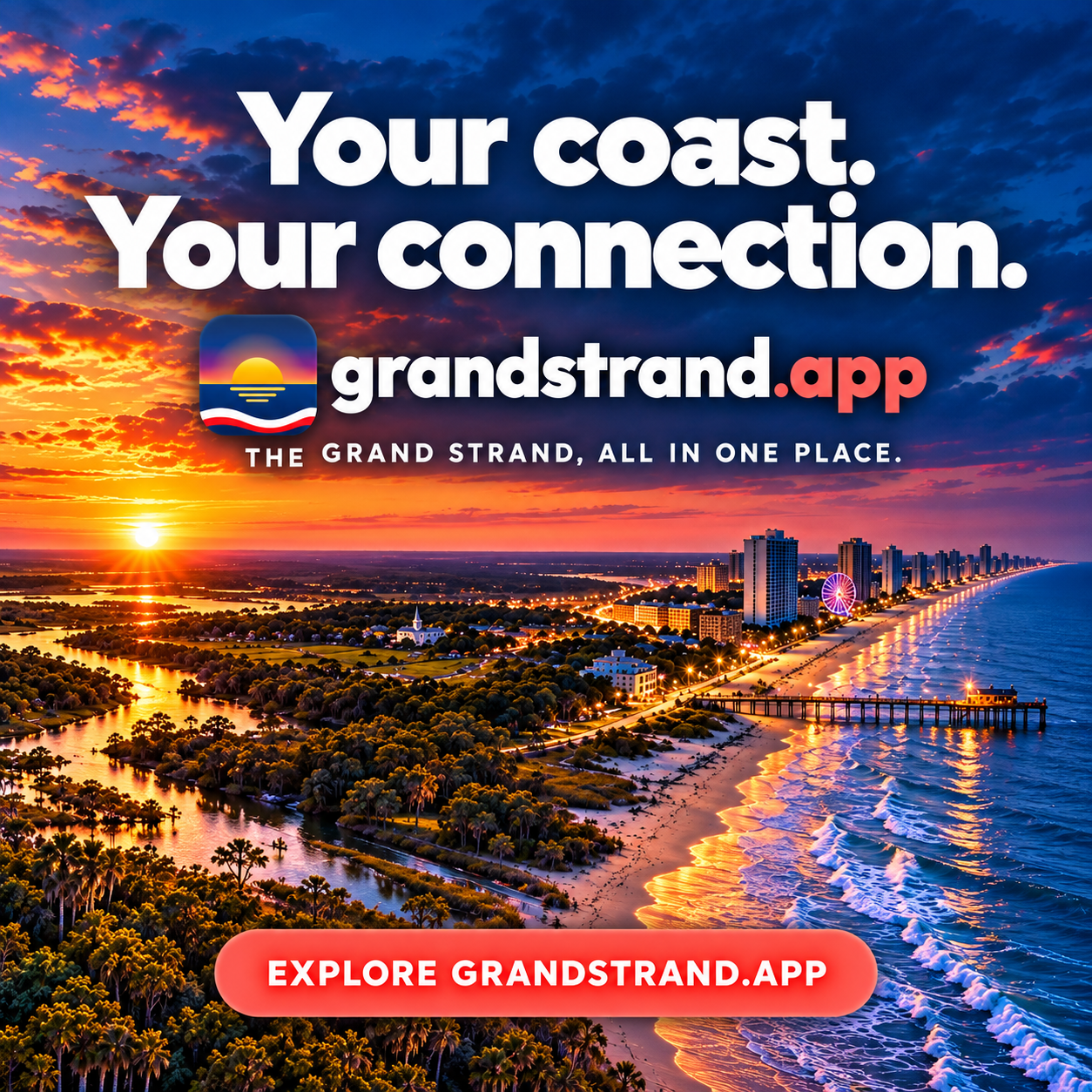
Why it matters: In a softer year, the destinations that win are the ones that are easiest to plan and enjoy. That is the gap Grand Strand App is built for. Rather than a static directory, it opens on live conditions: surf, the next tide from the NOAA gauge at Springmaid Pier, beach-safety notes, and weather. Its concierge then suggests three stops with drive times based on the weather, the tide, and the time of day.
Parking is a seasonal policy question
Parking on the Grand Strand changes with the calendar. In Myrtle Beach’s downtown district, which runs from Sixth Avenue South to 21st Avenue North, paid parking returned on March 1, 2026, and runs through September 30, with enforcement from 9 a.m. to midnight, seven days a week, and tickets starting at $30, according to WMBF News. From October 1 through the end of February, city-metered spaces downtown are free under a City Council decision to restore off-season free parking.
The result is a market where demand peaks in exactly the months when public parking costs the most and is hardest to find, while private driveways and garages a few blocks from the beach often sit empty.
The cost of searching is not trivial anywhere. A widely cited 2017 INRIX study estimated that the average U.S. driver spent about 17 hours a year looking for parking, at a cost of about $345 per driver in wasted time, fuel, and emissions, or $72.7 billion nationally. The figures are national and several years old, but the pattern they describe is sharper in a crowded beach town during peak season.
How the two products fit together
Spot Check’s model is simple. Drivers search a live map of driveway, garage, lot, street, covered, and EV-charging spaces, each showing status and an hourly price. They message a host or send a booking request, park, and leave a review. Hosts list a space in about two minutes by dropping a pin, choosing a type, and setting an hourly price and size or clearance.
Grand Strand App acts as the demand funnel. Its navigation includes a “reserve a driveway” link to Spot Check and a “list a parking space” link for owners, and its Grand Strand Season series covers parking topics directly, including free downtown parking, North Myrtle Beach parking, and whether rental guests should use valet service. Spot Check, in turn, publishes a daily Parking Briefing that is syndicated into Boston Made Reader.
The pairing reflects a strategy Boston Made has used across its portfolio: a content product that earns daily attention, linked to a transactional product that serves the need that content keeps surfacing.
What the platforms will have to prove
- Supply before demand. Any two-sided marketplace has to recruit hosts before drivers will trust the map. Spot Check’s early inventory is small, and growth will depend on reaching homeowners and rental owners near high-traffic areas.
- Local rules. Renting a driveway can be affected by municipal ordinances, HOA covenants, and rental-property agreements. Hosts will need clear guidance, and the platform will need to keep pace with local policy.
- Trust and accountability. Reviews are Spot Check’s main trust mechanism today. Clear booking terms, dispute handling, and verified listings will matter as volume grows.
- Seasonality. With free downtown parking for five months of the year, Spot Check’s value is highest in spring and summer and around events. Grand Strand App’s off-season content, from fall calendars to shoulder-season itineraries, has to keep users engaged in the quieter months.
- Data quality. A live guide is only as good as its feeds. Grand Strand App’s reliance on marine forecasts and NOAA tide data is a strength, as long as those inputs stay current and clearly labeled.
The bottom line
Grand Strand App and Spot Check App are small, early products in a large regional market. Their bet is that a guide people check every morning can create steady demand for a parking marketplace, and that a parking marketplace gives the guide a practical reason to exist beyond inspiration. Both brands are now profiled on the Boston Made Brands page, and the founding story is on bostonmade.com.
Sources
- Visit Myrtle Beach, destination statistics: context.visitmyrtlebeach.com
- WMBF News, “Myrtle Beach tourism down 3% in 2025, local businesses hope for better 2026” (Feb. 5, 2026): wmbfnews.com
- WMBF News, “Paid parking returning to Myrtle Beach downtown district this weekend” (Feb. 27, 2026): wmbfnews.com
- INRIX via Parking.net, “Searching for Parking Costs Americans $73 Billion a Year” (2017): parking.net
- Product details from grandstrand.app and spotcheckapp.com, reviewed October 8, 2026.












 Corporate News3 weeks ago
 E-Commerce9 months ago
 Boston Made Stories2 weeks ago
 Pet Industry9 months ago
 Fiction1 month ago