
Connect with us

Weather where you are

Choose your location or share it once. We round your coordinates to about 1 km before sending them to our site and MET Norway for your forecast. Your choice stays in this browser tab.

Stay close to Boston

Get new Boston stories and Boston Made company updates, delivered as browser notifications.

Choose Enable notifications, then allow notifications in your browser.

Your browser subscription is stored by Boston Made and delivered through your browser’s push service. You can turn notifications off in your browser’s site settings. Privacy policy

Technology

Protecting Your Online Accounts: Passwords, Passkeys and Two-Factor Authentication

Most account takeovers start with a weak, reused or stolen password. This practical guide explains strong passwords, password managers, two-factor authentication and passkeys, and how to set up recovery so an account stays protected.


Published

on

A laptop with a vibrant colorful screen glowing on a dark wooden desk

BostonMade.io and the Boston Made App form the app and web platform that helps people find the independent sister brands affiliated with Boston Made, Inc. Using any online platform safely starts with protecting the accounts behind it. Account security can seem technical, but a few well-understood habits block most common attacks. This guide explains them in plain language.

How Accounts Get Taken Over

It helps to understand the most common threats first:

Advertisement

Advertisement
  • Password reuse and credential stuffing: When one website suffers a data breach, criminals try the stolen email-and-password combinations on many other sites, betting that people reuse passwords.
  • Phishing: Fake emails, texts or websites trick people into typing their password or a one-time code into a page controlled by an attacker.
  • Guessing: Short or common passwords, or those based on easily found personal details, can be guessed by automated tools.
  • Malware: Malicious software on a device can capture keystrokes or steal stored sign-in data.

Each of the defenses below targets one or more of these threats.

Strong, Unique Passwords

A strong password today is long rather than complicated. Security guidance, including recommendations from the U.S. National Institute of Standards and Technology, emphasizes length and uniqueness over forcing odd symbols or frequent changes. Practical tips:

  • Aim for long passwords. A passphrase of several unrelated words is easier to remember and harder to guess than a short string of symbols.
  • Never reuse a password across important accounts, especially email, banking and any account used to sign in to other services.
  • Avoid names, birthdays, pet names, favorite bands, addresses or other details that can be found online.
  • Change a password promptly if a service reports a breach or if there are signs of suspicious activity.

Let a Password Manager Do the Remembering

No one can remember dozens of long, unique passwords. A password manager is an app that creates, stores and fills them in automatically, protected by one strong master password and often by the device’s biometric lock. Many browsers and phone operating systems include built-in password managers, and independent apps are also available.

Password managers also help against phishing. Because they fill in passwords only on the real website address saved with each entry, they will not offer the password on a look-alike site. Many also warn when a saved password is weak, reused or has appeared in a known breach.

Two-Factor Authentication

Two-factor authentication (2FA), sometimes called multi-factor authentication, adds a second check beyond the password. Even if a password is stolen, an attacker still needs the second factor. Common types, from generally weaker to generally stronger:

Advertisement
  1. Text message (SMS) codes: Much better than a password alone, but vulnerable to phishing and to “SIM swapping,” in which criminals trick a carrier into moving a phone number to their device.
  2. Authenticator apps: Apps that generate a new six-digit code every 30 seconds or so. They do not depend on the phone network, but the codes can still be phished.
  3. Push approvals: A prompt on a trusted phone asking to approve a sign-in. Never approve a prompt that was not expected. Attackers sometimes send repeated prompts hoping someone taps “approve” to make them stop.
  4. Security keys: Small physical devices that plug in or tap a phone. They are designed to resist phishing because they check the website’s identity before responding.

Turning on any form of 2FA, starting with email accounts, is one of the most effective steps a person can take.

Passkeys: Signing In Without a Password

Passkeys are a newer sign-in method built on open standards developed by the FIDO Alliance and major technology companies. Instead of a password, the device creates a pair of cryptographic keys for each website. The private key stays on the person’s device or in a password manager, and the website keeps only the public key. Signing in uses a fingerprint, face scan or device PIN to unlock the private key.

Advertisement

Passkeys offer several advantages:

  • There is no password to reuse, guess or steal from the website’s servers.
  • They are tied to the real website, so they strongly resist phishing.
  • They are often faster than typing a password and a code.

Many major services now support passkeys, and they can typically be synced across a person’s devices through their platform account or password manager. Where a service offers passkeys, they are worth considering.

Plan for Recovery

Strong security is only half the job. People also need a way back in if a phone is lost or a password is forgotten:

  • Keep the recovery email address and phone number on important accounts up to date.
  • Save backup codes in a safe place when a service provides them.
  • Register more than one second factor where possible, such as two security keys or a passkey on two devices.
  • Learn each important service’s account recovery process before it is needed.

Spotting Phishing

Good habits make phishing much less effective. Be suspicious of urgent messages about locked accounts, prizes or payments. Navigate to a website directly instead of clicking links in unexpected messages. Check the web address before signing in. Never share a one-time code with someone who contacts you. Legitimate companies do not ask for those codes.

A Quick Checklist

  1. Secure the main email account first with a unique password and 2FA.
  2. Start using a password manager.
  3. Replace reused passwords, beginning with financial and email accounts.
  4. Turn on passkeys where available.
  5. Update recovery options and store backup codes.
  6. Keep devices and apps updated.

Quick check: Why are passkeys considered strongly resistant to phishing?

  1. They are longer than most passwords
  2. They are tied to the real website and never send a reusable secret to it
  3. They change every 30 seconds
Show answer

B. A passkey works only with the genuine website it was created for, and the private key never leaves the user’s device, so a fake site has nothing to capture.

PupWear (.org) Boston Made family PupWear (.org) Dog apparel and gear inspired by Boston the GoldenDoodle. Visit site →

Advertisement

Latest stories

View all

Boston History · Nov 26, 2026The Liberty Tree: Where Boston Learned to RebelAn elm near Boston Common became a gathering place, a political symbol, and one of revolutionary America's most famous trees.Read story
Continue Reading

Boston Made+ Exclusive

Expanding Platform Capabilities

Boston Made App news update.

Published

on

Title card: Expanding Platform Capabilities

Boston Made App continues to support the long-term vision of the Boston Made ecosystem. Under the strategic leadership of Paxton-Digital, the organization is investing in technology, governance, intellectual property management, and sustainable growth. This article highlights ongoing initiatives across the portfolio and demonstrates how each company contributes to a connected ecosystem, focusing on what it means for an app to…

This is a Boston Made+ exclusive story. Subscribe to keep reading — plans start at $20/month.

See plans and subscribe →  |  Already a member? Log in

Advertisement
Boston Made Foundation Boston Made family Boston Made Foundation The philanthropic arm of the Boston Made family. Visit site →

Advertisement

Continue Reading

Technology

Flying Cars Are Getting Real: Where Air Taxis Stand in October 2026, and the Math That Lifts Them

Joby flew real routes over Dallas–Fort Worth in September, Archer named a Texas network in October and BETA joined seven of eight federal pilot programs. None is FAA-certified yet. Here is where things stand, with the four equations that decide whether a flying car works.
Published

on

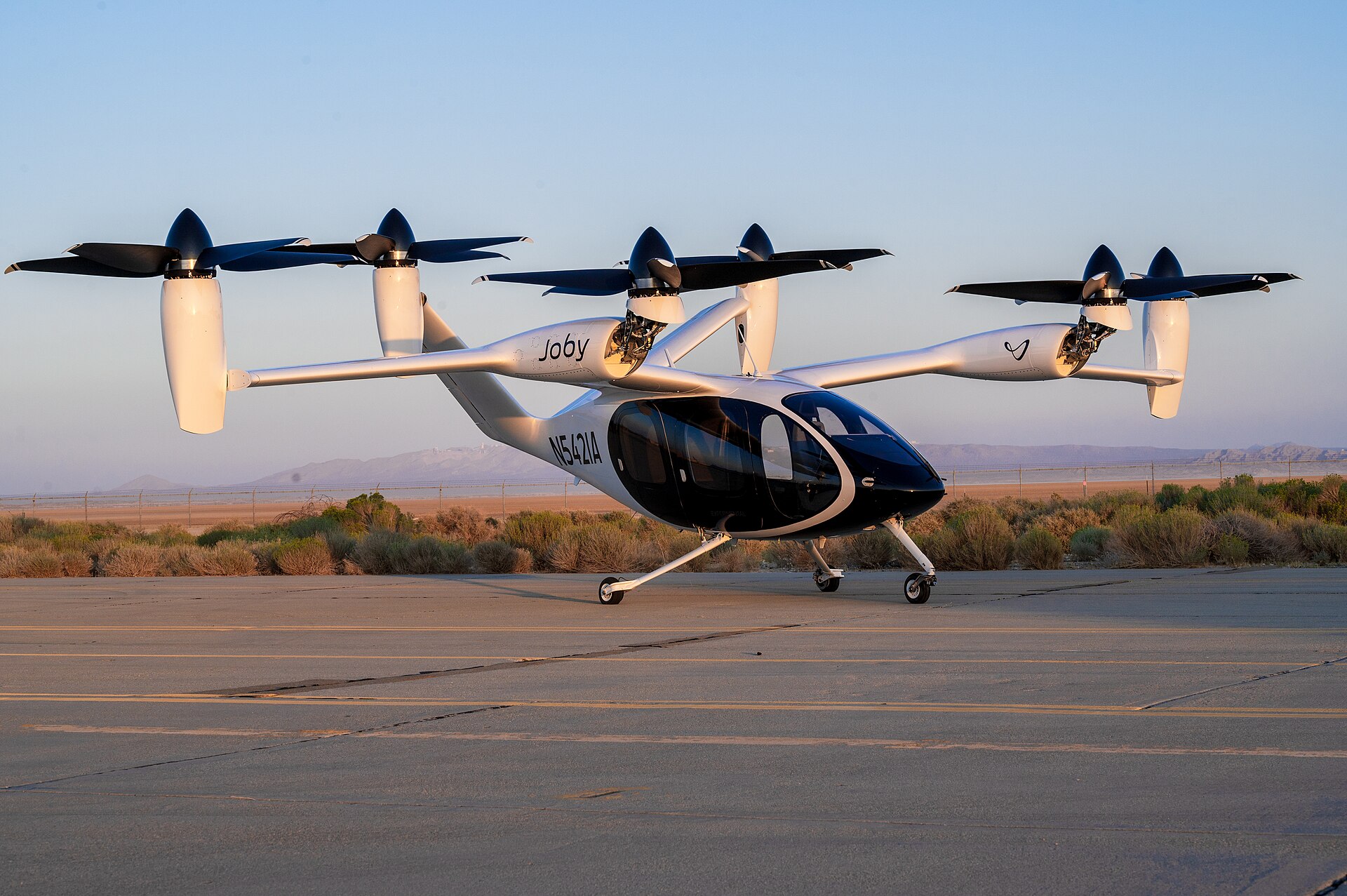
Joby Aviation S4 electric air taxi on a taxiway at Edwards Air Force Base, California

Electric air taxis are no longer only renderings. In September 2026, an electric air taxi flew real routes over Dallas–Fort Worth under a federal pilot program. Three U.S. developers, Joby Aviation, Archer Aviation and BETA Technologies, are flying aircraft designed for commercial service. None has an FAA type certificate for them yet. Here is where things stand, what the companies themselves have said, and the physics and math that decide whether a “flying car” can work.

What actually happened in 2026

  • A federal pilot program started. The U.S. Department of Transportation and the FAA picked the first participants in the eVTOL Integration Pilot Program (eIPP) in March 2026. The FAA lists eight participating governments: the Florida, Utah, Texas, North Carolina and Pennsylvania transportation departments, Louisiana DOTD, the City of Albuquerque and the Port Authority of New York and New Jersey. The FAA says the program “does not bypass certification” and is expected to run for three years after the first project becomes operational.
  • Joby Aviation flew in North Texas. From September 10 to 14, 2026, Joby flew a week-long campaign around Dallas–Fort Worth under TxDOT’s Project Nexus. The flights covered Perot Field Fort Worth Alliance Airport, a landing inside DFW Airport’s controlled airspace, a round trip to Arlington and the planned route to Toyota Motor North America’s Plano campus (Hillwood press release, Sept. 10, 2026).
  • Joby is in the last certification stage. Joby’s first FAA-conforming aircraft, registration N547JX, began flight testing in March 2026 (Joby press release, March 11, 2026). Joby’s Q2 2026 shareholder letter (Aug. 5, 2026) says the company has reached “the fifth and final stage” of FAA type certification. It reported $38.6 million in quarterly revenue and a $245.4 million net loss.
  • Archer named its Texas network. On October 23, 2026, Archer Aviation said it plans air taxi service linking the Dallas–Fort Worth, Houston and Austin areas. It would use its four-passenger Midnight aircraft on flights of 10 to 20 minutes. Archer did not give a start date, and Midnight has not received FAA type certification (AIAA, Oct. 23, 2026).
  • BETA Technologies was picked for the most programs. BETA said it was selected for seven of the eight eIPP launch programs, more than any other electric aircraft developer. It plans cargo and medical logistics with its ALIA aircraft, starting with conventional takeoff and landing (BETA press release, March 9, 2026).

BETA Technologies ALIA electric aircraft delivered to the U.S. Air Force at Duke Field, Florida
BETA Technologies’ ALIA at Duke Field, Florida, on its delivery to the U.S. Air Force for testing, Oct. 26, 2023. U.S. Air Force photo by Jennifer Bryant (public domain).

The math of a flying car

A car only has to push itself forward. A vertical-takeoff aircraft first has to hold its whole weight up on air. Four short equations show why that is hard, and why designers lift off on rotors and then cruise on wings. The numbers below are a worked example for an imaginary 2,000 kg aircraft. They are not any company’s published figures.

Advertisement

Advertisement

1. Thrust to hover

T = m · g

With m = 2,000 kg and g = 9.81 m/s², the rotors must push down about 19.6 kN, about the weight of a mid-size SUV, without any help from wings.

2. Power to hover (momentum theory)

Pideal = T3/2 ÷ √(2ρA)

Advertisement

ρ is air density (1.225 kg/m³ at sea level) and A is the total area swept by the rotors. With 30 m² of rotor disk, the ideal answer is about 320 kW. Real rotors lose some of that. Dividing by a typical efficiency (“figure of merit”) of 0.7 gives roughly 460 kW, about the output of several family cars at full throttle. Bigger rotor area means less power, which is why these aircraft have so many propellers.

3. Why they switch to wings

L = ½ ρ v² S CL

At 150 mph (67 m/s), a wing of about 14 m² with a lift coefficient of 0.5 carries the same 19.6 kN. The power then falls to weight × speed ÷ lift-to-drag ratio. With a lift-to-drag ratio of 10 and 85% drivetrain efficiency, cruise needs about 155 kW, a third of the hover figure.

Advertisement

4. The battery budget for a 25-mile hop

E = Pcruise · tcruise + Phover · thover

Ten minutes of cruise at 155 kW is about 26 kWh. Two minutes of hovering at 460 kW for takeoff and landing adds about 15 kWh, for roughly 41 kWh plus reserves. At 250 Wh per kilogram of battery, that energy alone weighs about 165 kg. This is why short hops, fast charging and lighter batteries decide the business case.

Try it yourself: open Tools → Flight in the bar at the bottom of this page. Change the mass, rotor area or air density and the hover equations update as you type. Tools also has a trip-cost calculator comparing gas and electric, plus loan, savings and equation solvers.

What it means for Massachusetts

None of the eIPP projects named so far are in Massachusetts. The Port Authority of New York and New Jersey’s application covers operations across New England, according to Joby’s March 9, 2026 announcement. For Boston-area businesses, the near-term effects are likely to show up first in cargo and medical logistics, the work BETA and its partners are targeting. Passenger air taxis come after that. Watch for three things: FAA “for credit” test flights, the first type certificate, and local vertiport and noise rules.

What to watch next

  • Whether Joby or Archer receives an FAA type certificate. Neither has one yet.
  • More eIPP flights in the other participating states, and the data the FAA says it is collecting from them.
  • Start dates for Archer’s Texas network, which it has not announced.

Sources

Photos: U.S. Air Force photos by Harlan Huntington (Joby S4, Edwards Air Force Base, Sept. 20, 2023) and Jennifer Bryant (BETA ALIA, Duke Field, Oct. 26, 2023), both public domain via Wikimedia Commons. The worked example uses textbook physics and round, illustrative inputs. It does not describe any company’s aircraft. This article is for information only and is not investment advice.

Boston Made Reader Boston Made family Boston Made Reader Free e-reader app for long reads, wires and books. Visit site →

Advertisement

Continue Reading

Technology

Before the First Nor’easter: A Tech Readiness Checklist for Small Businesses

Power outages and storms can knock a small business offline. A practical October checklist for backups, internet, phones and point-of-sale systems.


Published

on

Snow falling on buildings and street in city

October is the calm before the season of nor’easters, ice storms and heavy snow. For a small business in New England, a single outage can mean lost sales, missed calls and frozen systems. The best time to prepare is now, while the weather is still mild and there is time to fix what a quick review turns up.

Protect Power to Critical Equipment

Even brief power flickers can damage electronics or corrupt data. Start with the basics:

Advertisement

Advertisement
  • Put computers, network equipment and point-of-sale terminals on surge protectors at a minimum.
  • Consider an uninterruptible power supply, a battery unit that keeps key equipment running for a short time and allows a safe shutdown.
  • Label which outlets and devices matter most, so staff know what to protect first.
  • If you use a backup generator, follow the manufacturer’s safety instructions, never run it indoors and have a licensed electrician handle any connection to building wiring.

Plan for Internet Outages

Many businesses now depend entirely on the internet for payments, scheduling and communication. Think through what happens if your connection goes down:

  • Can your point-of-sale system process cards offline and sync later? Check its settings and limits in advance.
  • Is a cellular hotspot or phone tethering available as a temporary backup?
  • Do you know how to reach your internet provider’s outage information from a phone?
  • Are your router and modem on battery backup so a short power blip does not drop the connection?

Keep Phones and Customers Connected

If customers cannot reach you, they may assume you are closed for good. Make sure your business phone line can forward to a mobile number. Prepare a short message for your website, social media and online business listings explaining any closure or changed hours. Write it now, so you only need to fill in the details during a storm.

Confirm Your Backups

Storms are a common time for hardware failures and water damage. Before winter, verify that backups of important files and systems are running and that you can actually restore from them. Keep at least one copy off-site or in the cloud, so damage to the office does not take your data with it. If laptops leave the office during storms, make sure they are encrypted and protected with strong passwords.

Write a One-Page Plan

A simple, printed plan is easier to follow in a crisis than a complicated binder. Include:

  • Who decides whether to close and how staff will be notified.
  • Contact information for your internet provider, phone provider, IT help and landlord.
  • Steps to shut down and restart key systems safely.
  • Where backups, passwords and important documents are kept.

Sign up for local emergency alerts from your city or town and follow official guidance during storms, including from the Massachusetts Emergency Management Agency. An hour of preparation in October can save days of disruption in January.

Advertisement

Background

A nor’easter is a large coastal storm named for the strong northeast winds that blow in from the ocean ahead of it. These storms can form at any time of year but are most common and most disruptive from late fall through early spring, when they can bring heavy snow, ice, coastal flooding and damaging gusts to New England. Unlike a brief thunderstorm, a nor’easter can linger for a day or more, which means outages and travel problems can stretch out as well.

Advertisement

Winter weather affects technology in several ways at once. Wind and heavy, wet snow bring down tree limbs and power lines. Ice can damage utility equipment. Flooding can reach basements where servers, network gear or electrical panels are often installed. Even when the business itself is unaffected, staff may be unable to travel, and customers may stay home.

What it means for small businesses

For many small businesses, the most valuable step is simply deciding in advance what matters most. A short list of critical systems, usually payments, phones, email, scheduling and key files, makes it easier to spend preparation time wisely. A few additional ideas complement the checklist in the article:

  • Test your battery backups. Batteries in uninterruptible power supplies wear out over time. Many units have a self-test function; use it before winter rather than discovering a dead battery during an outage.
  • Move equipment off the floor. If network or computer equipment sits in a basement or on the floor, raising it can reduce the risk of water damage.
  • Know what works without power. Find out whether your door locks, alarm system and phones rely on electricity or internet service, and what happens when either goes out.
  • Plan for remote work. If staff can work from home, confirm they have the access and equipment they need before a storm, not during it.
  • Keep paper copies of essentials. A printed contact list and the one-page plan are useful precisely when screens and networks are down.

After the storm

Recovery deserves a plan too. Power can return unevenly, sometimes with surges. Many businesses wait a short time after power is restored before turning equipment back on, then restart systems in a sensible order: the internet connection and network first, then computers and point-of-sale systems. If any card transactions were processed offline, confirm they synced correctly. Update your website and listings once regular hours resume, so customers know you are open again.

It also helps to write down what went well and what did not. A brief review after each significant storm improves the plan for the next one.

Key terms

  • Nor’easter: A strong coastal storm with northeast winds, common along the East Coast in colder months.
  • Surge protector: A device that helps shield electronics from sudden voltage spikes.
  • Uninterruptible power supply (UPS): A battery unit that provides short-term power so equipment can keep running briefly or shut down safely.
  • Offline mode: A setting on some payment systems that stores transactions and processes them once the connection returns.
  • Off-site backup: A copy of data stored at a separate physical location or in the cloud.

What to watch

  • When was the last time you actually restored a file from your backups?
  • How long can your battery backups keep critical equipment running?
  • Does every staff member know where the one-page plan is and who makes the call to close?
  • Are your website and listings ready to display a closure notice quickly?
  • Have official storm alerts been set up on the phones of the people who need them?

Quick check: What does an uninterruptible power supply mainly provide during an outage?

  1. Unlimited power for the whole building
  2. Short-term battery power so key equipment can keep running briefly or shut down safely
  3. A faster internet connection
Show answer

B. A UPS is a battery unit that bridges short outages and allows a safe shutdown of critical equipment.

Paxton-Digital Boston Made family Paxton-Digital Enterprise technology for IP protection and portfolio management · a Kingswell company. Visit site →

Advertisement

Continue Reading
Advertisement

Advertisement

Ad

Advertisement

Trending

More doors into Boston Made

The newsstand, the brands and the AI research desk, each updated as new stories go live.

Boston Made Reader Every Boston Made story in one feed, newest first. Newest from Boston MadeBoston Holiday Lights and Events, Nov. 30 to New Year’s Eve Open Reader The brands Every company in the Boston Made family: what it does and where to find it. Boston Made+ReaderBOSSTOXBoston Made PetsPupwearThe SixFenway WebBoston Made CoffeeBoston Made Foundation See the brands BOSSTOX Research on AI infrastructure: compute, cooling, power and networks. Newest from BOSSTOXA Backup Exists; a Restore Still Needs to Be Demonstrated Read BOSSTOX
--:--·---·--°