Connect with us

Weather where you are

Choose your location or share it once. We round your coordinates to about 1 km before sending them to our site and MET Norway for your forecast. Your choice stays in this browser tab.

Stay close to Boston

Get new Boston stories and Boston Made company updates, delivered as browser notifications.

Choose Enable notifications, then allow notifications in your browser.

Your browser subscription is stored by Boston Made and delivered through your browser’s push service. You can turn notifications off in your browser’s site settings. Privacy policy

Real Estate & Development

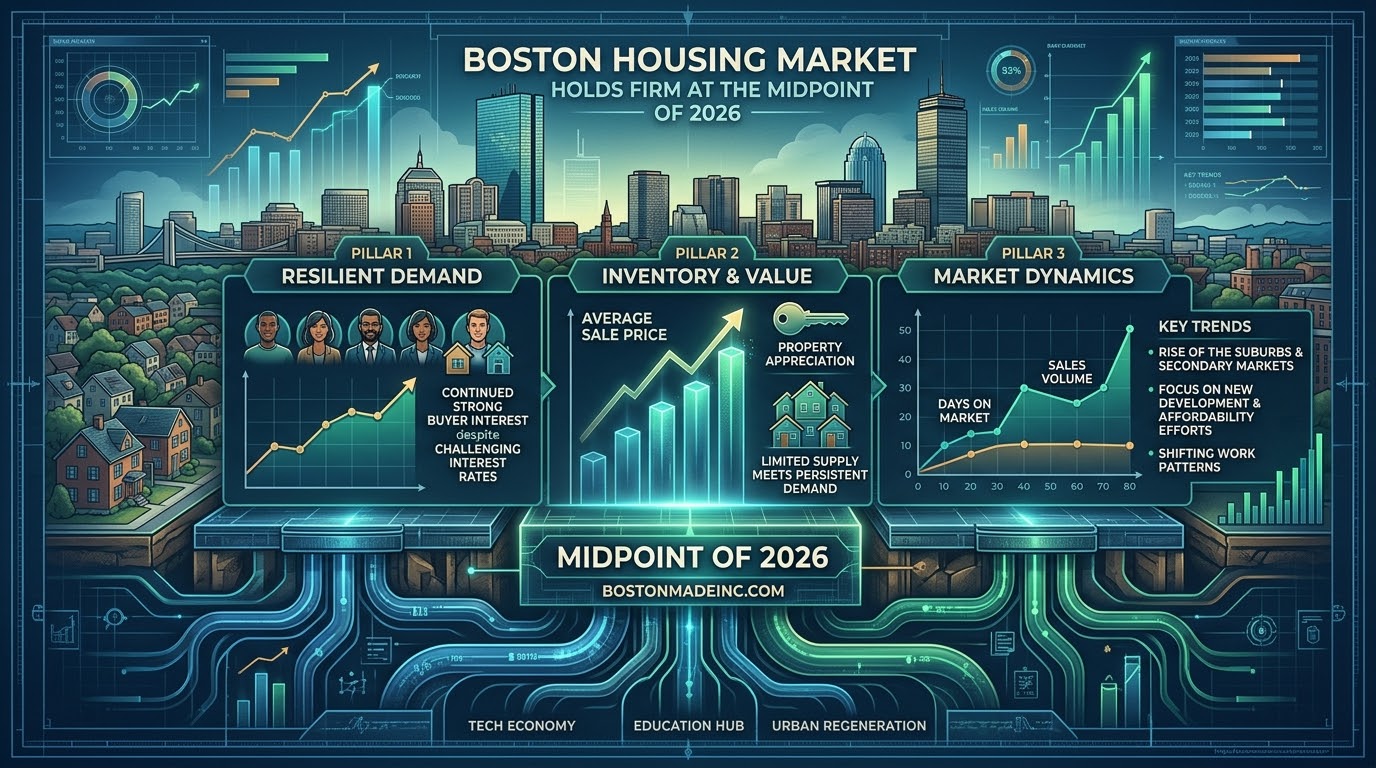
Boston Housing Market Holds Firm at the Midpoint of 2026

Nathanael Strickland

Published

on

Boston’s housing market has remained a focal point for the region’s economy through the middle of 2026, with real estate trackers including Redfin, Zillow, and locally based brokerages publishing mid-year assessments of the city’s home-price trends. While the specific figures vary by source and methodology, the broader picture described across multiple mid-2026 market reports is one of a housing market that has stayed comparatively resilient even as affordability remains a persistent concern for buyers.

Boston’s housing costs have long outpaced national medians, driven by constrained inventory, high demand tied to the region’s university and hospital systems, and a limited pipeline of new construction relative to demand — dynamics that multiple 2026 market analyses point to as continuing to define the city’s real estate landscape. Local brokerages tracking the market, including Centre Realty Group’s mid-year report, have characterized 2026 as a year of relative stability in prices even as transaction volume and buyer behavior have shifted with financing costs.

The Boston market’s trajectory carries outsized importance for the wider Massachusetts economy. Real estate and related construction, financing, and development activity make up a substantial share of economic activity in Greater Boston, and shifts in the housing market ripple into everything from municipal tax revenue to household spending power.

Developers and city planners have continued to focus on housing production as a core policy issue, with state and local officials pointing to new housing supply as a key lever for addressing affordability pressures that have built over multiple years. Whether new development can meaningfully expand supply fast enough to ease price pressure remains one of the central questions facing Boston’s real estate market through the rest of 2026 and into 2027.

For prospective buyers, sellers, and developers, the range of mid-year 2026 housing reports point to a market that, while not booming, has avoided a sharp downturn — a dynamic that real estate professionals in the region describe as a market finding a new equilibrium after several turbulent years shaped by shifting mortgage rates.


Sources:

Founder of Boston Made, Inc., a Boston-based media and business portfolio company. Nathanael leads Boston Made's independent, hyperlocal coverage of Boston's economy, businesses, and neighborhoods, alongside a growing portfolio of Boston-rooted brands — including Boston Made Pets, where his passion for dog wearables and canine wellness lives on. He's an avid reader and journaler who believes in reporting that's closer to home.

Continue Reading
Click to comment

Leave a Reply

Your email address will not be published. Required fields are marked *

Economy

Massachusetts Housing Awards Include New Homes and Preservation Projects in Boston

A $278 million statewide financing round supports housing development, including construction and preservation projects across Boston.

Nathanael Strickland

Published

on

Editorial graphic: Housing funding, with new construction and preservation across Boston.

Massachusetts announced $278 million in state and federal financing and tax credits on September 3 for housing developments across 20 communities. The package includes both new construction and preservation work.

Boston projects in the round

The state’s award list includes 65 senior homes at Fox Hall in South Boston, 35 family homes at 80 Shawsheen Road in East Boston, and 78 senior homes at 1198 Centre in Roslindale.

Other Boston awards support preservation of 331 homes at Orchard Gardens, rehabilitation of seven homes on St. Alphonsus Street, and construction of 72 family homes at 150 Centre Street.

Funding is one step toward delivery

These are development awards, rather than an announcement that the homes are ready for occupancy. Readers seeking housing should follow individual project announcements for construction progress and application information.

Source: Massachusetts Executive Office of Housing and Livable Communities announcement, September 3, 2026; reviewed September 8.

Continue Reading

Economy

Renting vs. Buying in Boston: The 2026 Math Favors Renters by $1,300 a Month

Boston 2-bedroom rents averaged $2,800 in early 2026, up 3.7% year-over-year, while the monthly cost of owning now runs about $1,362 higher than renting a 3-bedroom.


Nathanael Strickland

Published

on

For anyone weighing whether to rent or buy in Boston right now, the numbers tell a clear story: renting is the cheaper option, and the gap is widening.

Rents keep climbing across every unit size

According to Rental Beast’s first-quarter 2026 data, median rents in Boston rose across the board:

  • One-bedroom: $2,445, up 2.2% year-over-year
  • Two-bedroom: $2,800, up 3.7%
  • Three-bedroom: $3,421, up 2.9%
  • Single-family homes: $2,995, up 3.3%
  • Multi-family units: $2,670, up 2.7%

At the same time, landlords are pulling back on concessions. The concession rate sits at 25.8% in Boston, well below the 41.8% national average, and units are leasing in about 28 days — a sign that tenant demand remains firm even as rents rise.

Ownership costs pull further ahead

The bigger story may be on the ownership side. The report pegs the average monthly cost of homeownership in Boston at $4,782, compared with $3,421 to rent a comparable three-bedroom — a gap of roughly $1,362 per month, or more than $16,000 a year. That makes Boston one of the markets with the widest rent-versus-own premiums the firm tracks.

What it means for Boston households

With property managers expecting rents to keep climbing and mortgage costs still elevated, the rent-versus-buy decision is getting starker rather than more balanced. For many households, that math is reinforcing renting as the default, at least until financing costs ease or housing supply meaningfully expands.

Continue Reading

Economy

Boston Housing Market Holds Near-Record Highs Even as Rates Bite

Boston’s median home price hit $849,575 in July, up 2.4% year-over-year, as homes keep selling fast and above asking in one of the nation’s most competitive markets.


Nathanael Strickland

Published

on

Boston’s housing market is still running hot. The median sale price in the city reached $849,575 in July 2026, up 2.4% from a year earlier, according to Redfin data — and buyers are still fighting for what little inventory hits the market.

Homes are moving fast, and going for close to asking

The typical Boston home spent just 23 days on the market in July, one day longer than the same month last year, but still fast by national standards. Redfin rates Boston a 76 out of 100 on its Compete Score, calling the market “very competitive.” Nearly 35% of homes sold above their list price, and the median sale-to-list ratio landed at 99.9% — in plain terms, sellers are getting almost exactly what they’re asking for, and often more.

Over the three months ending in July, 1,668 homes changed hands in the city, a 3.4% increase in sales volume from the year before. That’s a signal that demand hasn’t cooled even as mortgage rates remain elevated compared to the pre-2022 era.

Why this matters for the region’s economy

Housing costs are the single biggest driver of Boston’s affordability conversation, and they ripple through everything from hiring to migration patterns. When homes keep appreciating and bidding wars remain the norm, it becomes harder for the workforce that keeps hospitals, labs, and startups running to actually live near their jobs — a dynamic that shows up later in labor force and population data across Massachusetts.

What to watch next

Inventory remains the key variable. As long as new listings stay scarce relative to demand, competitive bidding and fast sale timelines are likely to persist into the fall market. Boston Made’s Economy desk will keep tracking monthly sale-price and inventory data as it’s released.

Continue Reading

Trending