Connect with us

Weather where you are

Choose your location or share it once. We round your coordinates to about 1 km before sending them to our site and MET Norway for your forecast. Your choice stays in this browser tab.

Stay close to Boston

Get new Boston stories and Boston Made company updates, delivered as browser notifications.

Choose Enable notifications, then allow notifications in your browser.

Your browser subscription is stored by Boston Made and delivered through your browser’s push service. You can turn notifications off in your browser’s site settings. Privacy policy

Editorial

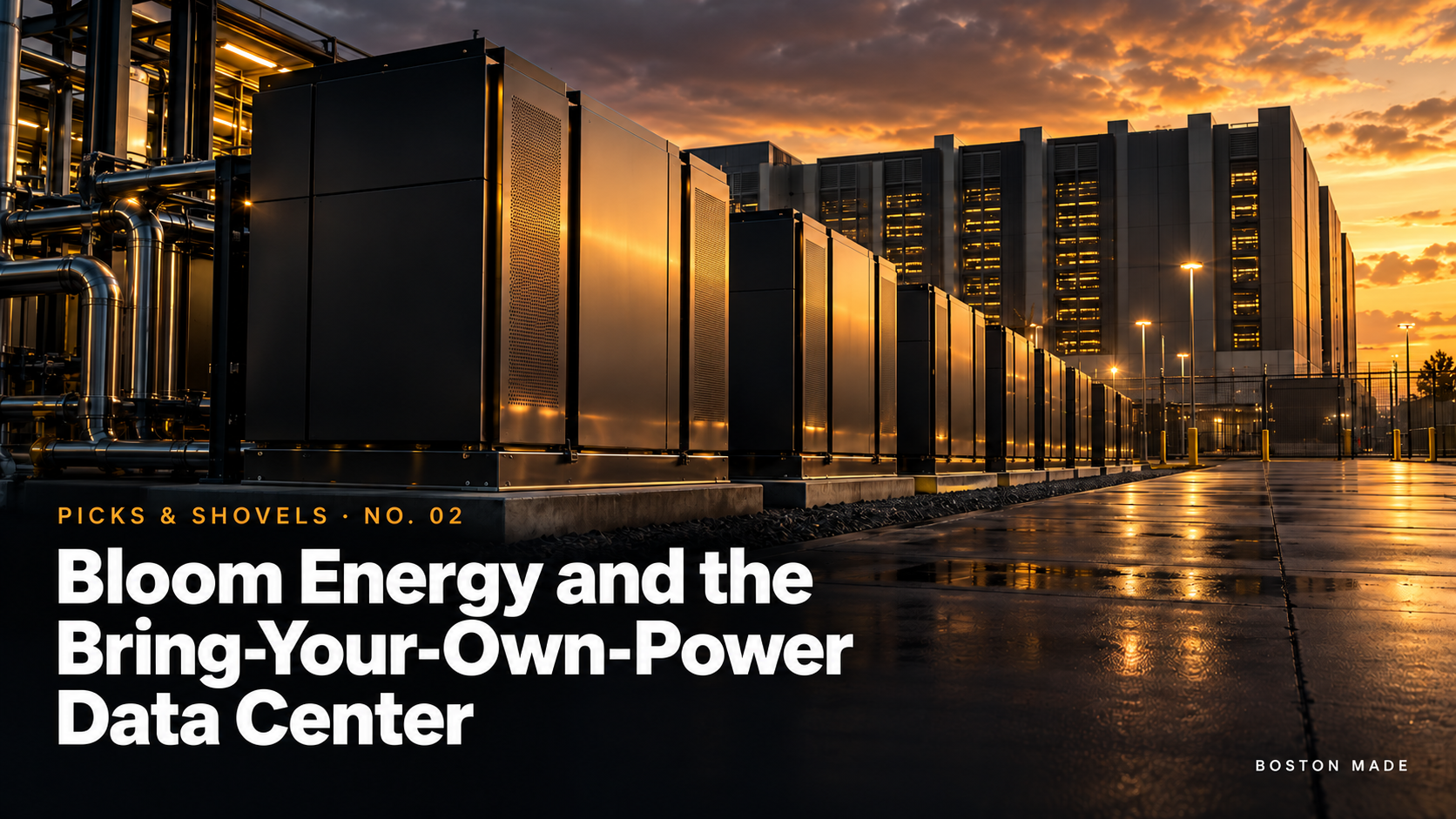
Picks & Shovels No. 02: Bloom Energy and the Bring-Your-Own-Power Data Center

When the grid says “wait five years,” some data centers make their own electricity. Bloom Energy’s fuel cells posted Q2 2026 revenue of $1.07 billion, up 166%, and guidance of $3.9–4.2 billion for the year.

Nathanael Strickland

Published

on

Picks & Shovels No. 02: Bloom Energy and the Bring-Your-Own-Power Data Center

PICKS & SHOVELS · No. 02 · On-site generation

If the interconnection queue is years long, build the power plant in the parking lot.

What it does

Bloom Energy (NYSE: BE) builds solid-oxide fuel-cell “Energy Servers.” They turn natural gas, or hydrogen, into electricity on site through an electrochemical reaction instead of combustion. A unit is roughly the size of a shipping container, and units stack together into a power plant.

The shovel it sells

Speed. A data center that can’t get grid power soon enough can install Bloom units “behind the meter” and switch on much sooner. In this storyline that is the bring-your-own-power data center.

What the numbers say

  • Q2 2026 revenue: $1.065 billion, up 165.5% from $401 million a year earlier. Product revenue rose 215%.
  • Gross margin: 33.4%, up from 26.7%.
  • FY2026 guidance raised: revenue of $3.9–4.2 billion, about double, and non-GAAP operating income of $800–900 million.
  • Financing: the Brookfield framework expanded from $5 billion to $25 billion.
  • Customers: management says all the major U.S. hyperscalers and more than a dozen neo-cloud, AI-lab and colocation operators have validated its systems.

Sources: The Energy Mag, Jul 28, 2026; Nasdaq call highlights, Jul 28, 2026.

Where it fits

Bloom and GE Vernova answer the same problem in two ways. Turbines are huge and centralized. Fuel cells are modular and fast to deploy. Both are winning because the grid itself can’t keep up.

What could go wrong

  • Exposure to natural-gas prices and pipeline access.
  • Reliance on project-financing partners.
  • Lumpy, concentrated deployments.
  • Competition from turbines, reciprocating engines and grid upgrades.
  • A long history of losses, so the margin gains are still being proven.

Why it’s under-covered

For years Bloom was filed under “hydrogen” and “clean-tech,” followed by analysts who don’t cover data centers. Its turn into an AI power supplier is newer than most of the coverage.


PICKS & SHOVELS is a Boston Made Newsroom storyline from the BOSSTOX intelligence desk: one under-covered AI-infrastructure company at a time, explained in plain English with sources. Previous: No. 01. Next: No. 03, Modine.

📚 Follow the whole storyline on the Boston Made Reader → Storylines · Track the companies in BOSSTOX Learn.

Not investment advice. Boston Made, Inc. and its writers are not licensed financial advisors. Figures come from the company filings and reports linked above, for the periods stated; check the primary filings before making any decision.

Founder of Boston Made, Inc., a Boston-based media and business portfolio company. I lead Boston Made's independent, hyperlocal coverage of Boston's economy, businesses, and neighborhoods, alongside a growing portfolio of Boston-rooted brands — including Boston Made Pets, where my passion for dog wearables and canine wellness lives on. I’m an avid reader and journaler who believes in reporting that's closer to home.

Continue Reading
Click to comment

Leave a Reply

Your email address will not be published. Required fields are marked *

Editorial

Picks & Shovels No. 10: AXT, the Wafer Under the Laser Under the Cloud

The lasers in AI optics start as indium-phosphide wafers. AXT makes them, and its InP revenue jumped from $3.6 million to $30.7 million in a year. Lumentum and Coherent have paid deposits to secure supply.

Nathanael Strickland

Published

on

Picks & Shovels No. 10: AXT, the Wafer Under the Laser Under the Cloud

PICKS & SHOVELS · No. 10 · Specialty materials

Follow the supply chain far enough down and you reach a wafer of indium phosphide. Almost nobody makes it.

What it does

AXT Inc (NASDAQ: AXTI) makes compound-semiconductor substrates, mainly indium phosphide (InP) and gallium arsenide wafers. Most of the production happens at its China-based subsidiary, Tongmei.

The shovel it sells

The raw InP wafers that laser makers like Lumentum and Coherent need to build the lasers inside AI transceivers. This is the bottom layer of the optical stack.

What the numbers say

  • Q2 2026: revenue was $47.6 million, up 164% year over year. InP revenue was $30.7 million, up from $3.6 million a year earlier.
  • Q3 2026 outlook: about $66 million in “realizable revenue,” with upside that depends on more Chinese export permits.
  • Capacity plan: quarterly InP capacity rising from about $20 million to $60 million by year-end and more than $130 million by the end of 2027.
  • Customers: supply agreements with prepayments or deposits from Lumentum ($43.5 million), Coherent ($25.4 million) and Casella ($22.3 million).

Sources: Semiconductor Today, Aug 4, 2026; SEC 8-K.

What could go wrong

  • It depends on Chinese export permits for InP.
  • Manufacturing based in China brings geopolitical and tariff exposure.
  • Small scale and concentrated customers.

Season one, wrapped

Ten companies, one chain: turbines and fuel cells make the power, switchgear routes it, chillers remove the heat, packaging and burn-in turn silicon into reliable chips, lasers and cables connect them, and a wafer company in the basement makes the lasers possible. Season two looks at Coherent, Fabrinet, Ciena, Astera Labs, Eaton, nVent and Amphenol. Start again at No. 00.


PICKS & SHOVELS is a Boston Made Newsroom storyline from the BOSSTOX intelligence desk: one under-covered AI-infrastructure company at a time, explained in plain English with sources. Previous: No. 09.

📚 Follow the whole storyline on the Boston Made Reader → Storylines · Track the companies in BOSSTOX Learn.

Not investment advice. Boston Made, Inc. and its writers are not licensed financial advisors. Figures come from the company filings and reports linked above, for the periods stated; check the primary filings before making any decision.

Continue Reading

Editorial

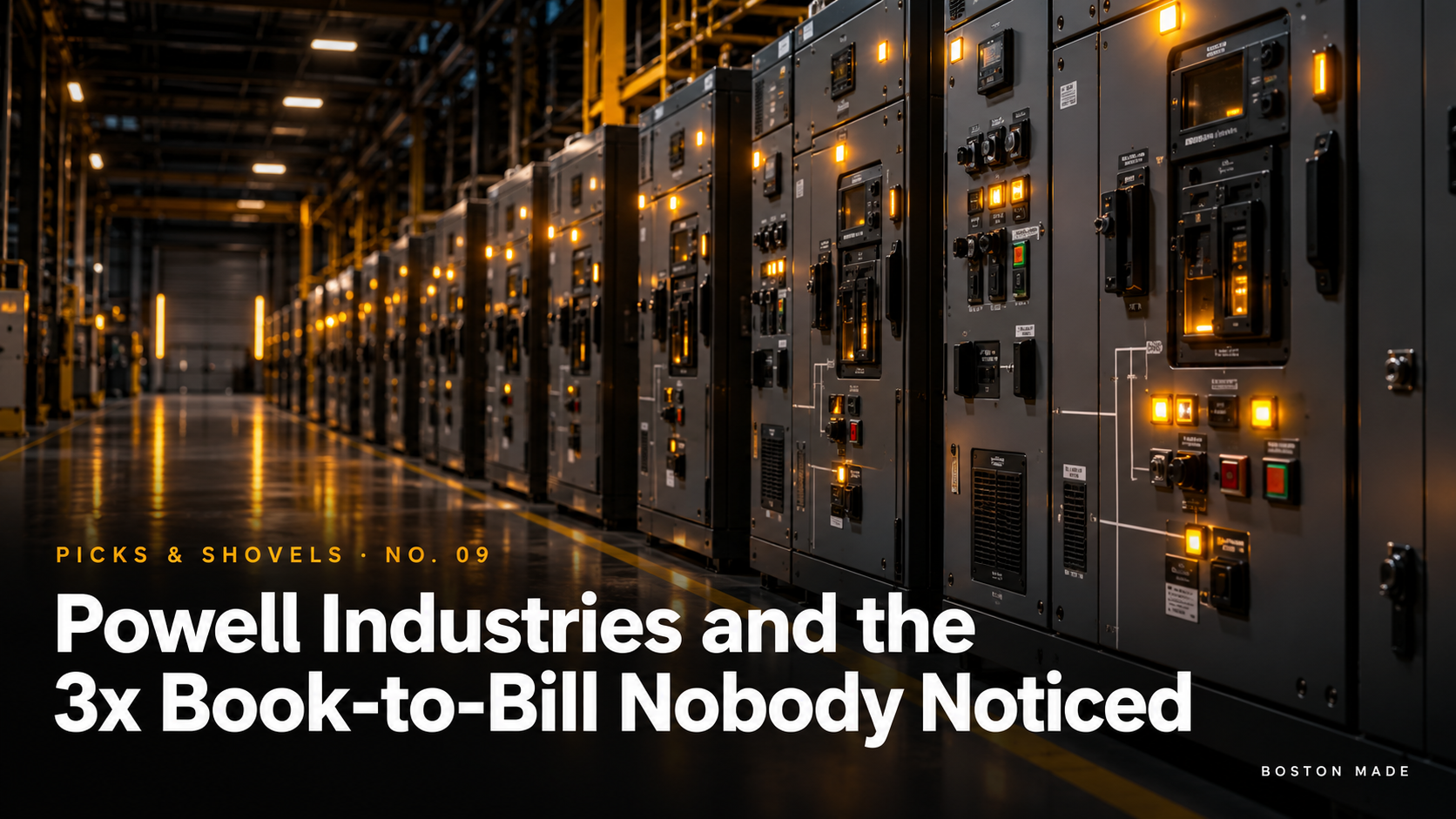
Picks & Shovels No. 09: Powell Industries and the 3x Book-to-Bill Nobody Noticed

A Houston switchgear maker booked $934 million of orders in one quarter — three times its revenue — including a $400 million-plus data-center order. Backlog hit $2.4 billion.
Nathanael Strickland

Published

on

Picks & Shovels No. 09: Powell Industries and the 3x Book-to-Bill Nobody Noticed

PICKS & SHOVELS · No. 09 · Switchgear

Between the power plant and the server sits a lot of steel cabinets full of breakers. Without them, nothing switches on safely.

What it does

Powell Industries (NASDAQ: POWL) engineers custom electrical equipment, including switchgear, motor-control centers and prefabricated “e-houses,” that distributes high-voltage power safely in plants, utilities and now data centers.

The shovel it sells

Medium-voltage gear, including the packages that tie on-site generation into a campus. That’s the same bring-your-own-power trend from No. 02.

What the numbers say

  • Fiscal Q3 2026 (ended Jun 30, 2026): revenue was $312 million, up 9%. New orders were $934 million, up 158%.
  • Book-to-bill: 3.0x. Backlog was $2.4 billion, up 69% year over year.
  • The orders include a data-center order worth “exceeding $400 million” for behind-the-meter on-site generation assets.
  • Management cited “increasing demand to support data centers and related AI capacity demand.” A yard expansion is due to finish by the end of fiscal 2026.

Source: Powell 8-K, Aug 3, 2026.

What could go wrong

  • A long history of oil, gas and petrochemical cycles.
  • Large fixed-price projects carry margin risk.
  • Capacity is tight with a backlog this big.
  • The big data-center orders are concentrated in a few customers.

Why it’s under-covered

Energy analysts have followed Powell for decades. AI analysts mostly haven’t found it yet.


PICKS & SHOVELS is a Boston Made Newsroom storyline from the BOSSTOX intelligence desk: one under-covered AI-infrastructure company at a time, explained in plain English with sources. Previous: No. 08. Next: No. 10, AXT.

📚 Follow the whole storyline on the Boston Made Reader → Storylines · Track the companies in BOSSTOX Learn.

Not investment advice. Boston Made, Inc. and its writers are not licensed financial advisors. Figures come from the company filings and reports linked above, for the periods stated; check the primary filings before making any decision.

Continue Reading

Editorial

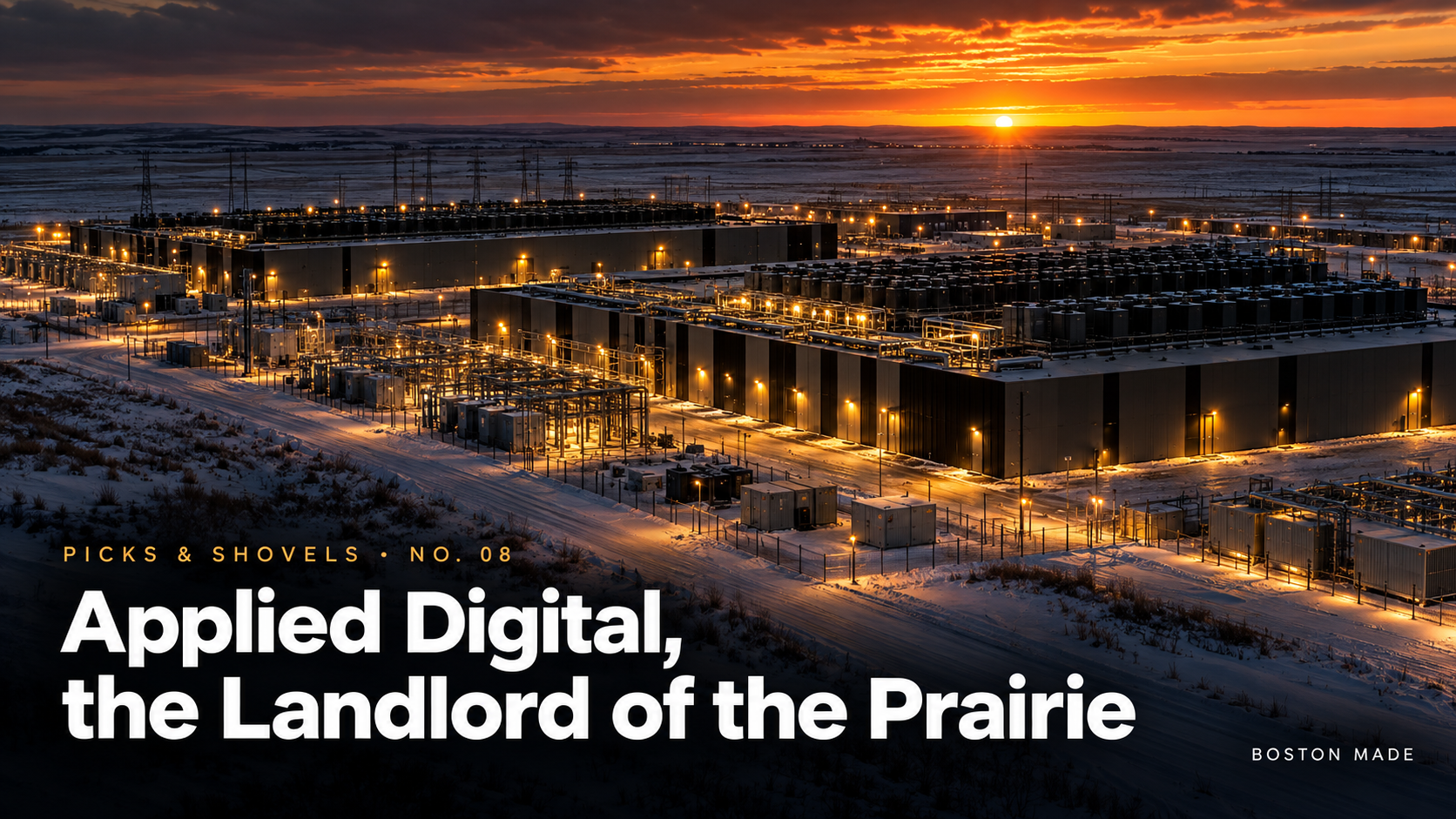
Picks & Shovels No. 08: Applied Digital, the Landlord of the Prairie

A former crypto host now has 1,410 MW of AI capacity under contract and about $36 billion in base-term lease revenue. Applied Digital builds powered campuses in North Dakota.

Nathanael Strickland

Published

on

Picks & Shovels No. 08: Applied Digital, the Landlord of the Prairie

PICKS & SHOVELS · No. 08 · Powered land

Cheap power, cold air and room to grow. North Dakota has all three, and that makes it valuable AI real estate.

What it does

Applied Digital (NASDAQ: APLD) develops large, purpose-built AI data-center campuses, branded “Polaris Forge,” and leases the capacity to hyperscalers and GPU clouds on long contracts.

The shovel it sells

Powered, finished buildings ready for racks. That’s the hardest thing to buy quickly in AI right now.

What the numbers say

  • Fiscal Q4 2026 (ended May 31, 2026): revenue was $258.7 million, up 407%. Fiscal 2026 revenue was $611.3 million, up 167%.
  • Contracted capacity: 1,410 MW across five campuses. That’s about $36 billion of revenue over the initial 15-year terms, or about $86 billion if every renewal is exercised.
  • Customers: CoreWeave, plus a new investment-grade U.S. hyperscaler with about $20 billion of contracted revenue across three leases.
  • Operations: 175 MW live at Polaris Forge. It completed a $2.15 billion offering of 6.75% senior secured notes.

Sources: Applied Digital FY2026 results, Jul 27, 2026; 10-K.

What could go wrong

  • Heavy leverage at high coupons.
  • Construction risk across several campuses at once.
  • Concentration in a couple of tenants.
  • Access to power and transmission, and lease economics if AI demand cools.

Why it’s under-covered

Many people still think of it as a small crypto-hosting stock, even though its contracted backlog now rivals established data-center REITs.


PICKS & SHOVELS is a Boston Made Newsroom storyline from the BOSSTOX intelligence desk: one under-covered AI-infrastructure company at a time, explained in plain English with sources. Previous: No. 07. Next: No. 09, Powell Industries.

📚 Follow the whole storyline on the Boston Made Reader → Storylines · Track the companies in BOSSTOX Learn.

Not investment advice. Boston Made, Inc. and its writers are not licensed financial advisors. Figures come from the company filings and reports linked above, for the periods stated; check the primary filings before making any decision.

Continue Reading
Advertisement

Advertisement

Ad

Advertisement

Trending

--:--·---·--°
♫ Music Videos
Press play — keeps playing while you browse