Connect with us

Weather where you are

Choose your location or share it once. We round your coordinates to about 1 km before sending them to our site and MET Norway for your forecast. Your choice stays in this browser tab.

Stay close to Boston

Get new Boston stories and Boston Made company updates, delivered as browser notifications.

Choose Enable notifications, then allow notifications in your browser.

Your browser subscription is stored by Boston Made and delivered through your browser’s push service. You can turn notifications off in your browser’s site settings. Privacy policy

Technology

The Infrastructure of Power: AI, the Atlantic Alliance, and the Next Economy

AI infrastructure is reshaping the industrial economy. An evidence-led editorial on chips, energy, capital, King Charles III and the US–UK/NATO relationship.

Nathanael Strickland

Published

on

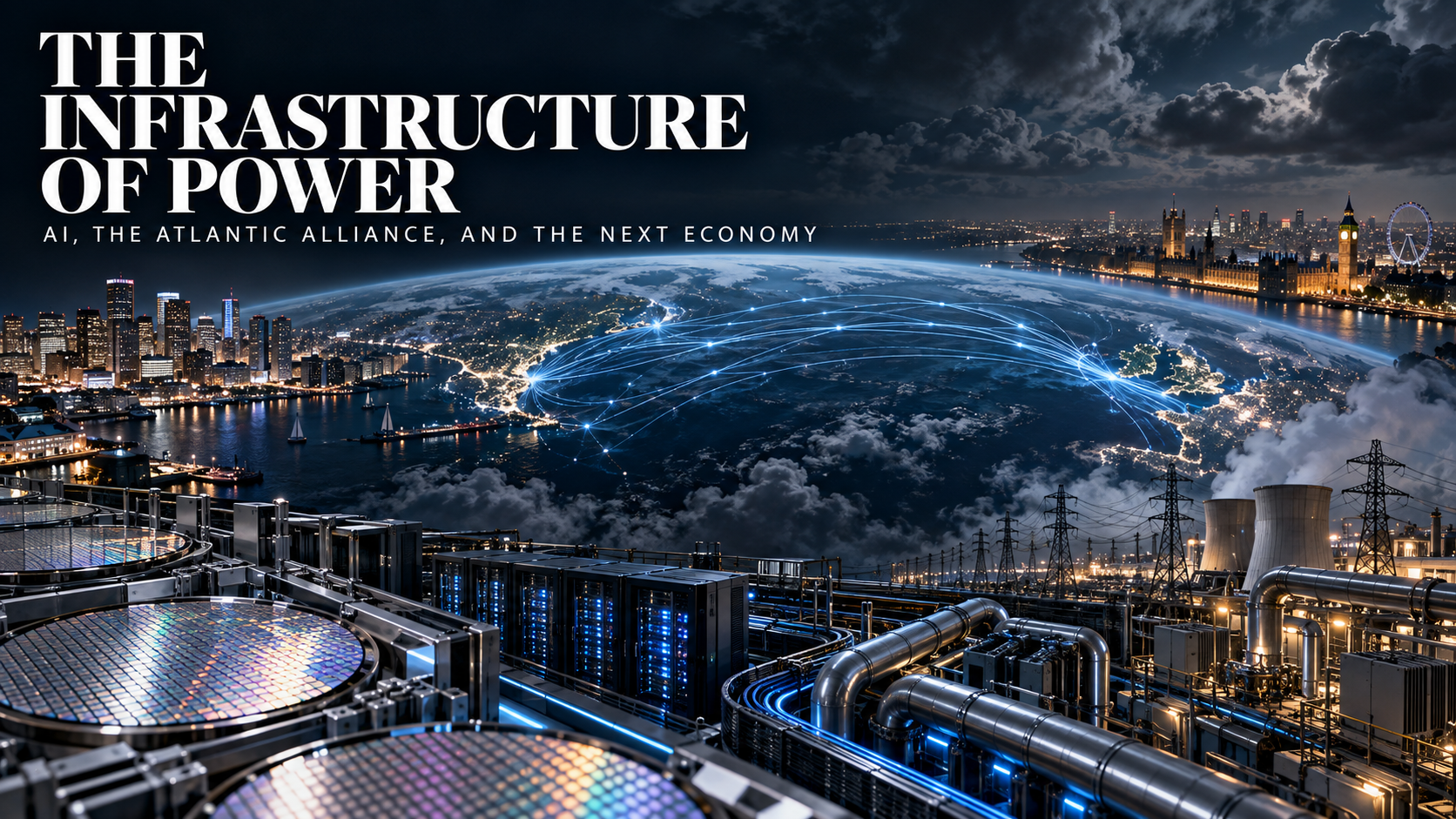
AI-generated conceptual illustration of semiconductor wafers, servers and power infrastructure connecting Boston and London across the Atlantic, with the title The Infrastructure of Power.

EDITORIAL & ANALYSIS · September 30, 2026
By Nathanael H. Strickland

AI’s next chapter will be written in semiconductor plants, electricity networks, cooling systems, fibre routes and financing agreements. Boston Made’s AI Picks-and-Shovels Watch reveals why the economic stakes reach well beyond software—and why the Atlantic alliance has a practical interest in getting the foundations right.

The popular image of artificial intelligence is a conversation on a screen. The less visible reality is an industrial system: memory that must be manufactured, processors that must be tested, buildings that must be powered, heat that must be removed, and networks that must carry information reliably.

Across the Watch’s 26 dated research records through September 29, the pattern is increasingly clear. The frontier is moving through the physical economy. Our editorial conclusion is that the ability to turn capital and engineering into dependable, usable capacity may become as consequential as the ability to produce an impressive model.

That is a plausible shift in economic power, not proof of an inevitable “new world order.” The findings describe an evolving industrial landscape whose outcome will depend on investment, public decisions, competition, security and the benefits delivered to ordinary people.

What the Watch is actually showing

The AI Picks-and-Shovels Watch follows connected constraints rather than treating every announcement as a completed project. Its underlying research records distinguish company disclosures, forecasts, contracts, pre-orders, pilots and operating evidence. Across memory, testing, cooling, efficient processors, power conversion, modular delivery, connectivity and finance, those distinctions matter.

  • Memory is a capacity and cost question. TrendForce’s September 29 research forecasts a 121% year-on-year increase in blended HBM selling prices for 2027. That is a forecast shaped partly by product mix; it is not a signed quote, a realised price or a 121% increase in the cost of every AI server.
  • Testing is part of the industrial foundation. Teradyne’s Magnum E2 launch addresses next-generation DRAM and NAND testing. The announcement establishes a product offering, not independently measured customer throughput or guaranteed revenue.
  • Custom silicon is creating another development pathway. SEMIFIVE announced an approximately $52 million development contract for a US fabless customer’s inference accelerator. Its H1 2027 tape-out and 2028 mass-production schedule remain planned milestones, not completed manufacturing capacity.
  • Capital is reaching beyond the server room. Six Samsung affiliates announced a combined $1 billion investment in Helix, whose remit includes data centres, electricity infrastructure and fibre. The strategic interest is in an integrated system. An investment announcement does not itself establish that a campus has been energised or accepted.
  • The supplier economy is already meaningful. Legrand’s September capital-markets material identifies data centres as 32% of first-half 2026 sales. Its portfolio spans power, physical infrastructure, controls, cooling and lifecycle services. That is a company-specific sales measure, not a measure of the whole economy.
  • Connectivity is a long-term industrial commitment. Verizon and Corning announced a multiyear supply agreement involving more than 80 million fibre miles over 2027–2032, including next-generation AI infrastructure. Planned supply is not the same as fibre already installed and carrying traffic.

The remaining Watch lanes reinforce the same operating questions: how will cooling perform at the relevant temperatures; when will power equipment and prefabricated modules arrive; can efficient processors deliver useful work at lower energy cost; and do contracted GPU commitments become accepted capacity and collected revenue?

A memorandum of understanding, a customer prepayment and a functioning data centre are different pieces of evidence. Adding their headline values together would create a misleading picture. The useful measure is the movement from announced, to contracted, to delivered, to energised, to accepted, to productive operation.

How this could change the economy

First, AI investment can distribute work across a much wider supply chain. Electrical engineering, construction, cooling maintenance, cable manufacturing, testing and operations all become relevant to digital expansion. That creates potential opportunities outside the small group of businesses selling models. It does not establish the size, durability or local distribution of new employment; permanent operating jobs must be distinguished from temporary construction work.

Second, the economics of electricity become part of the economics of software. The IEA’s Electricity 2026 outlook expects data-centre expansion to account for roughly half of US electricity-demand growth through 2030. This is a forecast of incremental growth, not a claim that data centres will consume half of all US electricity. Reliable supply, grid flexibility and connection schedules consequently belong in any serious AI strategy.

Our inference is that constrained locations may face difficult choices about who pays for additional capacity and how new demand competes with existing uses. The answer will depend on regulation, tariffs, local network conditions and project design. An AI campus should be judged partly on whether it strengthens its host community’s infrastructure rather than shifting avoidable costs onto households.

Third, scarce components can favour large buyers. Companies with financing, procurement expertise and long-term supply arrangements may secure better access to chips, memory and power. Smaller businesses could depend increasingly on rented capacity. Competition policy, open standards and workable exit routes therefore matter alongside physical construction.

Fourth, productive adoption must justify the capital. More servers do not automatically mean better healthcare, more efficient public services or stronger manufacturing. Those gains require useful applications, suitable data, trained people and reliable operations. Demand can disappoint. Hardware can age faster than a financing plan expects. Energy availability and project acceptance can slip. The Watch’s evidence gates are a defence against confusing financial ambition with economic output.

The United States and Britain: a relationship with practical work to do

The US–UK connection already has a policy framework relevant to these constraints. The Technology Prosperity Deal memorandum signed on September 18, 2025 describes intended cooperation on AI infrastructure, research access to compute, model evaluation, civil nuclear technologies, quantum technologies and secure innovation.

The memorandum explicitly does not create legally binding obligations or commit expenditure. It is evidence of stated policy intent, not proof that every proposed programme has been funded or delivered.

Our analysis is that the next test of the relationship is implementation. Shared research access, compatible evaluation methods, resilient telecommunications, dependable energy and supplier qualification could make cooperation useful to universities, hospitals, manufacturers and smaller companies. Governments would still need to resolve procurement, security, jurisdiction and delivery questions.

For the United States, this expands the discussion from technological leadership to industrial execution. For Britain, it raises a corresponding question: how can access to advanced technology translate into durable domestic capability and public benefit? Partnership is valuable when it creates usable capacity, skilled people and institutions that can retain control of their responsibilities.

The supplier records also caution against treating the Atlantic as a self-contained economy. Important participants in this story operate across Asia, Europe and North America. Resilience calls for understanding those dependencies and developing credible alternatives, rather than pretending they can disappear through rhetoric.

Where King Charles III fits

King Charles III matters here through constitutional diplomacy and public convening, not through personal control of AI infrastructure or NATO policy. The Royal Family’s account of the monarchy’s role makes the constitutional distinction clear: the King is head of state; elected Parliament has the power to legislate.

There is also a direct, recent connection to the subject. In his April 28, 2026 address to the US Congress, the King discussed the Atlantic partnership, NATO, shared security, and cooperation in AI, drug discovery, fusion and quantum computing. He connected the relationship’s future to shared prosperity and responsibility for the natural world.

That provides diplomatic context for this editorial. It does not make the Watch a royal initiative, suggest a royal endorsement of Boston Made, or establish a particular policy position on the companies discussed.

Our interpretation is that his convening role can help keep the human questions visible: what kind of places will infrastructure create; how will prosperity be shared; and how can innovation respect communities and the environment? Those questions gain urgency as AI moves from digital promise into land, energy, industry and public services. Governments and accountable institutions remain responsible for the decisions.

Why NATO belongs in the discussion

NATO’s interest in AI is not simply a race to obtain the largest number of processors. Its revised AI strategy, published in July 2024, emphasises responsible use, interoperability, testing and validation, quality data, cooperation with industry and protection of vital components.

Our inference from the Watch is that these ambitions depend on infrastructure that remains dependable under pressure. Fragile power arrangements, insecure supply chains or poorly evaluated systems can weaken the capabilities that compute is supposed to support. Resilience involves maintenance, energy security, trustworthy information and skilled operators as well as advanced hardware.

Commercial infrastructure announcements do not automatically become NATO procurement programmes, and commercial AI clusters should not be described as military assets without evidence. The connection is a strategic one: civilian industrial capacity and responsible technological development can influence the options available to an alliance.

A new economic order is a choice about institutions

Used carefully, “a new world order” can describe a changing geography of production and influence. It should not imply a secret command structure or a predetermined political outcome. The evidence here is more concrete: the organisations and places able to assemble reliable power, computing, connectivity and capital may gain an advantage.

The constructive version of that future would combine technological capability with competitive markets, accountable institutions, secure cooperation and benefits that extend beyond infrastructure owners. A less attractive version would concentrate access, impose unexamined costs on communities and promise prosperity that the operating evidence never delivers.

For Boston Made, the useful response is to make the system legible. Follow the supplier. Check the source. Separate the forecast from the result. Ask who will use the capacity, who will pay for it, and when it will actually work.

The next economy will be judged by what it can reliably deliver—not by the size of its announcements.


Editorial method: This article synthesises the AI Picks-and-Shovels Watch records through September 29, 2026 and the linked primary sources. Company announcements and forecasts are attributed; economic and geopolitical implications are editorial analysis, not guaranteed outcomes. The cover is an AI-generated conceptual illustration, not documentary photography. No royal, governmental or NATO endorsement is claimed.

Continue exploring: AI Picks-and-Shovels Watch · BOSSTOX research records · Boston Made App

For businesses: Discuss a website or research project · Ask about clearly labeled advertising placements.

Founder of Boston Made, Inc., a Boston-based media and business portfolio company. I lead Boston Made's independent, hyperlocal coverage of Boston's economy, businesses, and neighborhoods, alongside a growing portfolio of Boston-rooted brands — including Boston Made Pets, where my passion for dog wearables and canine wellness lives on. I’m an avid reader and journaler who believes in reporting that's closer to home.

Continue Reading

Corporate News

Reimagining Boston Made: Inside a 72-Hour Push to Connect an Entire Digital Ecosystem

In a concentrated 72-hour push, Boston Made brought its websites, newsroom, software, shopping and storytelling closer to a shared experience. Founder Nathanael H. Strickland explains what changed, what is live and what comes next.

Nathanael Strickland

Published

on

Antique globe over Boston Harbor at sunset with blue and gold connections across the city

By Nathanael H. Strickland · September 27, 2026

There is a difference between making a website look new and making a network of websites feel like one place. Boston Made, Inc. has spent the past 72 hours working on the latter.

The company’s public home, newsroom, reader, apps, storefronts and specialist brands have grown in different directions over time. Each served a purpose, but a person moving from a story to a product, or from a software overview to an account, could encounter a different visual language and a different way to find the next step. Our recent work has been an intensive attempt to make those journeys clearer. It draws on months of ideas and development, brought together in a focused three-day redesign and rollout.

This is the story of that work: the visible changes, the software behind them, the experiments that make Boston Made distinctive, and the unfinished pieces we are continuing to address.

A front door with a clearer purpose

At bostonmade.com, the public entrance now centers on ATLAS. It introduces the platform before asking visitors to sign in, makes the next actions clear, and connects the broader Boston Made network without forcing someone to understand every brand at once. The dedicated ATLAS and access addresses serve the sign-in journey, while archived.bostonmade.com preserves the legacy site as a separate destination.

We refined the dark ATLAS treatment around a vintage globe and atlas motif, with a more disciplined navigation structure and a deliberate place for the Boston Made Universe near the end of the page. The goal is orientation: visitors should understand where they are, what ATLAS offers, and how to move between the company, its products and its stories. A background video for the ATLAS sign-in surface remains an active piece of work; the design must remain readable and usable when video is unavailable or a visitor prefers reduced motion.

ATLAS is one part of a larger software ambition. The public presentation and account paths are available, while AI-backed functionality is being introduced only as its underlying service and permissions are ready. We would rather describe a capability accurately than imply that every planned intelligence feature is already running for every visitor.

One network, many destinations

The shared dock and the Boston Made Universe give the network a recognizable route between destinations. From the corporate site or Boston Made Newsroom, a visitor can find the Reader, Boston Made Pets, BOSSTOX, Fenway Web, the Boston Made App, Kingswell Strategic Ventures and other projects. The dock is intended to be a compact, collapsible way to move around the network, with destinations such as Network, games, shopping and music videos.

That connection is more than a row of links. We have worked on consistent typography, color, spacing, brand marks and navigation patterns while allowing each business its own character. The newsroom should still feel like a publication. Pets should still feel like a boutique shop. ATLAS should still feel like software. A common system makes the next step familiar without making every page identical.

Some destinations are still being aligned with the shared version of the dock, and individual controls have needed further repairs. We are treating those differences as part of the rollout, not pretending that a visual match alone completes the job. A music video button has to play, a shop link has to land in the right place, and a collapsed dock must leave the content and cookie notices usable on a phone.

The newsroom as the narrative center

At bostonmadeinc.com, stories connect the work across the company. The newsroom has become a place to explain products, cover local and broader subjects, introduce experiments and show why the brands belong together. Its live pages bring the network navigation together with articles, a Reader path, a shop showcase, membership links and ways to work with the company.

We have also put more attention into the material itself. A compelling ecosystem needs more than a carousel of announcements. It needs reporting, useful context and a coherent account of what is being built. Recent editorial work has stretched from business and technology to Boston’s ties with Britain, community stories, games and the people behind them. Where a story refers to a developing product, its language should make that status clear. The byline on this account reflects the founder’s requested author identity: Nathanael H. Strickland.

The Reader extends that idea into longer-form reading and discovery. The brands experience offers a route through the family of businesses. Keep Up With Nate gives the founder’s personal story its own voice. Together, these surfaces create paths into the work for a reader, prospective customer, partner or curious visitor.

Building software people can actually use

Behind the design is a practical question: can the software help someone complete a task? The Boston Made App brings accounts and membership into a dedicated space. BOSSTOX explores market monitoring and premium research. Paxton-Digital’s SCOUT direction focuses on healthcare intelligence. Kingswell’s Keystone concept brings business tools into a single working environment. Fenway Web approaches website creation as an accessible service and builder.

We have also advanced the Boston Made Intelligence API, including structured taxonomy, signals and pathway endpoints. That work gives us a way to organize complex information and build more useful experiences on top of it. It is infrastructure, not a claim that every connected product has reached the same stage of readiness.

For Beacon Federal Partners, Beacon Watch demonstrates a more operational use case: keeping a shared watchlist and monitoring federal opportunities. Its accessible watch page and checks are one stage of the work. Other pieces, including some alert delivery and access-dependent updates, still require verification. The lesson applies across the company: a dashboard is only useful when the data, account path, notifications and follow-through work together.

Checkout and subscriptions require the same discipline. We have addressed parts of the ATLAS payment flow and are continuing to verify other product billing paths. We will not describe every payment integration as complete while checks remain open.

Commerce with a distinct point of view

Boston Made Pets has moved toward a more curated boutique experience. Recent product work has given individual jackets and apparel more considered names, descriptions, categories and rounded prices. The Black Puffer Dog Jacket, West End Dog Jacket and Classic Navy Dog Hoodie are examples of a catalog that should feel selected and explained, not filled with generic listings.

The custom designer dog jacket takes that thinking further. Its proposed purchase journey begins with a material-sample brochure and a pre-order deposit, then leads to a more personal design decision. Product photography, tactile presentation, the size and fit information, and the route to checkout all matter. A beautiful card that leaves a customer uncertain about delivery or the final price is not a finished shopping experience.

Other commerce concepts in the network include Lumo, centered on gold-market connections, and the wider Pupwear idea. These are distinct businesses with distinct operating requirements. Their presence in the network should help people discover them without suggesting that every planned marketplace or transaction feature is already available.

Stories that can become experiences

One of the most unusual strands of Boston Made is its effort to make stories playable. The games destination has featured free interactive ideas, including Find Boston, a mystery involving a Goldendoodle, and Mr. B’s Fine Cuts, a character-led Cherry Grove story. We have also prepared richer game work around Harbor Key, Wild Buffaloes and the broader LAZ Nation concept.

The ambition is for each game to earn its own page, art direction, decisions and replay value. It should feel like a place to explore, rather than a static promotion with a button attached. Some of the more extensive game packages have been prepared but have not been fully deployed to the live host. Play-only mechanics and any proposed reward or payment features also require careful implementation and review. We are keeping those distinctions visible as the work develops.

This story-driven approach influences more than the games. It shapes how a reader encounters a character in the newsroom, how a customer learns the story behind a product, and how an ATLAS visitor understands the larger system. The narrative gives each destination a reason to exist and a route back to the whole.

A measured rollout, even at speed

Seventy-two hours is a short time to revisit a network of this size. It does not mean every planned feature was designed, built, tested and launched from scratch in three days. The push connected earlier work, revised visible surfaces, shipped selected updates and exposed places where the network still needs repair.

We have chosen progressive delivery for a reason. A visitor should be able to use a familiar path today while new capabilities arrive in focused increments. That means checking navigation before adding another destination, checking readability before adding motion, and checking account and billing behavior before promising a seamless subscription. It also means preserving the archive, reducing unnecessary overlays, respecting reduced-motion preferences and making touch and keyboard interactions work.

The work has often happened through ChatGPT as a practical creative and development workspace: drafting and editing articles, generating visual concepts, shaping product copy, reviewing interfaces, writing and checking code, assembling game packages, and working through deployment and verification. The founder has directed the vision and decisions. The tools have helped move from idea to an inspectable draft or working release much faster, while human judgment remains responsible for what the company says and ships.

What comes next

The next stage is straightforward to describe, even if it takes care to execute. We will finish connecting the remaining shared navigation, repair the controls that do not yet behave as intended, continue validating sign-in and subscriptions, and release stronger interactive experiences only when they are ready on the live site. We will keep refining the Reader, newsroom, software and shop so a visitor can move through them without losing their place.

Boston Made began with a simple idea: one hub, many brands. The recent transformation gives that idea a clearer digital form. The work of the next weeks is to make the connections dependable, useful and enjoyable in everyday use.

Explore the network: ATLAS · Newsroom · Reader · Pets · App · Brands

Continue Reading

Economic Development

The New Atlantic Bridge: Aligning Boston’s Smart Infrastructure With King Charles III’s Urban Philosophy

From George III’s tea taxes to King Charles III’s Poundbury, what Boston and Britain can learn from each other about keeping historic streets walkable, and where smart parking and EV charging fit in.

Nathanael Strickland

Published

on

Two and a half centuries after Boston dumped British tea into its harbour, the conversation between Boston and Britain is about something else entirely: how to move people through old, beautiful places without letting cars take them over.

From George III to Charles III

Boston’s relationship with the British Crown began with a dispute about trade. The Townshend Acts of 1767 put duties on glass, paper and tea. The Tea Act of 1773 revived the argument over taxation without representation, and on 16 December 1773 colonists emptied 340 chests of East India Company tea into Boston Harbor. London answered with the Boston Port Act of 1774, which closed the harbour to commerce until the tea was paid for. (Massachusetts Historical Society)

The relationship today looks very different. The United Kingdom is among the largest foreign employers in Massachusetts (Global Business Alliance), and ideas now cross the Atlantic as readily as goods. One of the most interesting of those ideas concerns the street itself: who it is for, and how much of it the car should be allowed to take.

Why British towns need a different kind of mobility

Many British cities and market towns were laid out long before the car. Their streets are narrow, their centres are protected, and every surface car park or new gantry competes with the character people value. Congestion is real: INRIX’s 2025 Global Traffic Scorecard found London drivers lost 91 hours to traffic, with Bristol (64 hours), Manchester (62) and Leeds (59) close behind, and the average UK driver lost 59 hours, at a cost of about £822 each. (INRIX)

At the same time the vehicle fleet is changing. Under the UK’s zero emission vehicle mandate, 33% of new cars sold in 2026 must be zero-emission. Sales of new pure petrol and diesel cars are set to end in 2030, with hybrids allowed until 2035, although the 2030 trajectory is currently under review. (GOV.UK) By 1 July 2026 there were 121,171 public charging devices in the UK. (DfT)

The question for British towns is therefore not whether cars will change, but where they will park and charge without cluttering the streets people want to walk on.

The King’s long argument about the street

Few public figures have argued about the built environment for as long as King Charles III. As Prince of Wales he told the Royal Institute of British Architects in 1984 that a proposed National Gallery extension was “a monstrous carbuncle on the face of a much-loved and elegant friend”, and in 1989 he set out his principles in the book A Vision of Britain: human scale, local character, and places designed around people rather than traffic. (RIBA Journal)

Poundbury: the experiment

Those ideas were tested at Poundbury, an urban extension of Dorchester in Dorset built on Duchy of Cornwall land. Léon Krier was appointed masterplanner in 1988 and building began in 1993. Irregular street layouts slow traffic, every neighbourhood is designed to be within about a five-minute walk of its centre, homes sit alongside shops and workshops, and utilities run underground rather than on poles. (Institution of Civil Engineers) The Duchy has since applied similar principles at Nansledan, near Newquay.

Poundbury has its critics, and the evidence is worth taking seriously. A 2023 Centre for Cities review found that residents still rely heavily on cars: only 17% of households have no car and 55% drive to work, largely because there are not enough local jobs. (Centre for Cities) Good street design, in other words, changes how a place feels, but it does not by itself remove the car. The car still has to go somewhere.

Stewardship, not endorsement

The King has also spent decades on environmental causes, from the Sustainable Markets Initiative launched in 2020 to the Terra Carta of 2021. As monarch he has said he can no longer give his time to those causes as before, and he remains politically neutral. Nothing here suggests he endorses any company, including ours. What we take from his work is a design principle: infrastructure should serve a place quietly, not dominate it.

Smart parking as the invisible grid

That principle points to a practical conclusion. If historic streets are to stay walkable while the fleet electrifies, parking and charging need to move off the kerb and into places that are dense, safe and largely out of sight. That is the problem Boston Made is planning to work on in the UK.

Boston knows something about hiding infrastructure. The Central Artery/Tunnel Project, the Big Dig, replaced an elevated highway through downtown with tunnels, created more than 300 acres of open land including the Rose Kennedy Greenway, and, according to the state, cut vehicle hours of congestion by 62%. (Mass.gov) It was also famously expensive and late, which is its own lesson: invisible infrastructure pays off only when it is planned carefully.

Our concept combines three layers:

  • Booking and hospitality. Drivers reserve a space or EV charging slot in advance, priced in pounds, so fewer cars circle looking for a space.
  • Sensing. Pressure-sensitive flooring and cameras confirm where vehicles are and that people have walked clear before any automated equipment moves.
  • Automated storage. Caster-based guided vehicles move cars into dense storage, so a site can hold more vehicles in less space, and charging bays can be monitored for heat and isolated automatically.

The details, including the UK rules we would build around, are on our UK smart parking page.

A roadmap for working with British places

Public-private alignment

Any UK site starts with the local planning authority and, where relevant, heritage and conservation guidance. Private parking in England also runs under the industry’s Private Parking Single Code of Practice, which sets grace periods, signage standards and caps on charges, and which all existing sites must meet by 31 December 2026. We would design every site to those standards from the outset, and treat parking charges as a last resort rather than a business model.

What we would measure

We are not going to promise numbers before a single site is built. These are the outcomes we would measure and publish for each project:

  • Kerbside spaces and surface parking returned to pedestrians, trees or trade.
  • Time drivers spend searching for a space, before and after.
  • EV charging sessions delivered and the share of electricity from renewable tariffs.
  • Footfall and spending on nearby high streets.
  • Complaints and appeals as a share of visits, as a measure of fairness.

The new bridge

The first transatlantic argument about Boston was about who controlled trade. The next one can be about how two old places, each proud of its streets, make room for the future without losing what makes them worth visiting. We think the answer is infrastructure that serves quietly, and we would like to build it with British partners.

If you own or manage a car park, hotel or venue in the UK, or work in planning or mobility, talk to us. UK readers can also find prices in pounds and shipping details on our UK page.

Boston Made’s UK parking services are in development. This article reflects our plans and publicly reported facts as of September 2026; it is not legal or planning advice.

Continue Reading

Technology

Man vs. Machine in the Cage: Inside the First “Human vs. Terminator” Robot Fight

Content creator Frankie LaPenna stepped into a San Francisco cage against a six-foot humanoid robot. The kicks went viral, but who actually won, and who was really fighting?

Nathanael Strickland

Published

on

Boston Made Newsroom illustration: Man vs. Machine in the Cage: Inside the First “Human vs. Terminator” Robot Fight

A six-foot humanoid robot and a human fighter met in a cage in San Francisco in what organizer Robot Entertainment Kombat (REK) billed as the first “Human VS Terminator robot fight.” Videos of the bout went viral this week.

What happened

American content creator Frankie LaPenna threw a flurry of punches, Gulf News reported. The robot answered with punches and powerful kicks, at one point sending him flying backward across the cage.

Who won?

That depends on who you ask. REK says LaPenna “kept fighting and eventually defeated the robot.” Other reports say the fight was stopped after he was knocked down, and the full footage has not been released.

Who was really fighting

The “Terminator” wasn’t thinking for itself. A human pilot controlled it remotely using VR or gamepad controls, and AI handled balance, not fight decisions. As one observer put it, the other person “had a six foot robot doing the fighting for them.”

Why it matters

  • Humanoid robots are getting stronger, faster and more stable, and robot combat is becoming a spectator sport, with robot bouts also drawing crowds in Shanghai.
  • Balance and recovery, the hardest problems in walking robots, were handled by AI. That is the real technical milestone.
  • Safety rules for human-vs-robot contact sports don’t exist yet.
Get the full picture with MasterpassBoston Made Masterpass members unlock every exclusive briefing across the network, plus member-only analysis on markets, security and policy.

Get Masterpass ↗

Continue Reading
Advertisement

Advertisement

Ad

Advertisement

Trending

--:--·---·--°
♫ Music Videos
Press play — keeps playing while you browse