Boston’s nickname, “Beantown,” points to one dish, but the city’s food history is much broader. It draws on Native agriculture, Puritan Sabbath customs, the Atlantic molasses trade, the North Atlantic fisheries, grand nineteenth-century hotels and a cooking school that changed American recipes. This feature traces the roots of the dishes most closely tied to Boston. A separate feature covers the Italian food traditions of the North End.
Native Foundations
Long before European settlement, Native peoples of the region grew corn, beans and squash together, a planting system often called the “Three Sisters.” They harvested shellfish, fished the rivers and bays, gathered berries, including cranberries, and tapped maple trees. English colonists depended on Native knowledge and crops in their first years. Corn in particular became a staple of colonial cooking, appearing in breads, puddings and porridges. Many foods now thought of as New England traditions grew out of these Native foods.
Advertisement
Baked Beans and the Sabbath
Beans slow-cooked with fat and a sweetener had Native precedents, and colonists adapted them. Puritan practice discouraged work, including cooking, on the Sabbath, which ran from sundown Saturday. A pot of beans could be put into a warm brick oven on Saturday and left to cook slowly overnight, ready for Saturday supper and Sunday meals. Baked beans with brown bread became a Saturday night tradition in many New England households.
Boston’s baked beans came to be sweetened with molasses, a product of the city’s trade with the West Indies, where enslaved people produced sugar and its byproducts on plantations. Boston distilled much of that molasses into rum, and plentiful molasses made its way into local cooking. The connection between beans, molasses and the city is the most common explanation for the “Beantown” nickname, though exactly when and how the name took hold is uncertain.
Brown Bread and Indian Pudding
Wheat did not grow well in early New England, so colonists made bread with rye and cornmeal. Boston brown bread, a dark, moist bread made with rye, cornmeal, whole wheat and molasses, is traditionally steamed in a cylindrical mold or can. Indian pudding, made from cornmeal, milk and molasses and baked for hours, is another colonial dish built on corn, its name reflecting the colonial term for cornmeal. Both are still served in some traditional New England restaurants.
From the Sea: Cod, Clams and Chowder
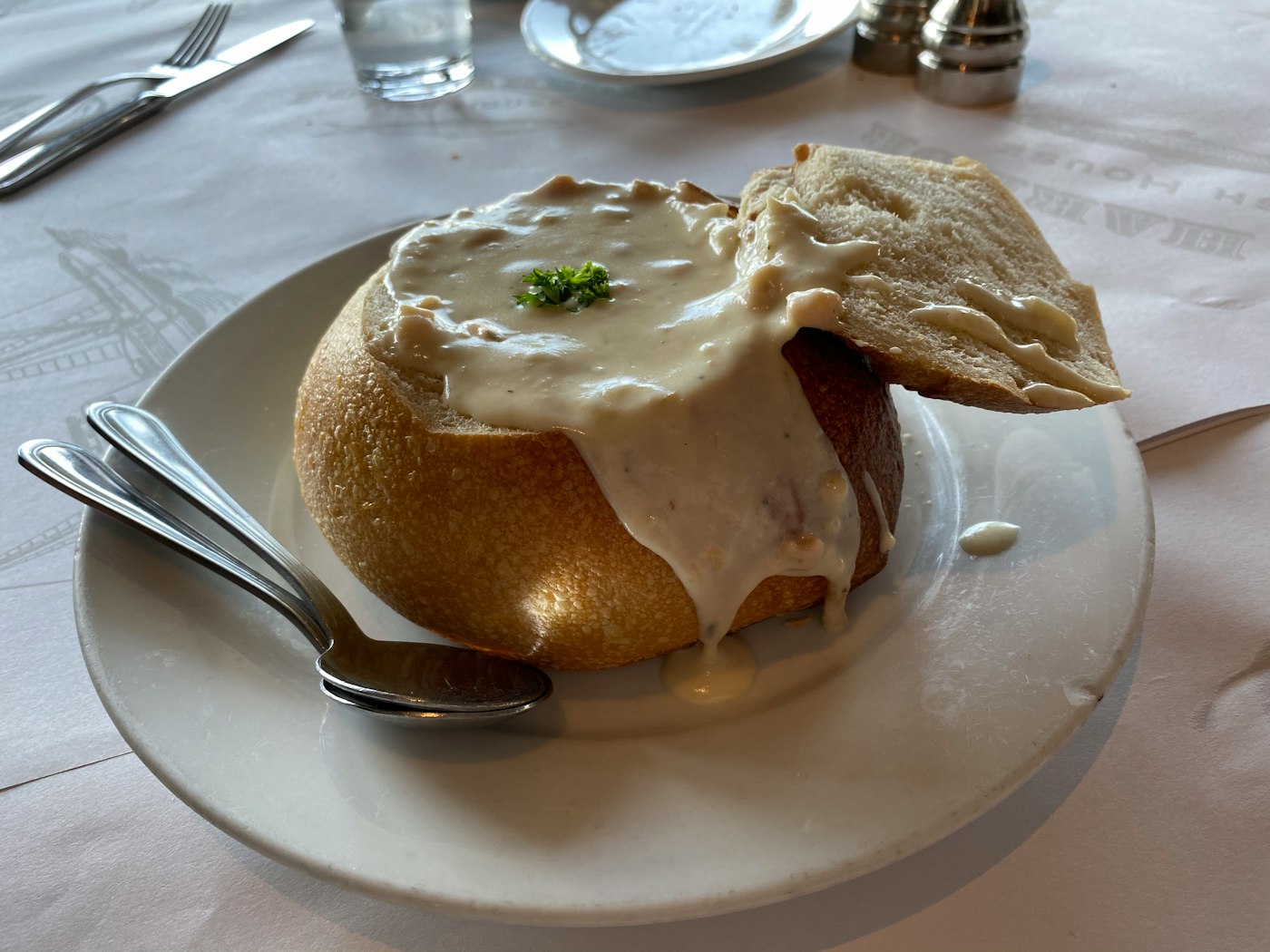
The sea fed Boston as well as enriching it. Salt cod was a staple, and fish cakes and creamed cod were everyday meals. Chowder, a stew of fish or clams, likely came to New England with French, English or Breton fishermen, and by the eighteenth century it was a common dish along the coast. The creamy New England clam chowder, made with milk or cream, potatoes and salt pork, became the regional standard. New Englanders have long looked down on the tomato-based Manhattan style. Oysters were also cheap and plentiful in the nineteenth century, sold in oyster houses throughout the city.
Union Oyster House and Durgin-Park
Two restaurants near Faneuil Hall became institutions. The Union Oyster House, in a building near Haymarket, has served food since 1826 and is often described as the oldest restaurant in continuous service in the United States. Durgin-Park, which operated in the Quincy Market area from the 1820s until it closed in 2019, was known for long communal tables, generous portions, plain New England cooking and famously brusque waitresses.
Advertisement
The Parker House: Rolls and Cream Pie
The Parker House hotel, opened by Harvey Parker on School Street in 1855, became one of the city’s most famous hotels and restaurants. Two foods are linked to its kitchen:
- Parker House rolls: Soft, buttery, folded dinner rolls that became popular across the country.
- Boston cream pie: Actually a cake, with layers of sponge cake filled with custard and topped with chocolate glaze. The hotel credits its kitchen with creating it in the 1850s. In 1996 Massachusetts named Boston cream pie its official state dessert.
The hotel, now the Omni Parker House, still serves both.
The Boston Cooking School and Fannie Farmer
One of Boston’s most important contributions to American food was not a dish but a method. The Boston Cooking School, founded in 1879, trained cooks and teachers. Fannie Merritt Farmer, who studied there and later led it, published The Boston Cooking-School Cook Book in 1896. Farmer championed precise, level measurements in recipes, using standard cups and spoons instead of vague directions like “a handful.” Her book became one of the best-selling cookbooks in American history and helped standardize home cooking across the country.
Massachusetts Treats
Other well-known foods have Massachusetts roots:
- Fig Newtons were first produced in 1891 by the Kennedy Biscuit Company in Cambridgeport and named after the nearby town of Newton.
- Necco Wafers were made for generations by the New England Confectionery Company, which traced its roots to the 1840s.
- The chocolate chip cookie is credited to Ruth Wakefield at the Toll House Inn in Whitman, Massachusetts, in the 1930s.
- Cranberries from southeastern Massachusetts bogs became a major commercial crop in the nineteenth century.
Markets and Everyday Eating
For most nineteenth-century Bostonians, food came from markets rather than restaurants. Quincy Market and the stalls around Faneuil Hall sold meat, poultry, butter, cheese and produce from New England farms, while Haymarket’s open-air vendors sold fruit and vegetables cheaply. Fish came from the waterfront, and oysters were sold from carts and cellars. Working families cooked in small kitchens with wood or coal stoves, relying on beans, potatoes, salt pork, bread and seasonal vegetables. Haymarket’s weekend produce market still operates near the same spot, a living link to that older way of shopping.
A Food Culture That Keeps Changing
Boston’s culinary roots are Puritan, Native, Atlantic and Victorian, and immigrants from Ireland, Italy, Portugal, China, the Caribbean, Vietnam, Latin America and elsewhere have added their own traditions. The city’s table keeps expanding, which is another way Boston keeps reinventing itself.
Quick check: Which Boston cookbook author popularized precise, level measurements in recipes in the 1890s?
- Fannie Farmer
- Ruth Wakefield
- Harvey Parker
Show answer
A. Fannie Farmer, whose 1896 Boston Cooking-School Cook Book championed standard, level measurements.


 Boston Made family
PupWear (.org)
Dog apparel and gear inspired by Boston the GoldenDoodle. Visit site →









 Economy4 weeks ago

 Boston Made Stories4 weeks ago

 Service2 weeks ago

 Corporate News4 weeks ago
 Boston Made Stories3 weeks ago
 Boston Made Stories3 weeks ago
 Boston Made Stories3 weeks ago

 Technology2 weeks ago